
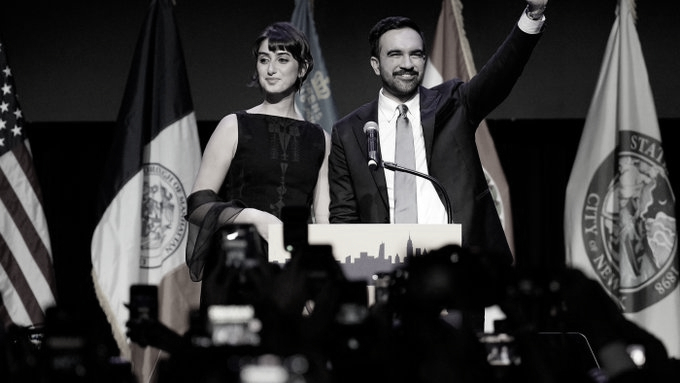
Zohran Mamdani wins New York mayoral race
Zohran Mamdani, 34, created history in the fiercely contested 2025 New York City mayoral election by defeating former Governor Andrew Cuomo, who captured 41.6% of the vote, and Republican Curtis Sliwa, who received 7.1%, winning a decisive 50.4%. The election saw over 2 million voters, the highest turnout in more than three decades, underscoring the citywide engagement in this pivotal race. Zohran Mamdani is set to be officially sworn in as New York City mayor on January 1, 2026, marking the formal start of his historic term, succeeding Democratic Mayor Eric Adams.
Born in Uganda and a naturalized U.S. citizen, Mamdani celebrated New York’s immigrant roots, telling supporters, “New York was built by immigrants, powered by immigrants, and now led by an immigrant.” Despite a modest net worth of around $200,000, he connected deeply with voters through authentic speeches, personal charisma, and clear vision, demonstrating that wealth is not a prerequisite for political influence. Quoting Jawaharlal Nehru, Mamdani said, “Tonight, New York has stepped from the old into the new,” marking a historic generational and symbolic shift. His victory reflects a city ready for progressive change, inclusivity, and grassroots leadership.
Progressive vision meets real-world challenges
Mamdani campaigned on a progressive platform, promising rent freezes, city-owned grocery stores, free and faster bus service, affordable housing, expanded childcare, labor protections, and fair taxation on the wealthy. His ability to differentiate himself from other candidates resonated with voters: “No matter which party you belong to, you need to show who you are and why you’re different. Democratic candidates are not all the same; Republican candidates are not the same either.”
However, translating these promises into reality will require navigating multiple challenges. Budget constraints could make rent freezes and city-owned grocery programs difficult to implement quickly. Affordable housing construction faces logistical hurdles and zoning restrictions. Expanding childcare, free bus service, and labor protections will require coordination with unions, the City Council, and community organizations. Mamdani will also need to balance his progressive agenda with opposition from business interests, Republican leaders, and wealthy donors who previously sought to block his election.
Despite these obstacles, Mamdani plans a pragmatic approach: prioritizing high-need neighborhoods, piloting services in phases, leveraging public-private partnerships, and creating a new Department of Community Safety to ensure accountability. His grassroots support and national prominence give him moral and political leverage to push reforms, though he must maintain broad coalitions to avoid gridlock.
Overcoming threats and national opposition
The 2025 mayoral election was marked by intense opposition from elite interests and national political figures. At least 26 billionaires spent millions attempting to block Mamdani, including Michael Bloomberg (~$13 million), Joe Gebbia (~$3 million), Bill Ackman (~$1.75 million), and the Lauder family (~$1.7 million), while two billionaires, including Elizabeth Simons, openly supported him, reflecting ideological divides even among wealthy donors.
Mamdani faces potential challenges stemming from opposition at the federal level, particularly from President Donald Trump. On October 15, 2025, Trump criticized him as “a little communist” and threatened possible National Guard deployment and cuts to federal funding, framing a scenario that could complicate the new mayor’s policy agenda. Mamdani responded assertively, declaring, “Trump will have to go through all of us to impact New York,” emphasizing solidarity, defending immigrant communities, and asserting that xenophobic calls to deport him to India will not deter his leadership. He also highlighted bomb threats at New Jersey polling stations as politically motivated attempts to intimidate voters, signaling that threats to democratic processes remain a concern he must navigate.
Nationally, Democratic victories in New Jersey (Mikie Sherrill) and Virginia (Abigail Spanberger) signaled a broader rejection of Trump’s agenda. Senate Minority Leader Chuck Schumer described the results as “a repudiation of the Trump agenda,” Barack Obama congratulated the Democratic candidates, and Vivek Ramaswamy called on Republicans to prioritize economic issues over identity politics.
Mamdani’s historic win, combining progressive policies, symbolic firsts (youngest, first Muslim, South Asian immigrant), grassroots momentum, and personal charisma, positions him as a rising national figure. His campaign demonstrates that authentic voter connection, clear differentiation from other candidates, and resilience in the face of elite and political opposition can overcome entrenched power, setting the stage for a new era in New York politics while navigating potential federal-level challenges.