
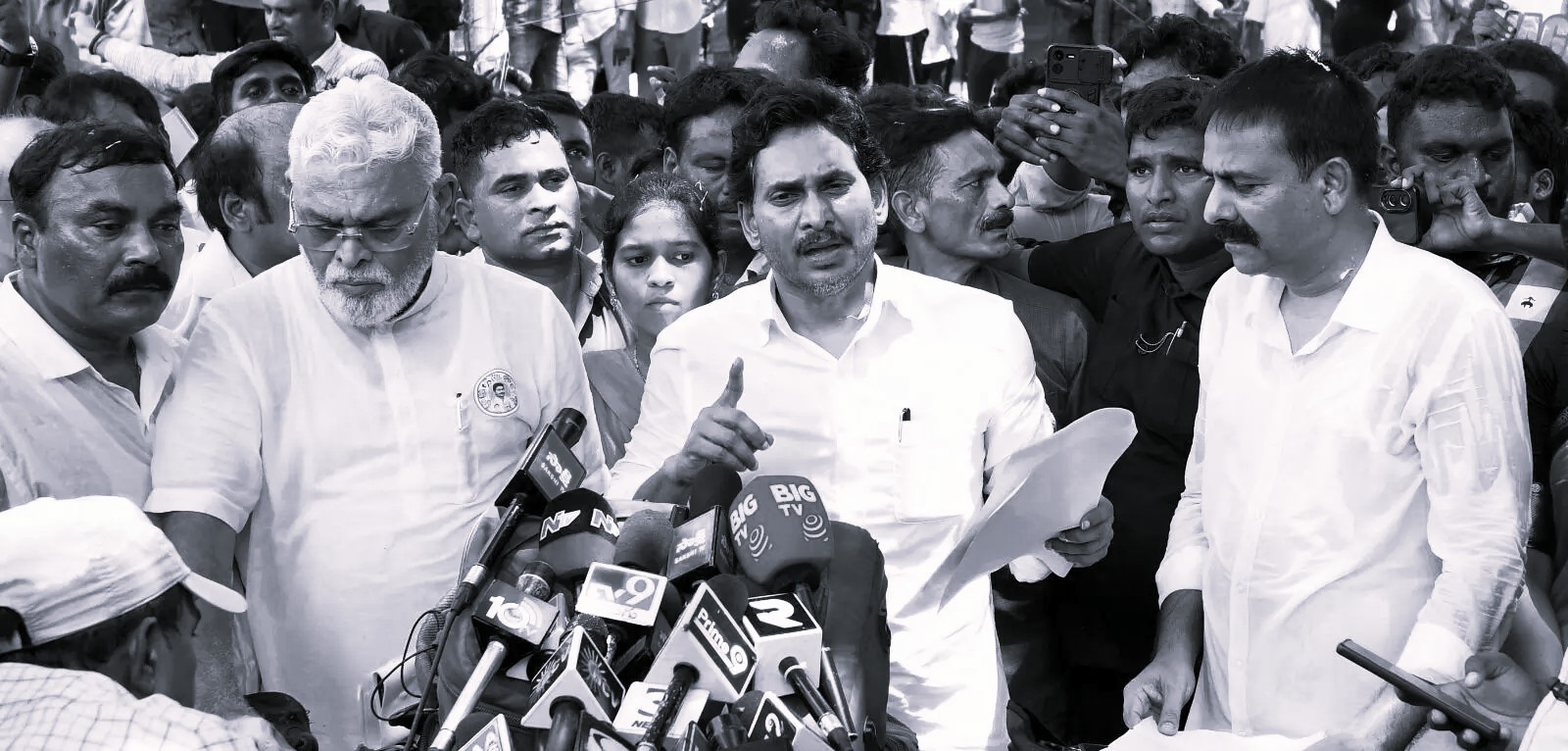
YS Jagan to submit one crore signatures to Governor opposing medical college privatisation
The state-wide agitation launched by the YSR Congress Party (YSRCP) against the Andhra Pradesh government’s decision to implement a Public Private Partnership (PPP) model for ten newly established government medical colleges has reached its final stage. As part of this movement, YSRCP president and former Chief Minister Y.S. Jagan Mohan Reddy is preparing to submit a massive petition bearing one crore signatures to Governor S. Abdul Nazeer on December 17, appealing to him to intervene and halt the privatisation move. The party announced that signature sheets collected from all 26 districts are being transported to Vijayawada in specially arranged vehicles, with senior leaders gearing up to accompany Jagan to Raj Bhavan. This follows an extensive month-long campaign across all 175 Assembly constituencies, during which the party organised Rachabanda meetings, rallies, and door-to-door outreach to mobilise public support and collect signatures opposing the PPP proposal.
The TDP-led NDA government has proposed that ten new medical colleges located in Adoni, Madanapalle, Markapuram, Pulivendula, Penugonda, Palakollu, Amalapuram, Narsipatnam, Bapatla, and Parvathipuram be developed and operated under the PPP model, with admissions expected to begin in the 2027–28 academic year. Government documents reveal that each college will have 150 MBBS seats, amounting to around 1,500 seats overall. Under the proposed structure, 75 seats in each college will remain under the government’s Convenor Quota, which the state argues will result in a net gain of 110 additional government-quota seats per year compared to previous patterns. The government claims that PPP will save approximately ₹3,700 crore in capital investment and about ₹500 crore annually in operating costs, accelerating the completion of long-delayed projects. It further states that the model will ensure free OPD services, free diagnostics, and free IPD care for 70% of hospital beds, while allowing market-rate services for the remaining 30%. The government argues that the PPP approach will bring efficiency, advanced technology, and institutional collaborations aimed at improving medical education and healthcare delivery.
Jagan Mohan Reddy, however, has been sharply critical of the move, calling hospitals “like temples” and arguing that handing them over for profit-making is an injustice to the poor. The YSRCP contends that colleges built with public funds should not be transferred to private operators, describing the move as a breach of public trust. The party fears that while some seats will remain affordable, overall fees especially for management and self-financing categories are likely to increase, making medical education inaccessible to poor and middle-class students. They also argue that PPP institutions may prioritise profitable services historically associated with private hospitals, potentially reducing attention to rural healthcare and widening doctor shortages in underserved areas. Jagan frequently cites his government’s achievement of sanctioning 17 new government medical colleges between 2019 and 2024 of which seven were completed and five became functional as evidence that Andhra Pradesh can build and operate medical institutions without private interference. YSRCP leaders have further alleged that after the change in government, MBBS seat strength has been reduced in colleges like Paderu and that the new PPP model will gradually shrink the number of truly low-cost public seats.
While opposition to PPP grows politically, a complicating factor is that the model is fully permitted under national regulations. The National Medical Commission (NMC) allows medical colleges to be established under PPP, and the Union Health Ministry reaffirmed this flexibility in 2023. NMC leaders have even referred to PPP as a future-oriented approach to filling infrastructure gaps in medical education. Courts have so far refrained from intervening, with the Andhra Pradesh High Court declining to halt the PPP policy at this stage, noting that such decisions fall within the government’s policy domain unless proven arbitrary or illegal. Experts have expressed mixed views: PPP can accelerate infrastructure development and improve hospital management, but without strict regulation on fees and service obligations, it may worsen inequalities in both education access and healthcare delivery. They warn that if private partners gain disproportionate influence in fee-setting and service allocation, the state could gradually become dependent on private players for critical public health functions.
With the submission of the one crore signatures, YSRCP hopes to generate public pressure and force reconsideration of the policy. The Governor may forward the petition to the state or Union government, but is unlikely to directly reverse a cabinet-approved decision. The YSRCP is expected to intensify the movement through continued protests, district meetings, and possibly legal challenges once formal PPP concession agreements are signed. The broader conflict reflects a deeper debate: whether vital sectors like healthcare and medical education should rely on public ownership and welfare principles or adopt hybrid models involving private capital and management. For students and parents, the decisive question will be the actual fee structure in both Convenor and Management quotas. For patients, especially in rural Andhra Pradesh, the key concern will be whether PPP hospitals continue providing accessible, affordable services or gradually shift towards revenue-driven models. The outcome of this confrontation is likely to shape the future of medical education and public healthcare in the state for decades.