
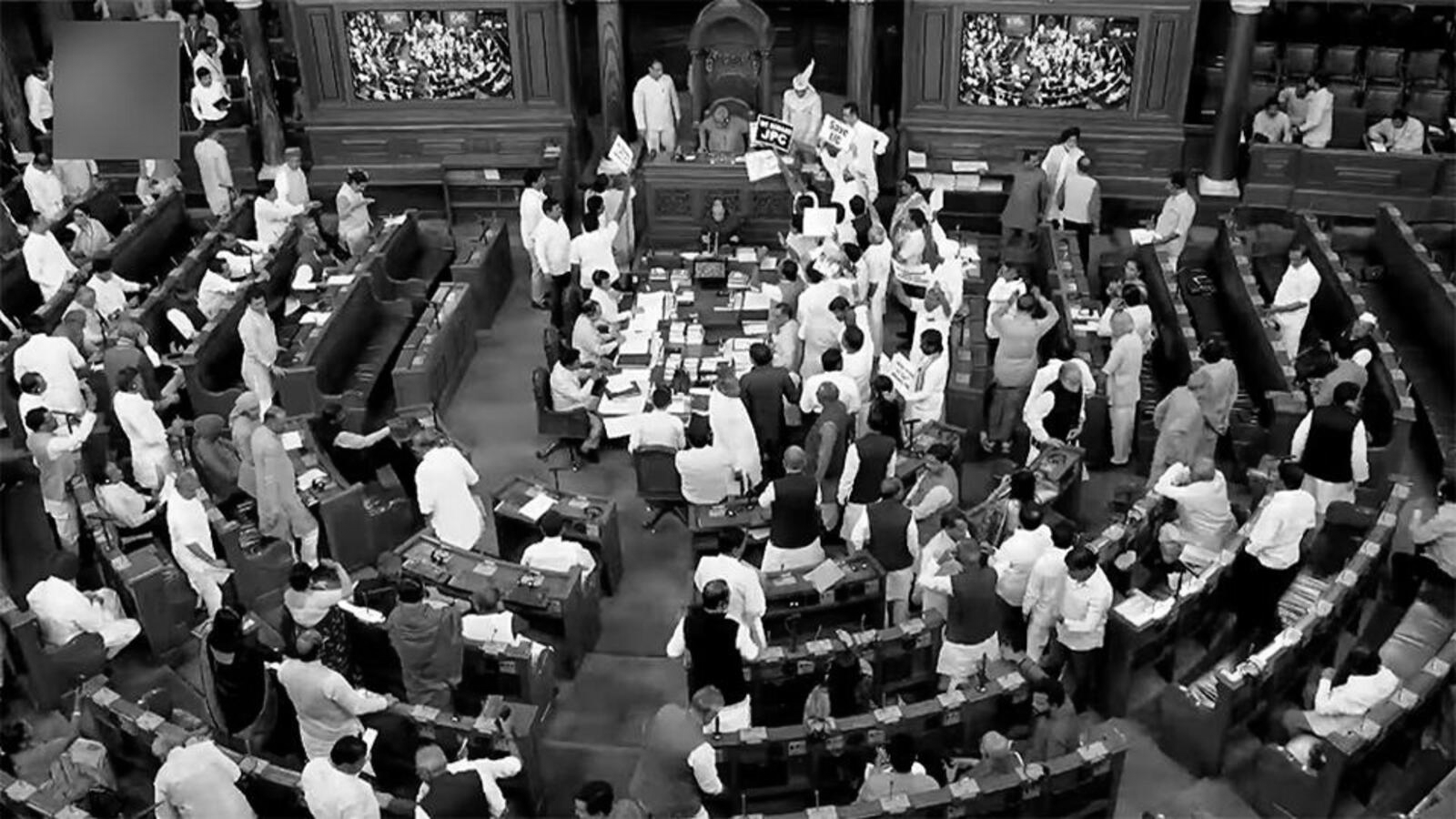
“You Did It to Us Then. Now It’s Our Turn”: Congress Cites Past to Defend Lok Sabha Protests
Amid the continuing Lok Sabha deadlock , the Congress on Thursday recalled that on June 10, 2004 , then Prime Minister Manmohan Singh was prevented by the BJP, then in opposition, from replying to the Motion of Thanks to the President’s Address . Congress general secretary Jairam Ramesh shared a video of Singh’s speech from March 10, 2005 , in which the former prime minister described his eventual reply as a “hard-earned privilege” after having been blocked the previous year.
The reference came as Prime Minister Narendra Modi was unable to address the Lok Sabha on Wednesday following disruptions by opposition members . Dramatic scenes unfolded when women MPs from the opposition entered the Well of the House carrying banners ahead of the prime minister’s scheduled reply, forcing repeated adjournments and ultimately bringing proceedings to a halt for the day.
Opposition MPs said their protests were aimed at pressing for discussions on the India–US trade deal and references to former Army chief M M Naravane ’s unpublished book , which they argue warrant parliamentary scrutiny. As members moved towards the Treasury benches, the presiding officer adjourned the House.
The confrontation has intensified since February 3, 2026 , when eight opposition MPs seven from the Congress and one from the CPI(M) were suspended for the remainder of the Budget Session for alleged unruly behaviour. The suspensions have become a central point of contention, with the opposition insisting they have aggravated the standoff rather than easing it.
The Congress’s invocation of the 2004 episode points to a familiar pattern in parliamentary politics, where both ruling parties and oppositions have, at different times, resorted to disruption as a political tool, often citing precedent to justify present conduct.
While the Rajya Sabha has continued the debate on the President’s Address without disruption and a discussion on the Union Budget is listed in the Lok Sabha, uncertainty remains over when the prime minister will be able to speak in the Lower House. As the impasse continues, the episode once again draws attention to how repeated disruptions steadily narrow the space for debate in Parliament.