
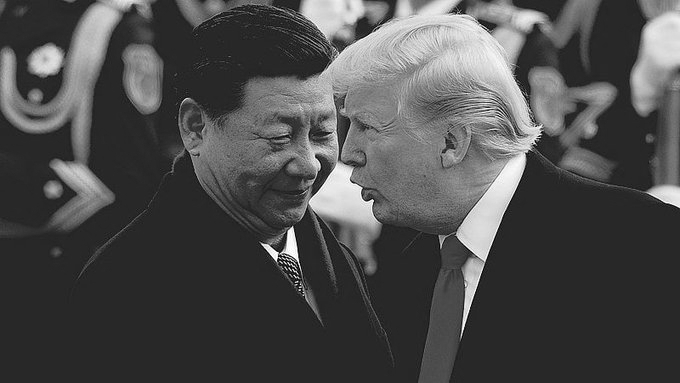
Xi To Visit US On Sept 23 To Meet Trump But Who Is Holding The Cards?
Chinese President Xi Jinping will arrive in Washington on September 23 for a state visit and meet US President Donald Trump on September 24, with trade, tariffs, Taiwan, Iran, Artificial Intelligence and rare earths at the centre of a summit that comes as Beijing’s economic position strengthens despite Washington’s tariff campaign.
“At the invitation of President of the United States of America Donald J Trump, President Xi Jinping will pay a state visit to the United States from September 23 to 25,” China’s Foreign Ministry said Monday. Xi will be formally welcomed in Washington, with Trump expected to personally receive him at Joint Base Andrews, a rare gesture by a US president. Trump will also host a state dinner and facilitate interactions between business communities from the two countries. A Chinese business delegation is expected to accompany Xi.
The visit comes after Trump travelled to Beijing in May for his first meeting with Xi this year. Their September 24 summit is expected to prioritise stability and an extension of the existing trade truce, rather than a sweeping new agreement. The current arrangement is due to expire on November 10.
Xi arrives with China's trade juggernaut still running strongly. Beijing’s global trade surplus is on course to cross $1 trillion for a second consecutive year, despite US tariffs. More than half of roughly 6,500 product categories China has exported to the US this year have recorded growth compared with 2025. Chinese exports to the US have nevertheless fallen 1.3 per cent in the first seven months, while Southeast Asia has emerged as China’s largest export market by regional bloc, highlighting Beijing’s diversification strategy.
That resilience is visible in Zhejiang, one of China’s major manufacturing and trading hubs. Its exports rose 10 per cent year-on-year to 2.66 trillion yuan ($396.5 billion) in the first seven months of 2026. Companies in cities such as Ningbo and Wenzhou have been encouraged to increase production, accelerate deliveries and send sales teams to the US for fresh orders as bilateral trade conditions stabilise.
For Washington, the trade discussions extend beyond tariffs. The US wants greater Chinese purchases of American goods, action against fentanyl precursor chemicals, improved access to rare earths and critical minerals, and implementation of earlier commitments. Beijing is seeking greater market access and relief from US technology restrictions. The two sides are also working to operationalise a proposed Board of Trade focused on identifying tariff cuts for non-strategic and non-critical goods.
Rare earths remain one of Beijing’s strongest sources of leverage. China dominates major stages of the global supply chain, including mining, refining and the production of rare-earth magnets. US officials have complained that Chinese deliveries of critical minerals remain insufficient despite earlier commitments. The existing trade and rare-earth arrangements face the same November 10 deadline, making the issue particularly important in the negotiations.
AI has now emerged as a new area where Washington and Beijing are simultaneously competitors and potential partners. During about eight hours of talks in New York on Sunday, US Treasury Secretary Scott Bessent and Chinese Vice Premier He Lifeng discussed AI alongside trade. Washington proposed an AI safety notification mechanism that would allow the two countries to share information about serious AI incidents and establish a crisis-communication channel for threats with national-security implications. The broader AI dialogue could eventually cover AI safety, cyberattacks, critical infrastructure and other risks. China has not formally endorsed the proposed mechanism.
At the same time, the technological rivalry remains intense. The US continues to restrict access to advanced technology and semiconductors, while Chinese AI companies have continued developing despite those controls. US officials said advanced AI chip export controls were not part of the latest New York mechanism discussions.
Taiwan will remain a sensitive issue, with Beijing seeking reduced US military and political support for Taipei and Washington’s proposed $14 billion arms package adding to tensions. The Iran war is another factor, with Washington seeking Chinese influence over Tehran, although expectations of Xi pressing Iran towards peace remain limited given China’s economic ties with Iran. Trump and Xi are also expected to discuss Russia’s war in Ukraine and China’s purchases of Russian energy, while Beijing continues to reject unilateral sanctions. The summit has meanwhile revived debate over Trump’s China strategy, with critics arguing that his approach has weakened US instruments such as the Quad, AUKUS, Indo-Pacific alliances and technology controls. Against this backdrop, the September 24 meeting will test whether Washington and Beijing can turn their latest trade and AI discussions into concrete arrangements while managing disputes over Taiwan, technology, critical minerals, Iran and Russia.