
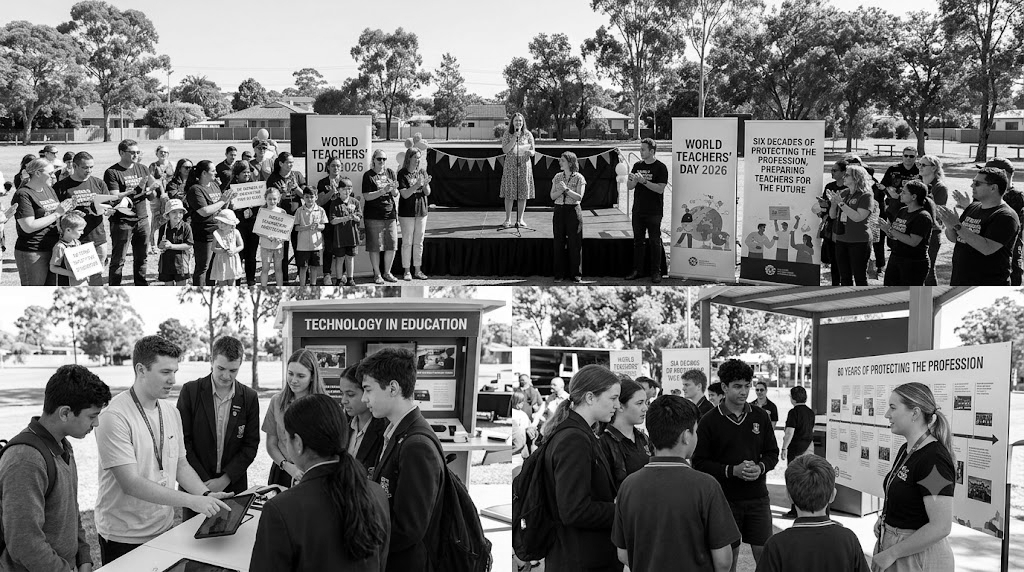
World Teachers’ Day 2026: Six Decades of Protecting the Profession, Preparing Teachers for the Future
Classrooms around the world are observing World Teachers’ Day today, recognising the contribution of educators and reflecting on the challenges facing the teaching profession. But in 2026, the occasion carries significance beyond the traditional celebration of teachers. Students now have access to smartphones, search engines, online courses and artificial intelligence, putting more information at their fingertips than ever before. As education becomes increasingly digital, the role of teachers is not disappearing. Instead, it is expanding from delivering lessons to guiding students, developing critical thinking, addressing misinformation and helping young people navigate an increasingly complex world.
World Teachers’ Day 2026 marks the 60th anniversary of the 1966 ILO/UNESCO Recommendation concerning the Status of Teachers. Observed every year on October 5, the international day commemorates the adoption of that landmark recommendation, which established international standards concerning teachers’ rights and responsibilities, preparation, recruitment, employment and teaching and learning conditions. World Teachers’ Day itself has been celebrated since 1994.
The origins of the observance go back to October 5, 1966, when UNESCO and the International Labour Organization adopted the Recommendation concerning the Status of Teachers at a special intergovernmental conference. At a time when education systems were expanding across the world, the agreement recognised that teachers needed more than social appreciation. Their professional preparation, working conditions, rights and responsibilities also required international standards.
The recommendation became an important reference point for governments and education systems. It addressed areas including teacher training, recruitment, employment, professional development and classroom conditions. In 1997, UNESCO adopted another recommendation concerning the status of higher-education teaching personnel, extending the international framework to teachers and academic personnel in higher education.
Nearly three decades after the 1966 agreement, UNESCO established World Teachers’ Day in 1994. Since then, October 5 has served both as a celebration of teachers and as an opportunity to examine the challenges confronting the profession. The day is co-convened by UNESCO, the International Labour Organization, UNICEF and Education International, reflecting the fact that teachers are not simply an education-sector concern but are central to social and economic development.
The 2026 observance comes at an important turning point. Six decades after the original recommendation, UNESCO and its partners are revisiting the framework because the world of education has changed dramatically. Artificial intelligence, digital technologies, climate change, migration, displacement and the growing demand for inclusive education have created challenges that were very different from those faced in 1966. The revision is intended to ensure that international standards continue to reflect the realities of the modern teaching profession.
The official 2026 theme, “Standing with teachers: 60 years of protecting the profession, advancing its status and shaping our futures,” captures this transition. The focus is not simply on thanking teachers for their contribution but on examining whether they have the recognition, autonomy, support, working conditions and professional opportunities needed to do their jobs effectively.
UNESCO’s approach identifies three important dimensions of teacher status. The first is symbolic status how much society values and respects teaching as a profession. The second is professional status, which includes teachers’ autonomy, access to professional support and their voice in education policymaking. The third is material status, which includes salaries, workload and working environments. A profession can struggle when teachers are praised publicly but face inadequate working conditions in practice.
The global shortage of teachers makes the issue even more urgent. UNESCO estimates that 44 million additional primary and secondary teachers will be needed by 2030 to achieve universal education. The shortage is particularly severe in parts of sub-Saharan Africa and Southern Asia, while other regions are also facing difficulties in attracting and retaining teachers because of changing working conditions and the declining attractiveness of the profession.
The challenge is therefore not simply to put more children into classrooms, but to ensure that there are enough qualified and adequately supported teachers to educate them. Recruitment alone cannot solve the problem. Education systems also need to invest in teacher preparation, continuous professional development, reasonable workloads and working environments that encourage teachers to remain in the profession.
Technology has added another layer to this debate. Artificial intelligence can help teachers prepare learning materials, analyse information and support personalised education. But it also creates concerns about students relying on AI for assignments, the spread of misinformation, privacy and unequal access to technology. The growing availability of information makes the teacher’s role as a guide even more important.
A student may be able to obtain an answer within seconds, but still need a teacher to determine whether that answer is accurate, understand its context and use it responsibly. This means AI is more likely to change the teacher’s role than eliminate the teacher. The human elements of education encouragement, empathy, judgement, communication and understanding individual students remain difficult to replace.
The transformation is not limited to AI. Teachers are increasingly expected to respond to climate-related disruptions, migration, displacement, diverse learning needs and social and emotional challenges. In many classrooms, teachers are simultaneously educators, mentors, counsellors and technology users. This expansion of responsibilities raises questions about whether education systems are providing teachers with the training and resources required to meet these new expectations.
India is part of this larger transformation. The National Education Policy 2020 has placed greater emphasis on foundational learning, competency-based education, critical thinking, experiential learning, multilingualism, vocational education and the use of technology. Implementing these goals depends heavily on teachers. A policy can change the curriculum, but teachers ultimately translate those ideas into classroom practice.
India also offers examples of how teaching can become more inclusive. Among the 10 finalists for the 2026 UNESCO-Hamdan Prize for Teacher Development is the NEEV Multilingual Education Programme from Bastar, Chhattisgarh, which focuses on integrating indigenous languages into classroom teaching. Its recognition highlights the importance of adapting teaching methods to local communities and linguistic realities rather than relying on a single approach everywhere.
The UNESCO-Hamdan Prize is also part of this year’s World Teachers’ Day programme at UNESCO Headquarters in Paris. The ninth edition of the prize recognises initiatives working to strengthen teacher development, with three laureates being announced during the global celebration. The programme brings together teachers, policymakers, education organisations and other stakeholders to discuss the future of the profession.
As the world observes World Teachers’ Day today, the significance of the occasion extends far beyond ceremonies and appreciation messages. The central challenge is to ensure that teachers can remain effective as education changes around them.
Sixty years ago, the international community recognised that teachers needed professional rights, standards and decent working conditions. Six decades later, that principle remains relevant, but the demands placed on teachers have grown enormously. The classroom of the future may contain artificial intelligence, immersive technologies and increasingly personalised learning systems. Yet behind those technologies will still be a teacher deciding how students learn, encouraging curiosity, identifying difficulties and helping young people understand the world around them.
World Teachers’ Day 2026 is therefore not only a celebration of the teachers who shaped generations past. It is a reminder that the future of education depends on whether today’s teachers are given the status, skills, autonomy and support to shape the generations to come.