
World Bank President Ajay Banga visits ancestral home in Pakistan's Punjab
In a poignant blend of personal heritage and high-level diplomacy, World Bank President Ajay Pal Singh Banga made an emotional return to his ancestral roots during a four-day official visit to Pakistan in early February 2026. The Indian-American leader, born in Khadki, Maharashtra, in 1959, traces his family lineage to pre-Partition Punjab now part of Pakistan. His journey to Khushab district on February 3 not only underscored enduring cultural ties across borders but also highlighted Pakistan’s efforts to preserve Sikh religious heritage and promote interfaith harmony.
Banga arrived in Pakistan on February 1 for meetings with top officials, including Prime Minister Shehbaz Sharif, Finance Minister Muhammad Aurangzeb, and others. Discussions focused on advancing the 10-year Country Partnership Framework, under which the World Bank has committed up to $20 billion in loans by 2035 to support Pakistan’s economic reforms, education, nutrition, renewable energy, climate resilience, and private sector growth. Amid these professional engagements, Banga carved out time for deeply personal moments tied to his Sikh identity.
The visit began on February 2 with a stop at the revered Gurdwara Sri Panja Sahib in Hasan Abdal, Khyber Pakhtunkhwa one of Sikhism’s holiest sites. Accompanied by his wife Anita Banga, he offered prayers, performed parikrama (circumambulation), and partook in langar (community meal). He was warmly welcomed by local Sikh leaders, including Punjab Minister for Minority Affairs Sardar Ramesh Singh Arora and Finance Minister Aurangzeb. Banga declined a request to address the congregation, humbly noting that his father had taught him only the Granthi Sahib holds authority to speak inside a gurdwara. The visit also included a side trip to the nearby Jaulian Buddhist archaeological site, reflecting broader appreciation for Pakistan’s ancient Gandhara heritage.
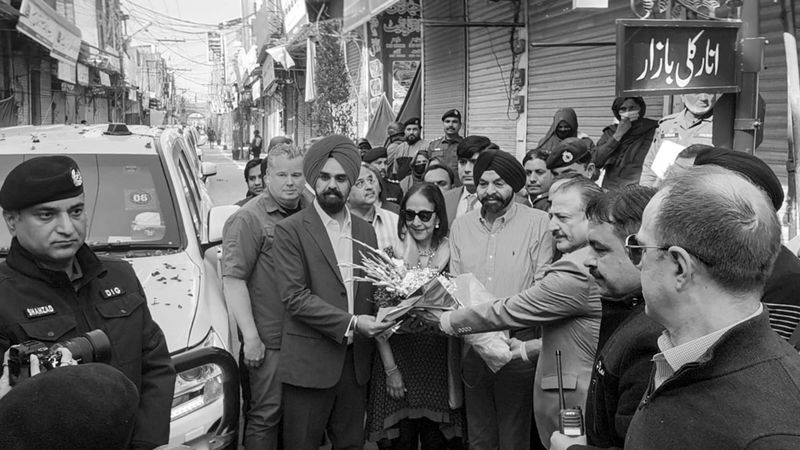
The emotional centerpiece came on February 3, when Banga traveled approximately 250 km from Islamabad to Khushab , a historic town near the Jhelum River known as the “City of Soldiers.” Here, in the Main Bazaar specifically the area referred to as Gali Sikhan Wali (Sikh Lane) he visited the ancestral home where his forefathers once lived. His father, retired Indian Army Lieutenant General Harbhajan Singh Banga, had grown up in the town before Partition-era migrations reshaped family paths.
Local officials from the Evacuee Trust Property Board (ETPB), which safeguards minority religious sites, greeted Banga warmly. They presented him with historical revenue records documenting the property, evoking visible emotion as he reconnected with this piece of his family’s past. Locals welcomed him with traditional hospitality, including floral tributes, posters featuring his image alongside Pakistani leaders, and community gatherings. Banga described the experience as one filled with “deep happiness and lasting memories.”
From there, Banga paid homage at the nearby Gurdwara Singh Sabha Khushab , also under ETPB management. He performed religious rituals, took photographs at the shrine, and commended the renovation work, preservation efforts, and facilities provided for Sikh pilgrims. ETPB Chairman Qamar Zaman Malik and Additional Secretary (Shrines) Nasir Mushtaq briefed him on measures aligned with international standards to protect minority heritage and ensure hospitality for visitors.
The trip concluded on February 4, leaving behind a powerful symbol of reconciliation. As Arora noted earlier, sacred Sikh sites in Pakistan foster a “bond of love” among Sikhs worldwide, including in India. Banga’s visit marked by humility, faith, and cross-border goodwill served as a reminder that personal histories can transcend geopolitical divides, even as institutions like the World Bank continue building economic bridges between nations.
In an era of complex relations, this rare moment of shared heritage offered a quiet yet compelling message: roots run deep, and respect for them can illuminate paths forward.