
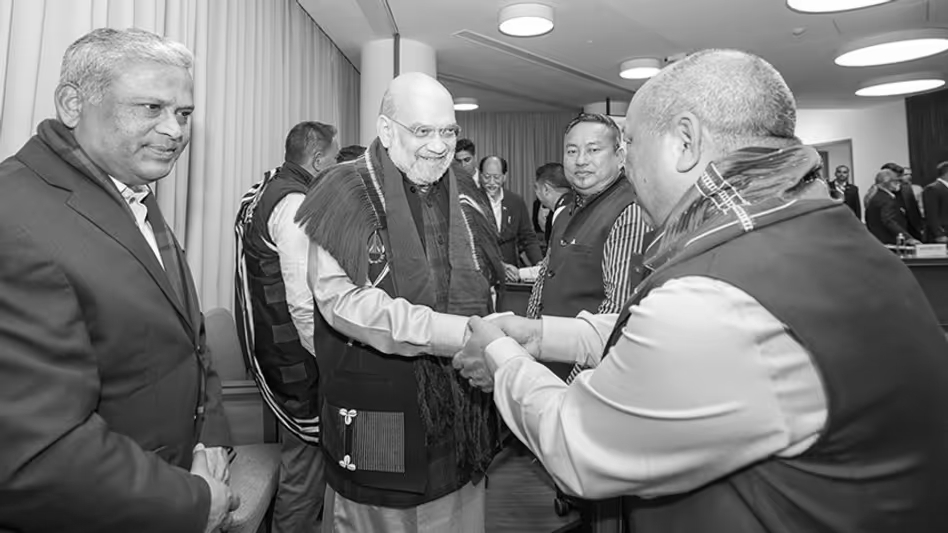
Working committee of Naga National Political Groups hails FNTA as “timely correction of historical injustice”
The Frontier Nagaland Territorial Authority (FNTA) agreement, signed on 5 February 2026 by the Centre, the Nagaland government, and the Eastern Nagaland Peoples’ Organisation (ENPO), has been hailed by the Working Committee of Naga National Political Groups (WC‑NNPGs) as a “ timely correction of historical injustice .” The pact provides administrative autonomy, governance reforms, and development initiatives for six eastern districts representing eight recognized tribes, and marks a significant step toward addressing decades of neglect in the region.
Highlighting recent developments, Nagaland Deputy Chief Minister Y. Patton announced that an interim setup will operate for one year in ENPO areas ahead of elections , ensuring smooth governance while preparations continue. At the national level, the Centre is reportedly considering appointing a Minister of State in the Home Ministry to fast-track Naga peace talks, signaling renewed urgency toward a comprehensive political settlement.
While welcoming the FNTA deal, the WC‑NNPGs emphasized that the broader Indo‑Naga political issue, covering the entire Naga ancestral homeland across Nagaland, Manipur, Assam, and Arunachal Pradesh, remains unresolved. The committee urged the Eastern Naga community to establish an “ingenious, independent, and transparent mechanism” to ensure the agreement translates into tangible improvements on the ground.
The working committee reiterated that the Framework Agreement (2015) with NSCN(IM) and the Agreed Position (2017) with WC‑NNPGs already provide the basis for a final political settlement. All core issues, including ancestral homeland concerns, have been thoroughly deliberated, and any attempt to downgrade the Agreed Position is inconceivable. The WC‑NNPGs called on Prime Minister Narendra Modi and Union Home Minister Amit Shah to announce and sign the final political agreement in line with previously negotiated terms.
The FNTA pact is expected to realign governance structures, improve administration, and deliver development benefits to eastern districts long considered underserved. Political leaders, civil society groups, and business bodies, including the Confederation of Nagaland Chamber of Commerce & Industry (CNCCI), have endorsed the agreement as a milestone for eastern Nagaland’s growth , while emphasizing that final political reconciliation remains the ultimate goal .
The FNTA agreement comes against the backdrop of decades-long negotiations, starting with the 1997 ceasefire agreement and continuing through over 80 rounds of talks , culminating in the Framework Agreement (2015) and the Agreed Position (2017) . While the Centre has not accepted NSCN‑IM’s demand for a separate flag and constitution, the FNTA represents tangible administrative recognition for the eastern districts, a critical step toward peace and inclusive governance.
With the interim setup in place and renewed political focus in New Delhi and Kohima, the FNTA agreement signals progress for eastern Nagaland, but all eyes remain on the final political settlement covering the entire Naga ancestral homeland, considered essential for lasting peace and coexistence.