
Will Iran Join the Abraham Accords? Trump’s Bold Middle East Gambit Raises Eyebrows
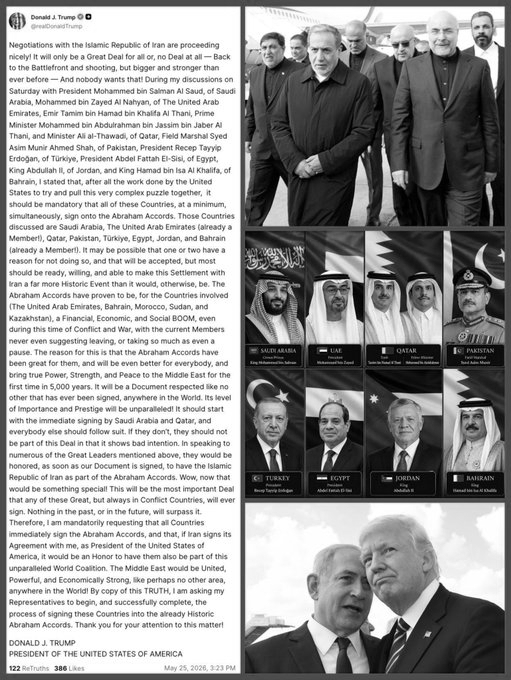
In a dramatic twist to ongoing Iran peace negotiations, President Donald Trump revealed that he personally told regional leaders during phone calls Saturday that signing the Abraham Accords must be mandatory for any nation participating in an Iran settlement framework, directly linking Israeli normalisation to the most consequential diplomatic process in the Middle East in a generation.
Trump singled out Saudi Arabia and Qatar to move first, warning that nations refusing to sign would signal "bad intention" and risk exclusion from the deal's benefits. The demand landed like a thunderclap across Arab capitals, placing governments from Riyadh to Islamabad in an acute geopolitical dilemma few anticipated when Iran peace talks began.
Until Saturday, the Iran negotiations had been framed narrowly: ending hostilities, reopening the Strait of Hormuz , and placing Tehran's nuclear programme under verifiable constraints. Trump has now torn that frame apart, turning a bilateral security negotiation into a sweeping regional realignment demand touching Saudi Arabia, Qatar, Pakistan, Turkey, Egypt, Jordan, and Bahrain simultaneously. Then came the further escalation, a Truth Social post musing that Iran itself could one day join the Accords, a normalisation framework built on Arab recognition of Israel that Tehran has spent decades violently opposing.
For Pakistan , a nuclear armed Muslim majority nation with deep domestic sensitivities over Palestine, the demand is particularly jarring. Any government seen bending to Israeli normalisation pressure would face serious political consequences at home. Qatar faces perhaps the sharpest contradiction of all. The Gulf state hosts the largest American military base in the Middle East while simultaneously serving as the primary political address for Hamas leadership . Signing the Accords would force Doha to choose, publicly and irrevocably, which role it intends to keep.
Saudi Arabia remains both the cornerstone of Trump's vision and its most immovable obstacle. Crown Prince Mohammed bin Salman has not shifted. Riyadh's position is unchanged: normalisation with Israel requires an irreversible, time-bound commitment to Palestinian statehood , something Israel's far right government has ruled out completely. When Trump raised Accords membership with bin Salman during their Oval Office meeting last November, the Crown Prince pushed back and the meeting grew tense . Saturday's phone call, delivered to multiple leaders simultaneously, suggests Trump has not softened his ask. He has only widened it.
Trump's suggestion that Iran could join the Accords was met with silence in Tehran and disbelief among analysts. The Islamic Republic's hostility to Israel is not a diplomatic posture that incentives can dislodge, it is foundational to the regime's identity .
Trump's maximalist framing does serve a tactical purpose. By demanding everything, any partial outcome, a signed Iran deal, even without new Accords members, becomes presentable as a triumph . But the immediate effect is turbulence. Governments across the Arab world and beyond now face a question they were not prepared to answer publicly: does joining an Iran peace framework require recognising Israel ? Whether that ultimatum accelerates history or fractures the negotiation it was meant to seal , the months ahead will decide.