
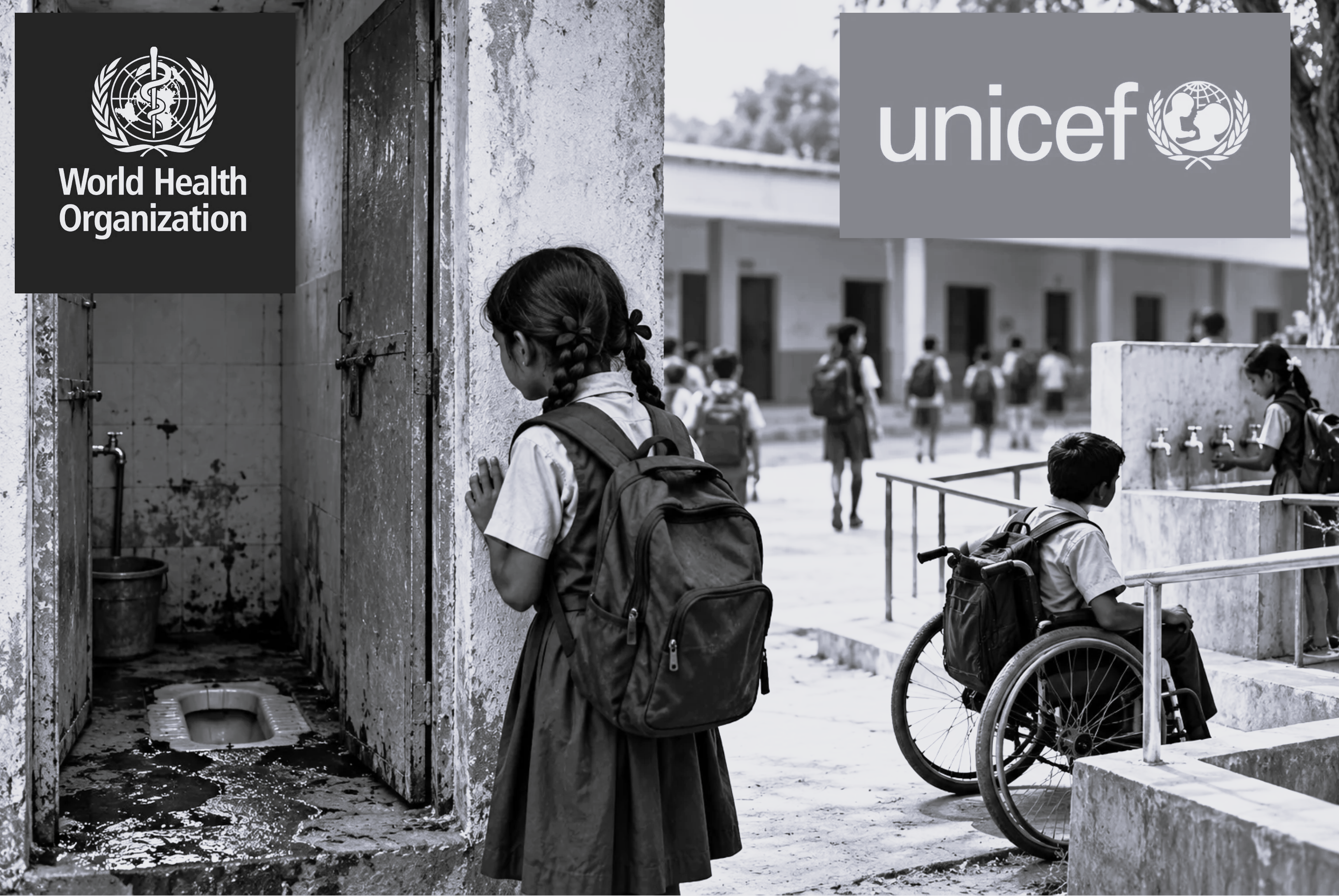
WHO-UNICEF Report: 50 Million Indian Children Lack School Sanitation Services
India has made significant progress in expanding sanitation facilities in schools, but a new WHO–UNICEF assessment reveals that the country still faces a substantial gap between having infrastructure and providing a usable sanitation service. In 2025, around 50 million Indian children attended schools classified as having no sanitation service, accounting for nearly one-fifth of the 244 million children globally in the same category. The finding comes from the WHO–UNICEF Joint Monitoring Programme (JMP) report, Progress on Drinking Water, Sanitation and Hygiene in Schools 2015–2025. India also recorded a 14% reduction in the number of schools with no sanitation service during the period assessed, indicating progress alongside a sizeable unfinished task.
What the 50 Million Figure Really Means
The 50 million figure should not be interpreted as a headcount from a single nationwide survey or as a figure limited to government schools. The JMP combines national datasets, including Education Management Information Systems, school censuses and school-facility surveys, and applies internationally comparable definitions and statistical methods. It uses school-age population data to estimate the number of children affected. For monitoring purposes, a basic sanitation service means an improved facility that is single-sex and usable. Schools with improved but incomplete facilities can fall into the limited-service category, while schools with unimproved facilities or none are classified as having no service.
A Toilet Is Not Necessarily a Sanitation Service
The distinction between construction and functionality is central to understanding India's sanitation challenge. A toilet may physically exist but still fail to provide a basic service if it is unusable, lacks privacy or does not meet the required standards. India's own Swachh Vidyalaya framework similarly goes beyond construction, prescribing separate facilities for boys and girls, indicative norms of one toilet unit for every 80 boys and one for every 40 girls in non-residential schools, as well as facilities for children with special needs and menstrual-waste management.
Progress Is Visible, But Uneven
India's UDISE+ data show substantial improvement in functional school toilets. NITI Aayog's analysis shows that the proportion of schools reporting functional girls' toilets rose from 85.17% in 2014-15 to 94% in 2024-25. Yet major regional differences remain. In 2024-25, functional girls' toilets were reported at 100% in several territories, while coverage was only 68.7% in Meghalaya, 73.7% in Arunachal Pradesh, 74.5% in Manipur, 75.4% in Tripura and 79.1% in Mizoram. Telangana improved to 92.9%.
The picture for boys' toilets is similarly uneven. Functional coverage was near universal in Chandigarh, Lakshadweep, Haryana and Goa, but stood at 72% in Meghalaya, 74.1% in Tripura, 75.5% in Arunachal Pradesh and 76.4% in Manipur. Andhra Pradesh recorded 88.8% and Telangana 86.7%. The figures show that national averages can conceal substantial state-level gaps.
The Accessibility Gap
One of the most revealing indicators concerns children with special needs. The proportion of schools reporting functional CwSN-friendly toilets increased from 16.64% in 2018-19 to 33.4% in 2024-25. While this represents more than a doubling, it also means that only about one-third of schools reported such a facility as functional. For children with disabilities, therefore, a toilet being present does not necessarily mean it is accessible.
Who Keeps the Toilets Clean?
The next challenge is maintenance. India does not have a single national cadre of permanent housekeeping workers assigned to every government school. Responsibility is distributed among state governments, local bodies, school-management structures and, in some places, outsourced or community-based arrangements. The Samagra Shiksha framework provides for school grants, with at least 10% of the composite school grant earmarked for Swachhata Action Plan activities, including maintenance and repair of school facilities and toilets.
State-level models illustrate different approaches. Andhra Pradesh's Toilet Maintenance Fund aims to maintain toilets in government schools and junior colleges, employ around 45,000 women, provide cleaning materials and safety equipment, and operate through training, standard operating procedures and a four-tier monitoring mechanism. Telangana has pursued a different model, involving women's groups and Amma Adarsha Patashala committees in school sanitation, repairs and maintenance.
India Already Has a School WASH Rating System
The country also has the Swachh Evam Harit Vidyalaya Rating (SHVR), rather than NAAC, for assessing school-level cleanliness and WASH performance. SHVR covers water, toilets, handwashing with soap, operations and maintenance, behaviour change and green-school activities. Participation has expanded from around 8.23 lakh schools under the 2021-22 Swachh Vidyalaya Puraskar to about 10.47 lakh schools in SHVR 2025-26.
Yet an earlier UNICEF-commissioned study involving about 1,015 rural government and government-aided schools, 11,027 girls, 44 districts and eight states found that although Swachh Vidyalaya ratings broadly reflected WASH quality, a sizeable proportion of highly rated schools did not meet expected standards when facilities were independently assessed. The study also found no clear independent relationship between higher WASH ratings and absenteeism, enrolment or retention after accounting for other factors.
Sanitation and the Dropout Question
India's dropout data show substantial long-term improvement, but the figures should not automatically be linked to sanitation. UDISE+-based analysis shows primary dropout falling from 4.34% in 2014-15 to 0.3% in 2024-25, while upper-primary dropout stood at 3.5% and secondary dropout at 11.5% in 2024-25. Secondary education remains the bigger retention challenge. Other factors, including household responsibilities, school distance, economic conditions, safety concerns and social norms, also influence attendance and retention.
Water Has Advanced Faster Than Hygiene
India's school drinking-water performance is comparatively stronger. Around 12 million Indian children lacked drinking-water services at school in 2025, and India was among countries considered on track for universal basic drinking-water coverage by 2030. Hygiene remains harder to measure: around 20 million Indian children were reported as lacking a hygiene service, but the JMP said insufficient recent data prevented it from producing comparable 2025 hygiene estimates for India and Central and Southern Asia beyond 2024.
From Counting Toilets to Measuring Services
India's school-sanitation story has therefore moved beyond the question of how many toilets have been built. The country has made clear progress in infrastructure, drinking water and functional girls' toilets, but regional disparities, accessibility gaps, maintenance responsibilities and data limitations remain. Globally, the JMP estimates that at the current pace, only 81% of schools will have basic sanitation by 2030, leaving 7% without any sanitation service. Achieving universal coverage would require a fivefold acceleration in sanitation progress.
For India, the next phase is not simply about constructing more toilets. It is about ensuring that every child can access a clean, safe, private, functional and accessible sanitation facility every school day. The measure of success, ultimately, should shift from the number of toilets constructed to the number of children who can actually use them.