
Who is behind the Kurmis to demand ST status
For nearly nine decades, the Kurmi community has been fighting to be recognized as a Scheduled Tribe (ST). During British rule, they were classified as an upper social group and landowners, and their demand for ST status was denied. Based on their social standing, history, customs, and lifestyle, the British refused to categorize them as tribals. Since then, they have continued their struggle, seeking reclassification from OBC (Other Backward Classes) to ST. Alongside, they have also demanded constitutional recognition for their language.
However, the central government has consistently rejected this demand, citing lack of historical or archaeological evidence to prove their tribal origin. The Kurmis, who are spread across a few states, continue to press for ST recognition, but political parties often raise the issue only to gain electoral mileage. From pre-independence to the present day, this issue remains unresolved largely due to the opportunistic and inconsistent approach of both regional and national parties.
Political parties face a dilemma: if they fully support the Kurmis, they risk alienating the existing ST communities. If they oppose the demand, they risk losing the Kurmi vote bank. As a result, most parties maintain a “neither here nor there” stance.
Struggle for better opportunities
The Kurmis are demanding ST status primarily to secure better opportunities in education, employment, and political representation. Though their lifestyle is considered more advanced than that of many ST communities, they feel disadvantaged within the large and competitive OBC category.
According to the Constitution, STs enjoy reserved seats in state assemblies and Parliament in proportion to their population. Since OBCs consist of numerous sub-castes competing for limited resources, the Kurmis believe they are being sidelined and continue to push for ST recognition.
In states like Bihar, Jharkhand, Odisha, Bengal, and Assam, the Kurmis have been fighting persistently. Some community leaders are also encouraging the movement for their own political relevance.
Who loses if Kurmis enters STs?
If the Kurmis are included in the ST category, the biggest losers would be the existing ST communities. They would be forced to share their reservation quota with the Kurmis. Importantly, the total ST reservation quota would not increase with the inclusion of Kurmis.
In landmark rulings such as the Indra Sawhney case, the Supreme Court has made it clear that reservations cannot exceed 50%. This means existing ST groups would lose both job opportunities and political seats if Kurmis are included.
Political parties calculations
National parties have largely remained neutral on this sensitive issue. The inclusion of Kurmis in the ST list requires state government recommendations, parliamentary debate, and presidential assent, a long and complicated process.
Meanwhile, other dominant communities like Patels in Gujarat, Jats in Haryana, and Marathas in Maharashtra have also been demanding reservations for years. Governments have managed their agitations with temporary promises and committees. Supporting the Kurmis now, analysts say, would be like “stirring a hornet’s nest.”
Thus, national parties tend to stall the issue by announcing commissions, studies, and reports, while offering Kurmi leaders political prominence to retain their support.
Regional parties, too, play a balancing game. They assure Kurmi leaders that they will fight together and pressure the Centre for reservations, while also blaming the Union government for inaction. At the same time, they avoid antagonizing the existing ST communities, who are numerically stronger.
Renewed agitation in Jharkhand
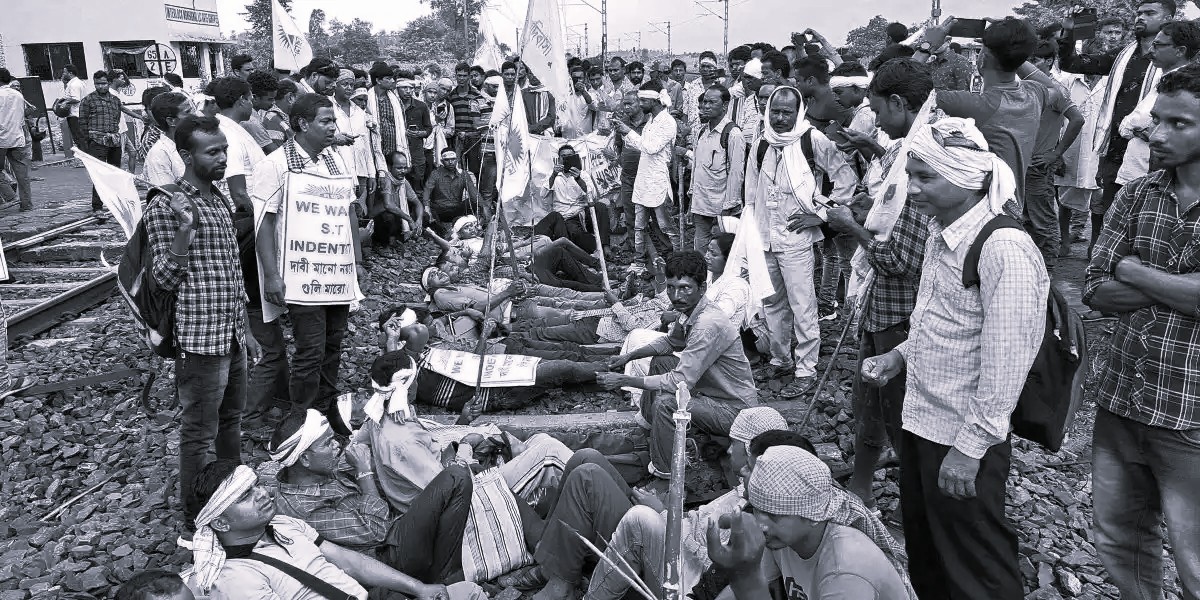
Recently, the Kurmi community in Jharkhand has once again intensified its agitation, demanding recognition as STs. Protests such as rail blockades, road blockades, and demonstrations have been staged across Ranchi, Dhanbad, and other districts.
Kurmi leaders argue that their customs, traditions, and way of life are closer to those of tribals, and therefore they deserve ST recognition. The movement is being framed as a fight for self-respect and dignity, with leaders vowing to continue their struggle until their demand is met.