
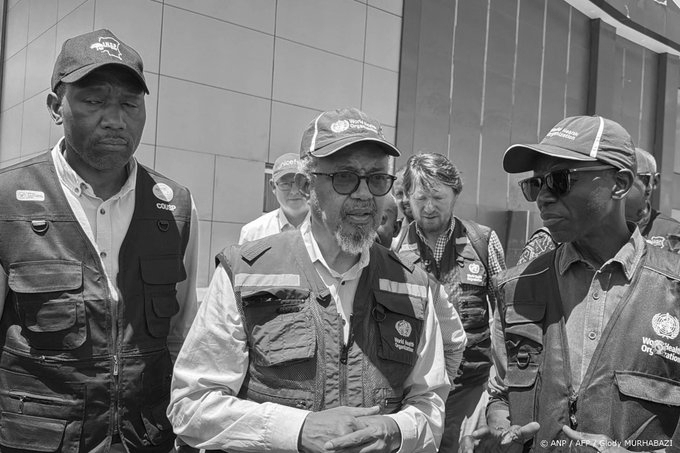
WHO Chief Visits Ebola Epicentre in DR Congo as Cases Cross 1,000
The head of the World Health Organisation World Health Organisation has arrived in Bunia in Ituri province , the epicentre of a rapidly escalating Ebola outbreak in eastern Democratic Republic of the Congo, as infections continue to outpace response efforts despite increased international assistance and strengthened field operations.
WHO Director-General Tedros Adhanom Ghebreyesus is visiting treatment centres and meeting national and local authorities, health workers and affected families to assess the situation and reinforce containment measures at the centre of the outbreak.
Health authorities report over 1,028 suspected cases and at least 223 suspected deaths in the Democratic Republic of the Congo, with confirmed infections also rising steadily as laboratory testing expands and surveillance improves in affected provinces.
In neighbouring Uganda , authorities have confirmed about nine cases and at least one death linked to cross-border transmission, raising concerns about regional spread and tighter monitoring at entry points.
The outbreak is caused by the Bundibugyo strain of Ebola virus , for which there is currently no approved vaccine or specific treatment, with care limited to supportive medical management. WHO estimates the fatality rate among confirmed cases at 30 to 50 percent , depending on access to care and early detection.
Transmission has now spread beyond initial hotspots in Ituri into parts of North Kivu and South Kivu , complicating contact tracing due to insecurity, population displacement and ongoing armed conflict in eastern Congo.
Despite improved organisation in treatment centres in Bunia, including additional staff, protective equipment and isolation capacity, health facilities continue to receive patients around the clock, with many operating near capacity.
Operational challenges persist, including insecurity restricting access to remote areas, community resistance and misinformation, and logistical constraints affecting rapid deployment of personnel and supplies. Aid agencies have also reported gaps in trained staff and funding.
International support has increased, with the United States committing more than USD 112 million in assistance and the European Union dispatching emergency medical supplies to Ituri.