
White House Security Breach Fuels Speculation on Kash Patel Exit
Ten minutes. That was all the time Cole Thomas Allen gave himself between sending a thousand-word manifesto to his own family and opening fire at the White House Correspondents' Dinner , one of the most heavily secured social events in American political life. Not a gap born of hesitation, but of cold, deliberate calculation.
The manifesto, which Allen's relatives handed over to investigators, was not the incoherent rambling of a man unmoored from reality. It was structured, hierarchical, and chillingly methodical . He signed it under two names, Cold Force and Friendly Federal Assassin and it began, of all things, with an apology. "I may have given a lot of people a surprise today," he wrote. "I apologize to my parents, my colleagues and students."
What followed the apology was far darker. Allen laid out a ranked target list , with Trump administration officials at the top ordered by seniority. The hotel staff, guests, Capitol Police, and the National Guard were explicitly spared. The Secret Service were targets only "if necessary" and "preferably non-lethally." FBI Director Kash Patel was conspicuously, inexplicably, absent from the list entirely, an omission that has since taken on a life of its own.
Allen had even thought through his ammunition. He chose buckshot over slugs , deliberately selecting a shorter-range spread to minimise casualties by reducing wall penetration. This was not a man in a frenzy. This was a man who had done the math.
His stated motivation was one of moral obligation. "I am no longer willing to permit a pedophile, rapist, and traitor to coat my hands with his crimes," he wrote, a reference widely understood to be directed at President Trump. He reframed the attack not as violence but as civic duty, even invoking his faith to justify it. "Turning the other cheek when someone else is oppressed," he wrote, "is not Christian behaviour. It is complicity in the oppressor's crimes ."
Trump, characteristically, was dismissive. In an interview with CBS News, he called Allen "a very sick person" who had been radicalised, and noted that he had been a Christian before becoming, in Trump's words, "anti-Christian." The framing was personal and political at once, which, for this presidency, is business as usual.
But beyond the ideology and the grievance, the manifesto surfaced something far more uncomfortable: a devastating critique of the security arrangements at an event attended by the President of the United States. Allen had checked into the hotel in advance. He had time to observe. And what he observed, he wrote, was that security was entirely focused outside, on the protesters demonstrating against the US-Iran war. He called the lapse "insane," and went further, writing that if he had been an Iranian agent, he could have walked in with an M2 .50 calibre heavy machine gun and no one would have noticed. That is not a boast. That is an indictment.
Allen did not expect to survive. He said goodbye to his students. He apologised to his parents for lying to them. He then walked into the hotel and acted on everything he had written. He is now in custody, facing multiple federal charges , assaulting a federal officer, discharging a firearm, and attempting to kill, with an attempted assassination charge potentially to follow. The US Attorney indicated a formal indictment would come within days or weeks.
And yet, the shooting has now generated a second, quieter story running parallel to the first, the story of Kash Patel .
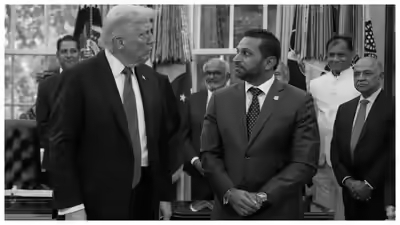
The FBI Director's glaring omission from Allen's target list has compounded what was already a growing narrative of his marginalisation within the Trump administration. Footage from inside the ballroom at the moment shots rang out showed Patel appearing almost adrift amid the panic , a strange, telling image for the country's top law enforcement officer. Minutes later, he stood beside Trump at the White House podium in his bow tie, lavishing praise on the Secret Service and crediting the President for inspiring American law enforcement "24/7, 365."
The performance didn't do much to quiet the whispers. In recent months, Kash has been the subject of a string of damaging reports, that he demanded FBI agents provide a full-time security detail for his girlfriend , that he alarmed colleagues with episodes of excessive drinking and unexplained absences . He has denied the claims and pursued legal action, but the chatter has refused to die. According to multiple reports, the question inside Trump's circle is not whether Patel goes, but when .
Trump has already fired Attorney General Pam Bondi , Homeland Security Secretary Kristin Noem , and Labour Chief Lori Chavez DeRosa . With midterms approaching, Iran on his plate, and approval ratings under pressure, a cabinet shakeup carries its own political logic. White House Press Secretary Karoline Leavitt called Patel "a critical player", the kind of language that, in this administration, has historically functioned less as a vote of confidence and more as a grace period notice .