
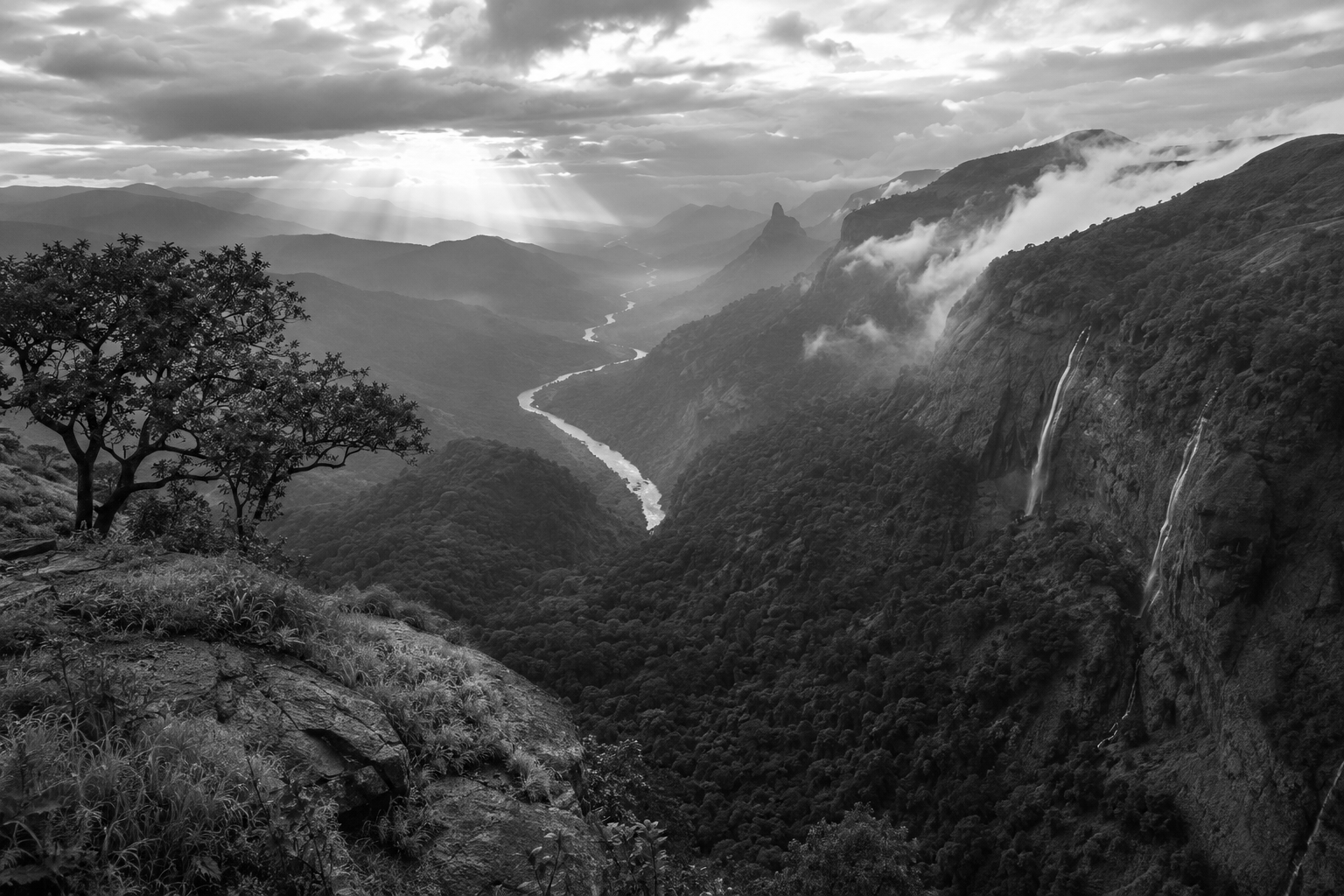
Western Ghats Protection Plan Returns with Seventh Draft Notification
The Union Ministry of Environment, Forest and Climate Change (MoEFCC) has once again revived its proposal to notify a significant portion of the Western Ghats as an Ecologically Sensitive Area (ESA). The Ministry recently issued the seventh draft notification, proposing to bring 56,825.7 square kilometres nearly 1.4 crore acres of the mountain range under a special conservation framework, underscoring the Centre's continuing effort to balance environmental protection with economic development.
The latest draft replaces the notification issued on July 31, 2024, which lapsed after its 725-day validity period. The fresh proposal spans six states: Gujarat (449 sq km), Maharashtra (17,340 sq km), Goa (1,461 sq km), Karnataka (20,668 sq km), Tamil Nadu (6,914 sq km) and Kerala (9,993.7 sq km) nearly 37 per cent of the range.
Stretching nearly 1,600 kilometres along India's western coast, the Ghats are widely regarded as the country's ecological backbone, one of the world's eight "hottest" biodiversity hotspots and a UNESCO World Heritage Site. The range is the source of major rivers including the Godavari, Krishna, Kaveri, Tungabhadra, Periyar and Sharavathi, making it vital for drinking water, irrigation, agriculture and hydropower across peninsular India.
Crucially, the proposal is a draft notification under the Environment (Protection) Act, 1986, not new legislation meaning it becomes legally enforceable once finalised, without requiring Parliament's approval.
A Debate That Began Over a Decade Ago
The push for special protection dates to 2010, when the Centre set up the Western Ghats Ecology Expert Panel (WGEEP) under ecologist Madhav Gadgil. Its 2011 report recommended declaring nearly 64 per cent of the Ghats ecologically sensitive, with a graded model, greater power for local Gram Sabhas, and tighter curbs on mining and industry recommendations that alarmed state governments and plantation owners worried about livelihoods.
The Centre then appointed a High-Level Working Group under former ISRO Chairman K. Kasturirangan, whose 2013 report took a more pragmatic route: scaling protection down to 56,825.7 sq km (37 per cent) while excluding settlements and plantations, and focusing on natural forests and ecologically intact areas.
That recommendation led to the first draft ESA notification in March 2014, but disputes over village boundaries and development restrictions stalled it. Revised drafts followed in September 2015, February 2017, October 2018, July 2022, July 2024, and now 2026 making this one of India's longest-running environmental policy exercises.
What Prompted the Fresh Draft
Responding in the Rajya Sabha on July 23, Union Minister of State for Environment Kirti Vardhan Singh said a committee headed by former Director General of Forests Sanjay Kumar, formed in 2022, is reviewing state concerns over the ESA's final demarcation before recommending finalisation to the Ministry. The sticking points remain familiar: village boundaries, inclusion or exclusion of specific areas, and balancing ecology against development.
Environmental groups want the notification expedited; several states want it softened so agriculture, plantations and local economies aren't hampered. Meanwhile, scientists point to rising pressure from infrastructure expansion, quarrying, mining, tourism, habitat fragmentation and climate change with extreme rainfall, landslides and shifting weather patterns reinforcing the case for scientifically planned land-use regulation.
What the ESA Framework Actually Proposes
Contrary to common misconceptions, the ESA notification is not a land acquisition drive, nor does it evict residents, ban farming, or shut plantations. It is an environmental land-use framework meant to prevent future ecological degradation while allowing sustainable livelihoods to continue.
Within the notified ESA, new mining, quarrying, sand mining, thermal power plants and highly polluting "Red Category" industries will be prohibited activities long linked to habitat destruction, erosion, water pollution and biodiversity loss. Large infrastructure highways, railways, hydropower projects, transmission lines, townships and major tourism developments won't be automatically banned but will face stricter environmental appraisal, weighing risks to forest fragmentation, wildlife corridors, river catchments and landslide-prone slopes.
Meanwhile, existing villages, agriculture, horticulture, tea, coffee, rubber and spice plantations, schools, hospitals and traditional livelihoods continue unaffected, the notification targets future high-impact activity, not existing settlements.
Implementation will run through existing institutions the MoEFCC, state forest departments and State Pollution Control Boards rather than a new statutory body. Notably, the Gadgil Committee had proposed a dedicated Western Ghats Ecology Authority, but the Kasturirangan Committee chose to strengthen existing mechanisms instead, with satellite imagery, GIS and remote sensing deployed to track forest cover, illegal mining and encroachment.
Balancing Conservation and Development
The Kasturirangan Committee's central goal was equilibrium: conserve ecologically intact landscapes while permitting economic activity in already-modified areas, given how many people depend on agriculture, plantations and tourism across the region. It also stressed protecting wildlife corridors, river catchments and endemic flora and fauna, while promoting eco-tourism and sustainable, scientific land-use planning seen by environmentalists as essential for water security, climate resilience and disaster mitigation across southern and western India.
Why the Western Ghats Matter
Beyond scenic value, the Ghats shelter thousands of species, many endemic including the Lion-tailed Macaque, Nilgiri Tahr, Malabar Civet and the Purple Frog. As India's natural water tower, the region's rivers sustain agriculture, industry and drinking water for millions, while healthy forests regulate rainfall, recharge groundwater, and blunt floods and landslides functions grow more critical as climate change intensifies.
Forest Cover: The Larger National Context
The renewed focus arrives amid wider concern over forest quality nationally. The India State of Forest Report (ISFR) 2023 recorded a marginal rise in overall forest cover, yet combined forest and tree cover remains below the National Forest Policy target of 33 per cent of India's geographical area.
Ecologists caution that satellite assessments include plantations and trees outside forests, so headline gains can mask stagnation or decline in natural ecosystems. The ISFR 2023 flagged falling recorded forest area in Tripura (-116.9 sq km), Telangana (-105.87 sq km), Assam (-86.66 sq km), Andhra Pradesh (-83.47 sq km) and Gujarat (-61.22 sq km), attributed not to any single project but to plantation harvesting, natural disturbances, infrastructure growth and gradual canopy degradation. While Gujarat is among the six states covered by the proposed ESA, Tripura, Assam and Telangana fall outside it, underscoring that forest decline is a broader national challenge extending well beyond the Western Ghats notification.
The Road Ahead
The seventh draft marks another step in India's long, often contentious journey to safeguard one of its most valuable ecological assets. Before finalisation, the Centre will keep weighing objections and suggestions from the six states through the Sanjay Kumar committee.
If approved, the ESA notification won't turn the Western Ghats into a no-development zone, it will instead create a science-based regulatory framework ensuring future growth doesn't irreversibly damage the forests, wildlife habitats and water resources that sustain millions. For policymakers, the challenge is balancing growth with ecological security; for environmentalists, it's a chance to protect one of the world's most important biodiversity hotspots before the damage becomes irreversible. Ultimately, success will hinge on whether conservation and development can move forward together not as rivals, but as partners in securing India's ecological future.