
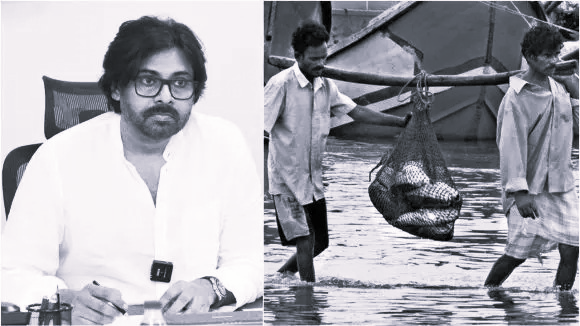
Week-long training program for fishermen concludes in Uppada
A week-long training program aimed at improving the livelihoods of fishermen in the Uppada coastal region has successfully concluded. This initiative is part of the 100-day action plan announced by the State Deputy Chief Minister Pawan Kalyan, focusing on study, awareness, and skill-building activities for local fishermen.
The training program involved studying advanced fishing technologies and practices adopted in Tamil Nadu and Kerala, with the goal of providing better infrastructure and resources to fishermen in Uppada and Kakinada. Fishermen were divided into two groups and sent to these states to gain hands-on experience.
On December 8, a total of 60 fishermen left for the respective states. Over three days, they were trained on modern cage culture, reef culture, marketing systems, harbors, hatcheries, fish egg incubation, and net-making under the guidance of experts from the Central Salt and Marine Chemicals Research Institute and the National Institute of Post-Harvest Technology. The sessions included both presentations and field visits to give participants practical exposure.
The first group visited Chennai, where marine experts provided training on cage and reef culture using both artificial and natural methods. They also learned scientific methods for conserving marine biodiversity and ensuring long-term sustainability of ocean resources. The group visited the Golden Marine Harvest Hatchery in Villupuram to study new technologies for enhancing fish production.
The team also explored modern marketing systems at a well-equipped fish market near Marina Beach, Chennai. They observed how fish are sold in hygienic conditions, cold storage facilities, grading systems, auctions, waste management, and supply chain processes. The visit highlighted how improved infrastructure can directly boost fishermen’s incomes.
The second group trained for three days at the National Institute of Post-Harvest Technology in Kerala. Under expert supervision, they studied integrating technology into fishing operations, sustainable income generation, and economically viable practices.
The team visited the model fishing harbor in Munambam to learn about net-making processes, quality standards, and marketing strategies. They also observed various hatcheries and fish breeding techniques. The hands-on exposure provided the fishermen with practical insights into modern practices that can improve their livelihoods and ensure higher profitability.
Officials believe that the successful completion of this week-long training program lays a strong foundation for enhancing the economic and living standards of fishermen in the Uppada region.