
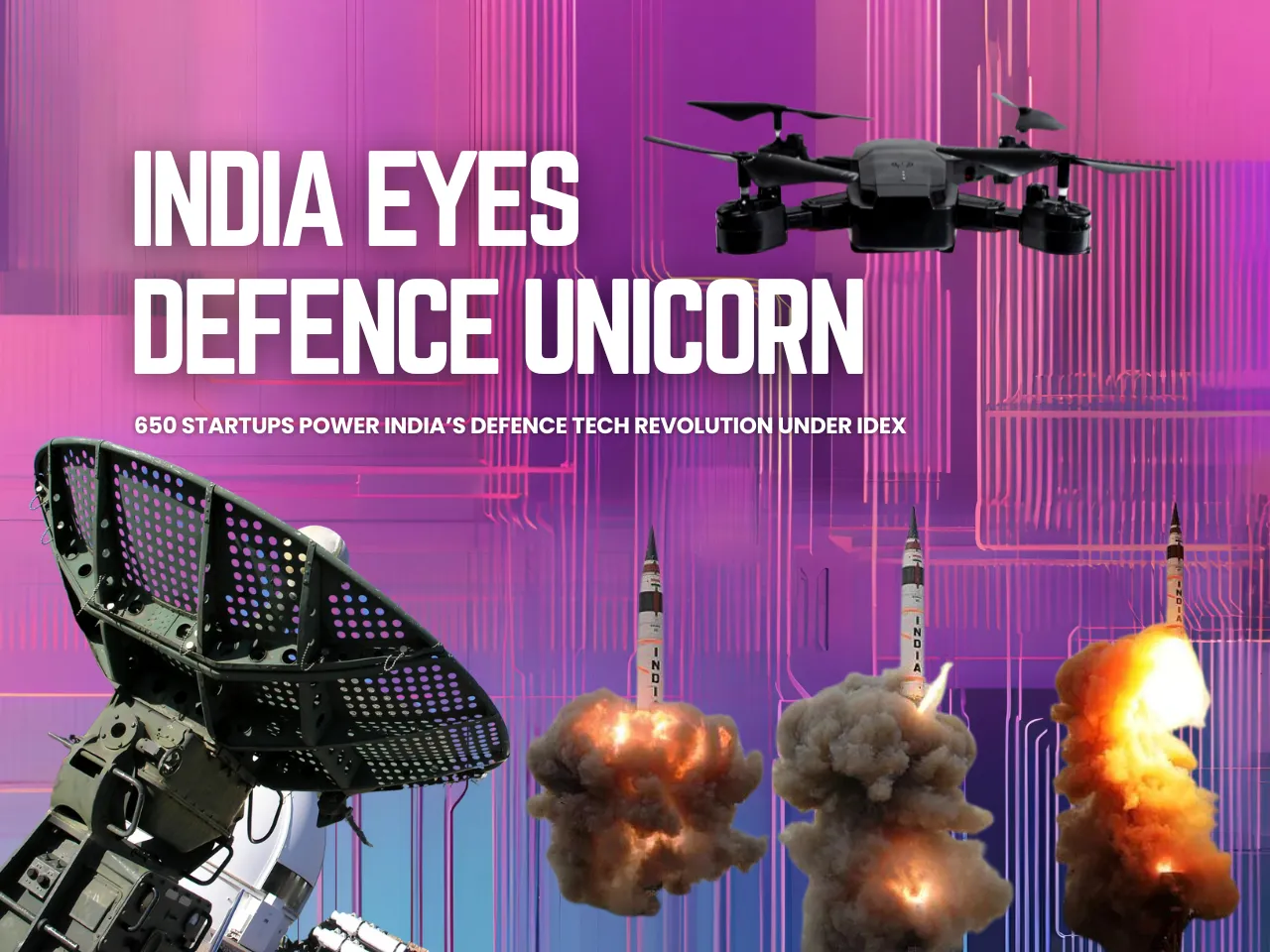
Wars of tomorrow to be fought with AI, Drones and Quantum Tech: Rajnath Singh
Defence Minister Rajnath Singh inaugurated the ‘Raksha Navachar Samvaad: Interaction with iDEX Startups’ at Vigyan Bhawan, New Delhi, ahead of the National Conference on Opportunities in Defence Manufacturing in India. Organised by the Department of Defence Production under the Ministry of Defence, focusing on tech driven war strategies in the future and also to connect the talent of India’s youth with the technological needs of the Armed Forces
During the event, Rajnath Singh launched the Defence Exim Portal to streamline defence export and import authorisations and unveiled the Srijan DEEP (Defence Establishments and Entrepreneurs Platform) portal, a digital repository mapping the capabilities and products of Indian defence industries. He also released two key publications: the Aerospace & Defence Sector Policy Compendium of States and Union Territories and the iDEX Coffee Table Book ‘Shared Horizons of Innovation’. The conference provided a platform for innovators to showcase emerging technologies and products, reinforcing the Ministry's commitment to advancing defence innovation, boosting indigenisation, and enhancing defence exports.
Speaking at the summit, Shri Rajnath Singh emphasised that the wars of tomorrow will be fought with algorithms, artificial intelligence, autonomous systems, and directed-energy weapons. Highlighting India’s progress in indigenous capabilities, he said, “We must not remain imitators or followers in technology, we must become creators and standard-setters for the world.” He called upon young innovators to create India’s first Defence Unicorn, reinforcing the vision of a self-reliant and technologically advanced defence sector.
India has made substantial strides in developing indigenous defence systems across various domains. The Defence Research and Development Organisation (DRDO) has led the development of Agni and Nirbhay missiles, the Tejas light combat aircraft, the Arjun main battle tank, and the Akash surface-to-air missile system. Despite a defence budget of ₹6.81 lakh crore in 2024–25, around ₹1.49 lakh crore is allocated for pensions, which places constraints on modernisation and research. Nevertheless, organisations such as Hindustan Aeronautics Limited (HAL) and Bharat Dynamics Limited (BDL)are Public Sector Undertakings (PSU) under the Ministry of Defence continue to invest heavily in R&D, contributing to innovations that enhance India’s strategic capabilities.
While India has strengthened indigenous development, strategic partnerships remain crucial. Collaborations with Russia have supported upgrades in T-72 tanks and the co-development of BrahMos missiles, while deals with France have led to the procurement of 26 Rafale fighter jets, with components being manufactured domestically by Tata Advanced Systems. Collaborations with Israel have enhanced India’s unmanned aerial vehicle (UAV) and radar capabilities.
The private sector has emerged as a key player in the defence ecosystem. Tata Advanced Systems has partnered with Lockheed Martin to manufacture C-130J Super Hercules aircraft components and with Airbus Defence & Space to produce C-295 military transport aircraft at its facility in Vadodara, Gujarat, a major boost to local aerospace manufacturing. Larsen & Toubro has built submarines and offshore patrol vessels for the Indian Navy and developed critical systems for Pinaka multi-barrel rocket launchers and K-series submarine-launched missiles.
India’s defence exports have also seen a significant increase, reaching approximately ₹23,600 crore in FY 2024 - 25, with products ranging from bulletproof jackets and Dornier aircraft originally belongs to Germany to lightweight torpedoes and fast interceptor boats. Indian defence systems are distinguished by cost-effectiveness, modularity, and adaptability to diverse operational environments, allowing them to operate efficiently across high-altitude, desert, and coastal regions.
As India navigates the challenges of budget allocation, technological modernisation, and international collaboration, its defence sector is steadily moving towards self-reliance and global competitiveness. Initiatives like iDEX, the Defence Exim and Srijan DEEP portals, and ongoing support for private sector participation ensure that India is not only strengthening its security but also shaping the future of innovation-driven defence manufacturing.