
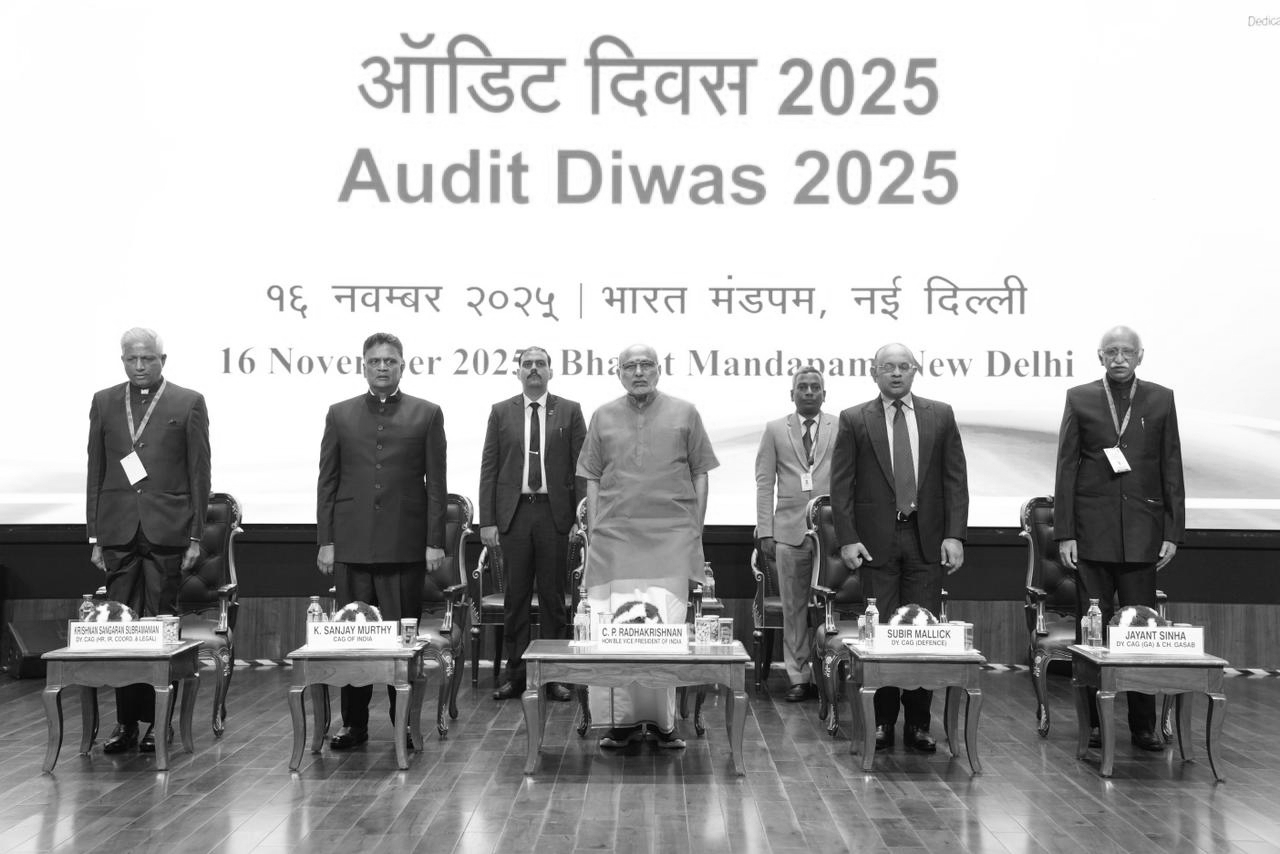
VP Radhakrishnan inaugurates CAG’s Audit Diwas 2025, calls audits a tool for reform
Vice President CP Radhakrishnan inaugurated Audit Diwas 2025, commending the CAG for transforming audits from a mere review of past records into a forward-looking instrument of reform, innovation, and foresight. He highlighted the institution’s pivotal role in promoting transparency, accountability, and good governance, and acknowledged the CAG’s efforts in capacity building through collaborations with premier academic and professional bodies like IITs and IIMs. The Vice President also described the CAG as the “guardian of the public purse”, emphasizing its role in upholding fairness, integrity, and transparency in public spending.
He further praised the CAG for notifying “One Nation, One Set of Object Heads of Expenditure” for the Union Government and all State Governments, a reform aimed at enhancing transparency and comparability of government expenditure. The Vice President highlighted the CAG’s global reputation, including its role as External Auditor for international organizations such as the WHO, ILO, and others, and noted its leadership as Chair of the Asian Organisation of Supreme Audit Institutions (ASOSAI), marking India’s emergence as a global leader in auditing.
The Comptroller and Auditor General of India (CAG), the nation’s top financial watchdog, was formally established in 1948 under Article 148 of the Indian Constitution, which ensures the CAG’s independence and authority to audit government finances. The CAG audits the accounts of the Union and State governments, public sector companies, and other government organizations, ensuring that public funds are used efficiently, legally, and for their intended purposes. Its reports are presented to the Parliament and State Legislatures, helping maintain accountability, financial discipline, and public trust.
CAG K. Sanjay Murthy outlined the institution’s ongoing transformation, emphasizing four key pillars: stakeholder engagement, digital transformation, alignment with national development goals, and capacity building. He highlighted initiatives such as making public finance data more accessible, engaging with urban local governments, and auditing Ease of Living and Ease of Doing Business for cities, MSMEs, and start-ups. He also spoke about leveraging AI and data analytics to enhance audit quality and efficiency, positioning the CAG as a forward-looking partner in governance rather than just a reviewer of past spending.
In recent years, the CAG has embraced technology and innovation. Initiatives like the CAG-Connect Portal, linking nearly 10 lakh auditee entities, and CAG-LLM, an AI-driven tool for audit analytics, have transformed the auditing process. Officers receive specialized training in Data Science, Artificial Intelligence, and Cybersecurity, and a dedicated group of AI Champions leads innovative projects to improve efficiency and impact.
The Audit Diwas celebrations also included the CAG Awards for Innovation and Excellence, technical demonstrations of AI in auditing, and the felicitation of winners of the National Online Essay Writing Competition, including Bhaskar Kumar (Hindi) and Master Advaith Sajeev (English). Five AI pilot projects were showcased, demonstrating how technology can strengthen auditing and governance.
Audit Diwas serves as a reminder that the CAG is more than an examiner of past records. By embracing technology, innovation, and forward-looking audits, it acts as a trusted partner in governance, ensuring that public funds are used wisely and effectively, contributing to India’s progress toward Viksit Bharat 2047.