
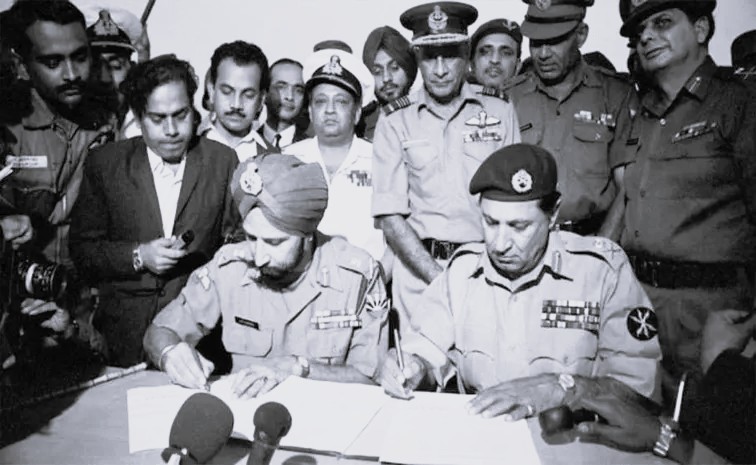
Vijay Diwas - A Symbol of India's Victory
In India, mainly two 'Vijay Diwas' (Victory Days) are celebrated. The first Vijay Diwas is December 16, which commemorates India's victory in the 1971 Indo-Pak War and the birth of Bangladesh. The other is Kargil Vijay Diwas, celebrated on July 26, to remember India's victory in the 1999 Kargil War. Both days are dedicated to recalling the sacrifices of the Indian Armed Forces and the honour of the nation. Let us learn more details about the Vijay Diwas we celebrate on December 16.
December 16 is a day that recalls a priceless, indelible memory in our hearts. This day reminds every Indian of the respect for the Indian Army, which stood up for justice and fought a war as a symbol of peace and equality. The entire nation celebrates Vijay Diwas annually, marking India's victory over Pakistan. India won the 1971 war. This victory was a great triumph for humanity against the injustice perpetrated by Pakistan. We celebrate this day to pay tribute to the valour of the soldiers who fought in that war and to remember their sacrifice.
This day not only reminds us of India’s story of victory but also the feeling that because of the sacrifice of our heroes, we are moving forward with self-respect, national peace, and patriotism. The heroism of all these people gives us new strength. This victory becomes a light that gives us new hope to serve the nation and stand for peace. The word "Vijay Diwas" means "Victory Day." This day remains in history as the day the Indian Army won the 1971 Indo-Pak War. It is a symbol of the historic victory achieved by the Indian Armed Forces over Pakistan and the emergence of a new nation, Bangladesh, on the world map.
What is Vijay Diwas?
'Vijay Diwas' means the day a victory was achieved. Specifically, it refers to the conclusion of the Indo-Pakistani War of 1971 and the unparalleled victory achieved by India in it. On this day, the entire nation remembers the courage, sacrifices, and unwavering determination of the Indian soldiers.
The Bangladesh Liberation War was caused by the rude behaviour of West Pakistan towards the people of East Pakistan and the disregard for the election results. On March 26, 1971, East Pakistan formally called for separation. Former Prime Minister of India, Indira Gandhi, supported their freedom struggle.
The Beginning of the War:
The 1971 war was a military conflict between India and Pakistan. It began on December 3, 1971, when the Pakistan Air Force carried out preemptive aerial strikes on 11 Indian Air Force stations. As a result, the Indian Army agreed to support the Bengali nationalist groups in the Bangladesh independence struggle in East Pakistan. The war was caused by the large-scale genocide carried out by the oppressive military regime led by General Yahya Khan of Pakistan against the people of East Pakistan. This war continued intensely for a short duration on the Eastern and Western fronts.
On December 4, 1971, India launched Operation Trident . In this operation, the Western Naval Command of the Indian Navy successfully carried out a surprise attack on the Karachi port under the code name 'Trident'. In East Pakistan, the Mukti Bahini guerrilla forces joined hands with the Indian troops to fight against the Pakistani forces in the east. During the war, the Southern Command protected the country's borders from any actions from Pakistan. Famous battles in the Southern Army's Area of Responsibility included Longewala and Parbat Ali. Here, the Pakistani Armed Forces were destroyed by the determined Indian forces.
The soldiers of the famous 10 Parachute Commando Battalion , led by Lieutenant Colonel (later Brigadier) Bhawani Singh, attacked the town of Chachro in Pakistan. These battles stand as an example in history, showcasing the tenacity, resolve, and courage of our soldiers. On December 14, the IAF attacked a house where a meeting with the Governor of East Pakistan was taking place. This attack caused immense damage to Pakistan. As a result, the surrender process began on December 16, 1971. At that time, approximately 93,000 Pakistani troops surrendered.
The 1971 war began on December 3 and lasted for only 13 days. On December 16, 1971, the Pakistani Army surrendered before the Indian Army. To celebrate this historic victory and to pay tribute to the Indian soldiers martyred in that war, this day has been celebrated as 'Vijay Diwas' every year since 1972.
Three Main Reasons to Celebrate Vijay Diwas:
Historic Victory in the 1971 War:
In 1971, the West Pakistan Army committed atrocities against the people of East Pakistan (now Bangladesh). Atrocities such as the suppression and genocide of Bengali-speaking people occurred. As a result, about ten million refugees entered India. To put an end to this inhuman situation and for the freedom of the people of East Pakistan, the Indian government took military action. In this 13-day war, the Indian Tri-Services (Army, Navy, Air Force) fought with excellent coordination. On December 16, Pakistan Army Chief General A.A. Khan Niazi, along with 93,000 soldiers, surrendered to the Indian Army in Dhaka. The surrender of an army on such a large scale is a rare event in world war history. This day is celebrated because of this grand victory.
The Birth of Bangladesh:
This war liberated East Pakistan, resulting in the formation of the independent nation of Bangladesh. India played a crucial role in providing freedom to a neighbouring country.
Tribute to the Sacrifices of Brave Soldiers (Veer Jawans):
Vijay Diwas is celebrated to honour the sacrifices, courage, and spirit of the thousands of Indian soldiers who laid down their lives for the country in this war, and to pass on their inspiration to future generations. On this day, the Prime Minister, Defence Minister, and the Chiefs of the Tri-Services pay tribute to the martyrs at the Amar Jawan Jyoti (National War Memorial) at India Gate in the capital, New Delhi. Special programs are also organised at military bases and schools across the country to remember the valour of the brave soldiers. Every year on December 16, programs are held at military memorial sites at the central and state levels.
The victory in the 1971 war helped strengthen India's military capabilities. It remains a crucial chapter in Indian history. Celebrations, parades, and other events take place across India. Vijay Diwas is especially celebrated grandly in Delhi and Kolkata.
Vijay Diwas is not just a victory but a symbol of humanity, courage, and patriotism.