
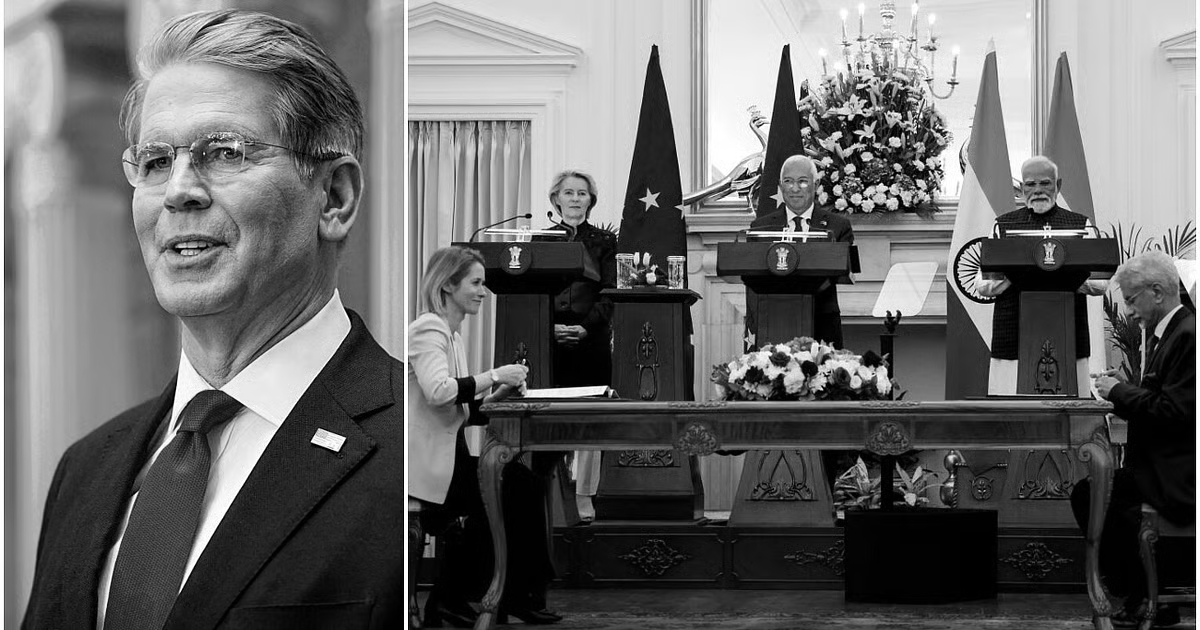
Very disappointed: US Treasury Secretary on India-EU trade deal
The landmark India–European Union Free Trade Agreement (FTA) has triggered debate far beyond tariff schedules, exposing deeper shifts in global economic power and alliance politics. While the deal is celebrated in New Delhi and Brussels as a transformative economic partnership, it has drawn pointed criticism from US Treasury Secretary Scott Bessent , who described Europe’s move as “very disappointing.” His reaction, however, reflects concerns that go well beyond immediate trade flows.
On the surface, the agreement does not threaten the United States in direct commercial terms. The US remains the EU’s largest export market by a wide margin, and EU–India trade is far smaller in comparison. The FTA is expected to expand EU–India commerce significantly, but experts do not see this as replacing EU–US trade . Instead, it adds another growth market for European firms. Yet Washington’s unease lies not in today’s trade numbers, but in what the agreement signals for the future balance of economic influence.
Bessent’s criticism is rooted primarily in geopolitics. From the US perspective, Western allies should maintain a united economic front in response to the Russia–Ukraine war . India continues to purchase discounted Russian crude, which is refined and sold as fuel on global markets. Bessent argued that Europe’s economic engagement with India, while India remains a major buyer of Russian oil, undercuts the spirit of Western sanctions pressure. In his framing, Europe’s trade outreach appears inconsistent with its strong political rhetoric supporting Ukraine.
Another factor is policy divergence . The United States imposed tariffs on India linked to Russian oil purchases, while the EU chose not to mirror that step and instead concluded a sweeping trade pact with New Delhi. This reflects a broader difference in approach: Washington has leaned on tariffs and market access as tools of strategic pressure, while Europe is pursuing diversification and deeper integration with emerging growth markets.
That divergence matters because of long-term leverage. If major economies like the EU build stronger trade networks with India and other rising markets, their dependence on access to the US market gradually declines. Over time, this could reduce the effectiveness of US tariff threats or economic pressure as diplomatic tools. In this sense, the concern in Washington is about future negotiating power , not immediate export losses.
The agreement also fits into a wider transition toward a multipolar trade system . Instead of global commerce revolving mainly around US-EU and US-China axes, new corridors are expanding EU-India, India-Middle East, and other regional partnerships. As these links deepen, economic influence becomes more distributed.
For India and the EU, the FTA represents strategic autonomy, market diversification, and long-term growth. For the US, it is a sign that allies are increasingly separating trade policy from Washington’s geopolitical pressure tactics. The debate, therefore, is less about tariffs and more about who shapes the next phase of the global economic order.