
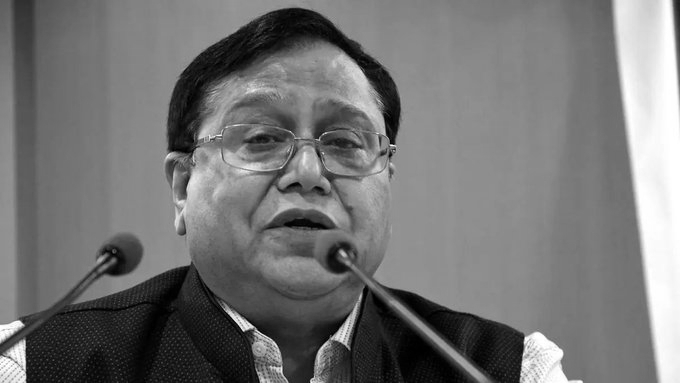
Venture capital backing for defence startups still inadequate: NITI Aayog’s Saraswat
NITI Aayog member and former DRDO director general V K Saraswat on Sunday said venture capitalists must significantly scale up financial support for Indian defence startups , noting that while government policies and budgetary backing are strong , private risk capital has not kept pace with the sector’s growth and long-term needs.
Speaking to PTI Videos on the sidelines of the ‘Advantage Vidarbha–2026 Business Conclave and Investment Summit’ , Saraswat said defence startups require patient funding due to high R&D costs and long gestation periods , areas where venture capital participation remains limited despite a rapidly improving innovation ecosystem.
Referring to India’s evolving defence partnerships, Saraswat said the country’s approach to deepening ties with the US while maintaining its long-standing relationship with Russia is guided by national security requirements rather than geopolitical choices. “It is not a question of choosing between A and B. It is about meeting our security needs and accessing the latest technologies required for future warfare,” he said.
On the 2026–27 Union Budget , which has earmarked a record Rs 7.85 lakh crore for defence , Saraswat said the enhanced allocation reflects a decisive shift towards large-scale indigenous production of weapons and equipment. Of the total outlay, Rs 2,19,306 crore has been set aside for capital expenditure , largely for the acquisition of new military hardware.
He said greater participation of private players and startups is key to reducing costs and improving efficiency in defence manufacturing by promoting indigenisation , introducing competition and adopting modern production practices. “Private sector involvement helps bring down costs, increase production rates and make defence products more competitive,” he said.
Saraswat added that the Budget allocations are aligned with lessons learnt from Operation Sindoor , particularly the need to prioritise technologies relevant to non-contact warfare . “The future of war is non-contact warfare, involving long-range missiles, stand-off weapons and advanced systems ,” he said.
Highlighting the role of defence R&D and innovation programmes run by the defence ministry, the Department of Science and Technology and the Department of Biotechnology , Saraswat said these initiatives have helped create a strong startup ecosystem . However, he stressed that startups must receive greater venture capital backing to scale up and commercialise advanced defence technologies.
“Indian defence startups have come a long way, supported by government policies, but venture capital support is still not adequate . They must be supported financially to sustain growth and strengthen the country’s defence manufacturing capabilities,” he said.