
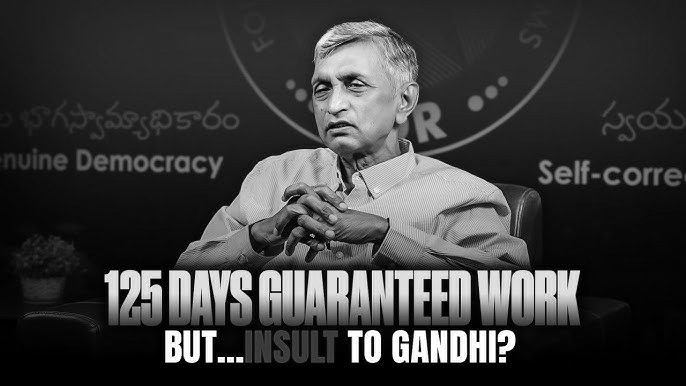
VB-G RAM-G Is a Course Correction, Not a Rollback of MGNREGA: JP
Dr. Jayaprakash Narayan (JP), founder of the Loksatta Party , has described the proposed Viksit Bharat Guarantee for Rozgar and Ajeevika Mission (Gramin) (VB-G RAM G) as a course correction rather than a rollback of MGNREGA, arguing that it restores the programme’s original intent while adapting it to present-day rural realities.
VB-G RAM G proposes 125 days of work annually for 50 million rural households , up from 100 earlier, introduces a 60:40 Centre–state funding split , mandates a 60-day pause during peak agricultural seasons , and shifts toward normative allocations focused on productivity-enhancing assets.
Recalling his role in the National Advisory Council during MGNREGA’s drafting, JP said the scheme was originally designed to support distressed, drought-prone regions during agricultural off-seasons , not to run year-round across fertile areas. He cited the Konaseema region of coastal Andhra Pradesh where three crops a year ensure near-full employment arguing that running employment works there merely creates labour shortages and inflates farm costs without helping genuinely distressed regions. Subsequent parliamentary changes expanded the scheme nationwide under political pressure, diluting this focus.
JP welcomed VB-G RAM G’s seasonal pause during peak farming , calling it essential to prevent agriculture from being starved of labour. He also highlighted the programme’s focus on water conservation, rural infrastructure, livelihoods, and climate resilience , particularly through linkages with the Drought Prone Areas Programme to build long-term productivity in rain-fed regions.
On funding, he termed the revised 60:40 cost-sharing formula a minor adjustment , noting that the Centre already transfers about 55 per cent of revenues to states . Southern states such as Tamil Nadu, Telangana, Andhra Pradesh, and Karnataka draw more funds largely due to better governance, digitised job cards, and faster execution , while weaker outcomes elsewhere reflect administrative shortcomings rather than design flaws.
JP stressed that MGNREGA has always been a demand-driven safety net , not a fixed-budget scheme. Allocations have expanded during crises such as after the 2008 financial shock when distress rose. However, with gradual modernization and rising rural consumption, reliance on manual wage work has reduced, making the programme less central than during its famine-relief origins.
He also noted that small and marginal farmers often face greater hardship than landless labourers , burdened by debt, unpaid family labour, and uncertain returns. Artificial wage escalation, he warned, can damage fragile farm economics. Employment guarantees, he said, are meant for distress relief , not as bargaining tools.
On the politics of renaming, JP argued that changing labels achieves little , and that Mahatma Gandhi’s legacy of peaceful progress and institutional reform remains untouched by such debates.
Since 2005, nearly ₹12–15 lakh crore has been spent under MGNREGA, with mixed outcomes. JP said success should be judged not by expenditure alone but by whether peak labour shortages are avoided and durable rural assets such as improved water tables are created .
He concluded that while VB-G RAM G corrects MGNREGA’s overreach by refocusing on productive, seasonal relief in genuinely distressed areas , its success will ultimately depend on governance quality. At the same time, he argued, urban poverty and unemployment require different solutions , centred on housing, small-town growth, skills, and infrastructure rather than employment guarantees.