
VB-G RAM G rural jobs Bill tabled in Lok Sabha amid opposition protest
The Viksit Bharat Guarantee for Rozgar and Ajeevika Mission (Gramin) (VB-G RAM G) Bill, 2025, which seeks to replace the Mahatma Gandhi National Rural Employment Guarantee Act (MGNREGA), was introduced in the Lok Sabha on Tuesday amid strong objections by opposition parties over the removal of Mahatma Gandhi’s name from the rural employment law.
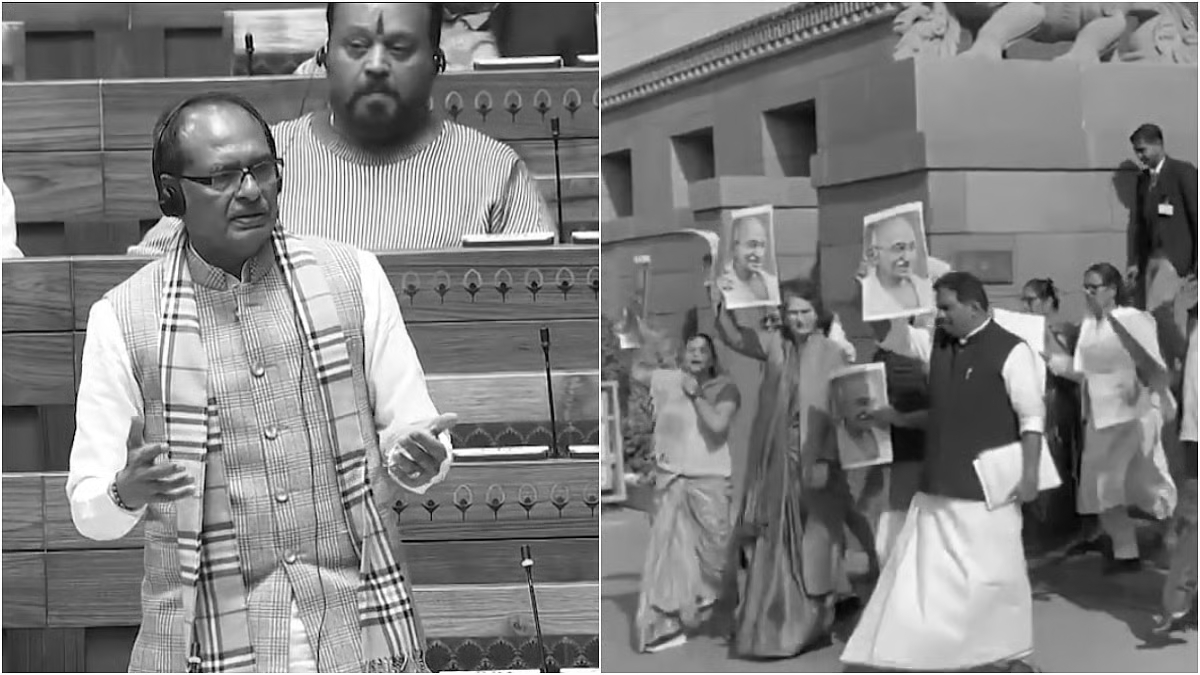
Introducing the Bill, Union Rural Development Minister Shivraj Singh Chouhan said the government not only believes in Mahatma Gandhi but also follows his principles. “The Narendra Modi government has done more for rural development than previous governments,” he said, countering opposition criticism.
Opposition parties, led by the Congress, strongly opposed the legislation at the introduction stage and demanded that it be referred to a parliamentary standing committee for detailed scrutiny. Congress MP Priyanka Gandhi Vadra and other opposition members objected to what they described as the symbolic erasure of the Father of the Nation’s legacy, entering the Well of the House holding photographs of Mahatma Gandhi.
Several opposition MPs also staged protests in the Parliament House complex soon after the Bill was tabled. Congress’ Priyanka Gandhi Vadra, Samajwadi Party chief Akhilesh Yadav, DMK’s T R Baalu and RSP’s N K Premchandran, among others, gathered near the Mahatma Gandhi statue and raised slogans accusing the BJP-led NDA government of “insulting” Mahatma Gandhi.
Holding placards and photographs of Mahatma Gandhi, the MPs marched from the Makar Dwar steps to the statue of the Father of the Nation at Prerna Sthal. Speaking to reporters, Priyanka Gandhi Vadra accused the government of attempting to weaken and eventually dismantle MGNREGA, which was enacted during the UPA regime, and criticised what she termed the government’s “obsession” with renaming welfare schemes.
The opposition maintained that MGNREGA embodied Mahatma Gandhi’s philosophy of dignity of labour, social justice and self-reliant villages, and that removing his name from a landmark welfare law was politically and ideologically motivated.
According to the Bill, the proposed law provides a statutory guarantee of 125 days of wage employment in a financial year to every rural household whose adult members volunteer to undertake unskilled manual work, an increase from the 100-day guarantee under MGNREGA. States will be required to frame schemes consistent with the provisions of the Act within six months of its commencement.
In a statement, the Rural Development Ministry said the legislation seeks to establish a modern statutory framework aligned with the goal of ‘Viksit Bharat 2047’ . The Bill aims to generate employment while creating durable rural infrastructure through four priority verticals water security through water-related works, core rural infrastructure, livelihood-linked infrastructure, and special works to mitigate the impact of extreme weather events.
All assets created under the scheme will be aggregated into the Viksit Bharat National Rural Infrastructure Stack , ensuring a unified and coordinated national development strategy, the ministry said.
Describing the Bill as a “major upgrade” over MGNREGA, the ministry said it addresses structural weaknesses while enhancing employment generation, transparency, planning and accountability. Opposition parties, however, maintained that replacing a flagship rural employment law with significant federal, financial and administrative implications warranted detailed examination by a parliamentary committee.