
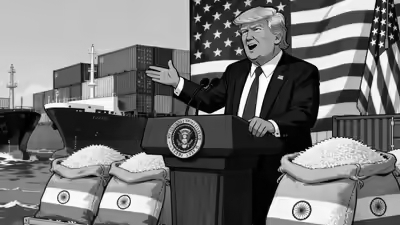
US urges India to halt Rice “Dumping” amid trade concerns
US President Donald Trump has urged India to stop “dumping” rice into the United States market, promising that the issue would be addressed swiftly through tariffs. The remarks came during a White House roundtable on Monday with representatives from the farming and agriculture sector, alongside key cabinet members, including Treasury Secretary Scott Bessent and Agriculture Secretary Brooke Rollins.
Meryl Kennedy, who manages Kennedy Rice Mill in Louisiana, told Trump that rice producers in the southern US were struggling due to imports from India, Thailand, and China (to Puerto Rico). She noted that existing tariffs were partially effective but required strengthening. Trump acknowledged the concerns and instructed Bessent to monitor the countries involved, promising quick action against what he described as unfair trade practices.
India is the world’s largest rice producer, cultivating around 150 million tonnes annually, and dominates global exports with a 30.3% share in 2024–2025, according to the Indian Rice Exporters Federation (IREF). India exported roughly 2.34 lakh tonnes of rice to the US in the 2024 fiscal year, less than 5% of its total Basmati rice exports of 52.4 lakh tonnes. West Asia remains the primary export market, while varieties like Sona Masoori are preferred in the US and Australia.
IREF National President Prem Garg described the 25% US tariff as a temporary hurdle and said India still retained a pricing advantage over competitors such as Vietnam and Pakistan. He added that with strategic planning and flexibility, Indian exporters could continue maintaining their presence in the US market.
While the roundtable focused on rice trade, Trump also announced a USD 12 billion federal aid package for US farmers, aimed at mitigating losses from tariffs, inflation, and trade disputes. Up to USD 11 billion will fund the Department of Agriculture’s Farmer Bridge Assistance program, offering one-time payments to row crop producers, including soybeans, sorghum, rice, corn, cotton, wheat, and potatoes.
The aid package is intended to provide farmers with financial stability as they sell their current harvests and plan for the next year. However, analysts and farming representatives have noted that government assistance does not address fundamental challenges such as rising costs and market uncertainties. Critics, including Senate Minority Leader Chuck Schumer and advocacy groups, have described the aid as a temporary fix rather than a solution to the broader issues created by trade disruptions and tariffs.
India’s rice exports to the US remain limited relative to its total output, and industry representatives stress that strategic adjustments could help maintain a competitive presence despite tariffs. As trade discussions continue, both countries face the challenge of balancing domestic agricultural interests with international market dynamics.