
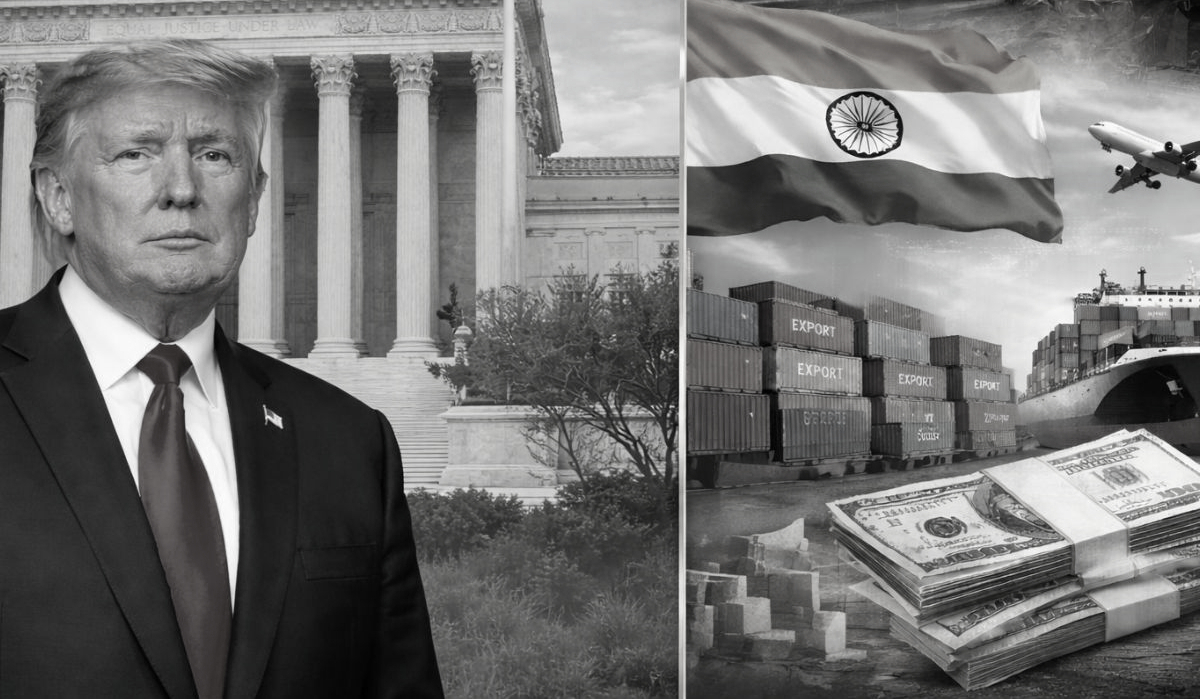
US tariff shift after court ruling: What it means for India
The recent US Supreme Court verdict striking down President Donald Trump ’s sweeping tariff regime has brought immediate relief to Indian exporters. With Washington announcing a temporary 10 per cent import surcharge , replacing the earlier 25 per cent reciprocal tariff , the cost burden on Indian goods entering the American market will fall sharply from February 24, 2026.
For Indian businesses, the most direct impact is improved price competitiveness . Earlier, many products were effectively facing steep combined duties when reciprocal tariffs were added to existing Most Favoured Nation (MFN) rates . Now, the additional burden will be capped at 10 per cent for 150 days. This narrowing of the duty gap could help exporters in key sectors regain some lost ground in the US market.
Reacting to the verdict, President Trump said “nothing changes” with regard to the ongoing India-US trade deal , signalling that negotiations between the two countries will continue despite the legal setback. His statement suggests that while the court has altered the tariff mechanism, the broader trade engagement remains on track.
Legally, however, the ruling sets clear boundaries. The administration can no longer rely on the struck-down framework to impose sweeping reciprocal duties. Unless and until Washington invokes an alternative legal route under US trade or national security laws, the current tariff structure, including the temporary 10 per cent surcharge, will prevail . This means that, for now, tariff rates are governed by what survives judicial scrutiny, not by executive announcement alone.
The verdict also alters the negotiating landscape for the proposed India-US trade agreement. India had earlier calibrated its tariff concessions based on indications that reciprocal tariffs would be reduced to 18 per cent. With the US now applying a uniform 10 per cent surcharge, experts believe New Delhi may reassess the balance of gains in the pending pact. The reduction strengthens India’s bargaining position, at least temporarily.
However, the relief comes with caution. The 10 per cent levy is valid only for 150 days, creating a window of opportunity rather than a permanent reset. Sector-specific tariffs , such as 50 per cent duties on steel, aluminium and copper, and 25 per cent on select auto components, remain unchanged, meaning certain export segments will continue to face pressure.