
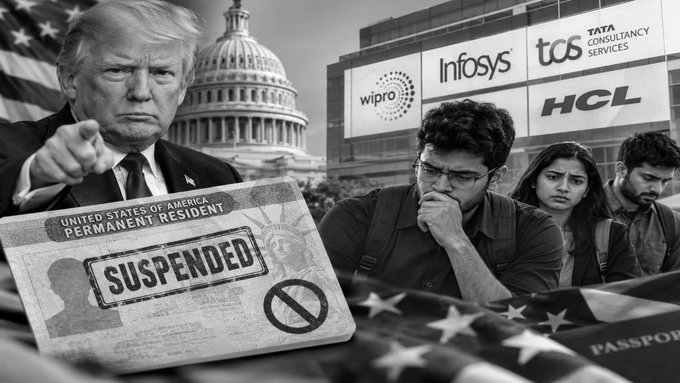
US Suspends Infosys, TCS, Wipro, HCLTech And Cognizant From Green Card Programme: What’s At Stake?
India on Friday strongly criticised the US decision to suspend green-card processing under the Permanent Labour Certification (PERM) programme for eight major technology companies, including Tata Consultancy Services (TCS), Infosys, Wipro, HCLTech and Cognizant. New Delhi said the move fails to advance the shared ambitions of the two countries and described US Vice President JD Vance’s reference to foreign professionals as “indentured servants” as “unwarranted and deeply offensive”.
The other companies facing the action are Microsoft, Adobe and Capgemini. US Labour Secretary Keith Sonderling said the administration would neither accept new nor process pending PERM applications involving these firms, arguing that the move was part of efforts to protect American workers from unfair competition.
Vance accused companies of bringing in foreign workers to replace American employees and undercut wages. India rejected this characterisation, saying Indian professionals are highly educated and contribute to the US economy through innovation, research, productivity and job creation. The Ministry of External Affairs (MEA) also pointed to the role generations of immigrants have played in building the American economy.
However, the immediate implications for Indian workers need to be understood carefully. PERM is a key step in the employment-based green-card process, not an H-1B visa programme. The MEA clarified that suspending PERM applications does not automatically invalidate existing H-1B visas or change the status of visa holders and their dependents. Eligible employees of the affected companies could nevertheless face delays or uncertainty in securing permanent residency.
The suspension comes amid wider US scrutiny of foreign-worker pathways, including investigations involving universities and proposals concerning participation in the Optional Practical Training programme. These developments could create further uncertainty for international students and skilled workers if additional restrictions are implemented.
The immediate business impact may be limited. Reuters has reported that Indian IT firms accounted for less than 2% of PERM applications during the October 2024-September 2025 period. TCS has said its applications over the preceding two years were in single digits and that it does not expect the suspension to affect its workforce strategy or client engagements. Microsoft has also disputed the suggestion that its visa filings primarily involve new foreign hires, saying most relate to extensions or changes of status for existing employees.
Still, the wider stakes are significant. India's IT industry generates hundreds of billions of dollars in annual revenue, with the US its largest overseas market. Prolonged restrictions could raise recruitment and compliance costs, complicate employee retention and affect project delivery or future export growth if the measures expand.
The implications also extend to India's foreign-exchange earnings. India received a record USD 135.4 billion in remittances in 2024-25, although these flows come from Indians working across countries and sectors, not only US technology professionals. Indian expatriates also contribute through deposits and investments. Any sustained employment or income disruption affecting Indian professionals in the US could weigh on some remittance flows, but the impact of this specific suspension is not yet quantifiable.
The move is not, by itself, a direct cause of rupee depreciation or inflation. The rupee has faced pressure from factors including a strong US dollar, foreign investor outflows and high crude oil prices. A weaker rupee can make imported oil and other goods more expensive, adding to inflationary pressure. Any effect from the green-card suspension would depend on whether it develops into a broader disruption to employment, investment and foreign-exchange inflows.
India said it would continue monitoring the issue, maintaining that skilled-worker mobility benefits both economies rather than one at the expense of the other.