
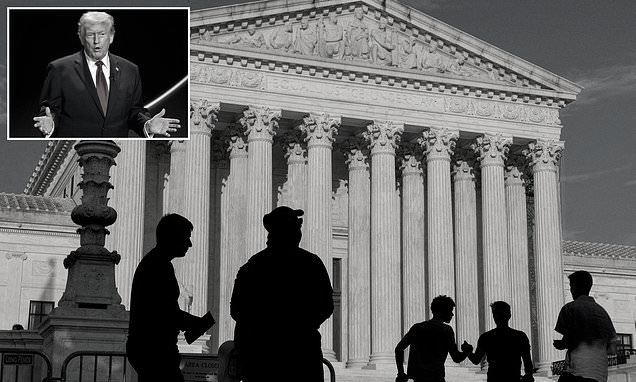
US Supreme Court to review Trump’s bid to end birthright citizenship
The United States Supreme Court has agreed to examine whether President Donald Trump’s attempt to end birthright citizenship.This case is among several of Trump’s executive actions currently under scrutiny by the Court, highlighting the ongoing legal challenges facing his administration and it is the most serious legal review of a policy he pushed throughout his presidency and continues to champion. As of now, there is no confirmed hearing date. The Court has accepted the case but has not released a schedule for oral arguments. Such an amendment demands approval from two-thirds of both chambers of Congress and ratification by three-fourths of state legislatures, making the proposal an extremely difficult political undertaking.
Several lower courts have blocked as unconstitutional Trump’s attempt to put restrictions on the law that states that anyone born on US soil is automatically an American citizen as the Republican administration continues its broad immigration crackdown.
Birthright citizenship comes from the Fourteenth Amendment’s Citizenship Clause, written in 1868 to ensure that the descendants of enslaved people were finally recognized as full citizens. It was intended as a permanent safeguard preventing future governments from denying citizenship based on race, ancestry, or parental status. Trump’s proposal aims to dismantle or reinterpret this protection by declaring that children born in the U.S. to non-citizen or non-permanent resident parents would no longer be citizens at birth. While Trump claimed he could do this through executive action, legal scholars argue that altering a constitutional guarantee requires a formal amendment.
Many critics have also highlighted Trump’s own family history as a contradiction to his position. His grandfather, Friedrich Trump, migrated from Germany to the United States at age sixteen, and his children became U.S. citizens solely because they were born on American soil. Opponents argue that Trump benefited directly from a constitutional right he now seeks to abolish for others, calling it a clear hypocrisy.
If birthright citizenship were restricted, the consequences would be severe for many immigrant communities, including the Indian-American diaspora. Of the estimated 5.4 million Indian-origin individuals in the U.S., nearly 1.6 million about 34% were born in America to Indian parents and currently hold citizenship automatically. Without birthright citizenship, these individuals would lose unquestioned proof of nationality, placing families in legal uncertainty and creating significant documentation burdens.
The case has reopened a national debate about identity, belonging, and the permanence of constitutional promises. The Supreme Court’s eventual ruling will determine whether the United States preserves the inclusive protections established after the Civil War or enters a new era of citizenship restrictions with far-reaching implications.