
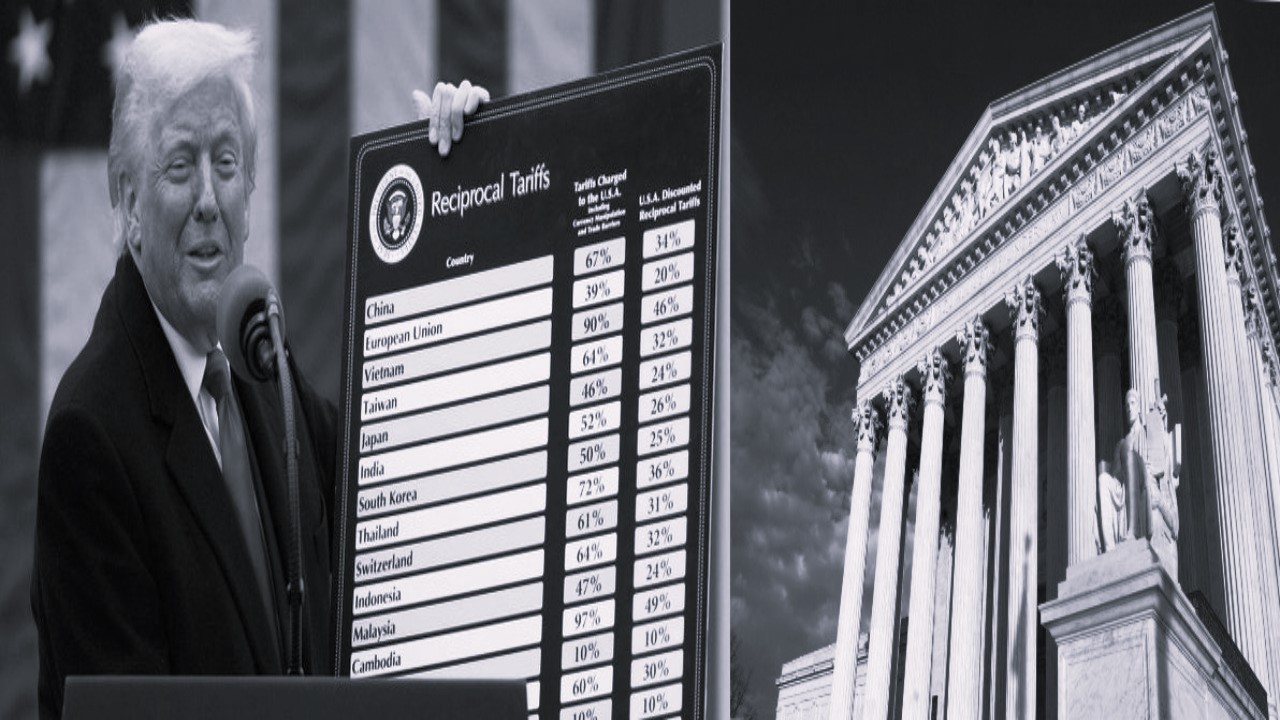
US Supreme Court Finds Its Spine. Strikes Down Trump’s Tariffs. Trump Disappointed but Defiant
In a rare display of institutional assertiveness, the US Supreme Court on Friday struck down sweeping import tariffs imposed by President Donald Trump , delivering a major constitutional rebuke to the executive branch and sharply redefining the limits of presidential authority over trade. In a 6–3 ruling , the court held that the power to levy tariffs and taxes rests exclusively with Congress , and cannot be exercised by the President through emergency economic laws.
The verdict followed expedited hearings , with the Supreme Court fast-tracking the case amid growing economic uncertainty and global market disruption. Legal analysts had widely expected a ruling by mid-December , given the scale of trade distortions and refund claims involved. However, the decision ultimately arrived nearly two months later , underscoring the complexity and sweeping implications of the case.
Writing for the majority, Chief Justice John Roberts ruled that the International Emergency Economic Powers Act (IEEPA) does not grant the President unchecked authority to impose tariffs. The law, the court noted, has historically been used for asset freezes and sanctions, not for redesigning global trade architecture through punitive duties. The judgment reaffirmed the constitutional separation of powers, stating that taxation authority cannot be assumed by the executive under the cover of economic emergencies.
The case stemmed from Trump’s 2025 declaration of a national emergency citing trade deficits and economic threats, followed by the imposition of so-called “reciprocal tariffs” on nearly all trading partners. Earlier tariffs on China , Canada , and Mexico had been justified on grounds ranging from drug trafficking to border security. Small businesses, industry groups, and several US states challenged the move, arguing it raised consumer prices, disrupted supply chains, and exceeded presidential authority.
Economically, the tariffs yielded over $130 billion in revenue but imposed a significant burden on American consumers and businesses. Estimates suggest US households faced sharply higher costs due to tariff-driven inflation. One of the biggest unresolved grey areas is whether tariffs already collected must now be refunded . The court offered no guidance on this issue, prompting Justice Brett Kavanaugh to warn that refund litigation could spiral into administrative confusion and prolonged legal battles.
Another key ambiguity surrounds targeted punitive tariffs. There is no explicit clarity on whether duties imposed on India for purchasing Russian oil , or on Mexico for supplying fuel to sanctions-hit Cuba , would automatically be deemed null and void. Legal experts say these measures could face fresh challenges but may not lapse automatically unless withdrawn by the administration or struck down in separate cases.
Trump responded with visible anger and defiance in a press conference following the ruling. Calling the verdict “deeply disappointing,” he accused the court of weakening America’s economic leverage and undermining domestic industry. While expressing frustration — including with some justices he had appointed Trump made clear that his trade agenda was far from finished.
Striking a defiant tone, Trump vowed to pursue alternative legal routes to impose tariffs, hinting at fresh trade investigations and duties under different statutes. He praised the three dissenting justices for standing by what he described as “economic realism,” insisting that the US would continue to defend its workers and industries.
The ruling marks Trump’s first major judicial setback on economic policy after a series of favourable judgments on administrative and social issues. More broadly, it signals a judicial reassertion of constitutional boundaries at a time when executive control over trade has steadily expanded.
Markets and global trading partners are now watching closely. With refund claims unresolved, punitive tariffs in legal limbo, and trade negotiations clouded by uncertainty, the decision reshapes US trade policy even as it restores constitutional clarity at the heart of American governance.