
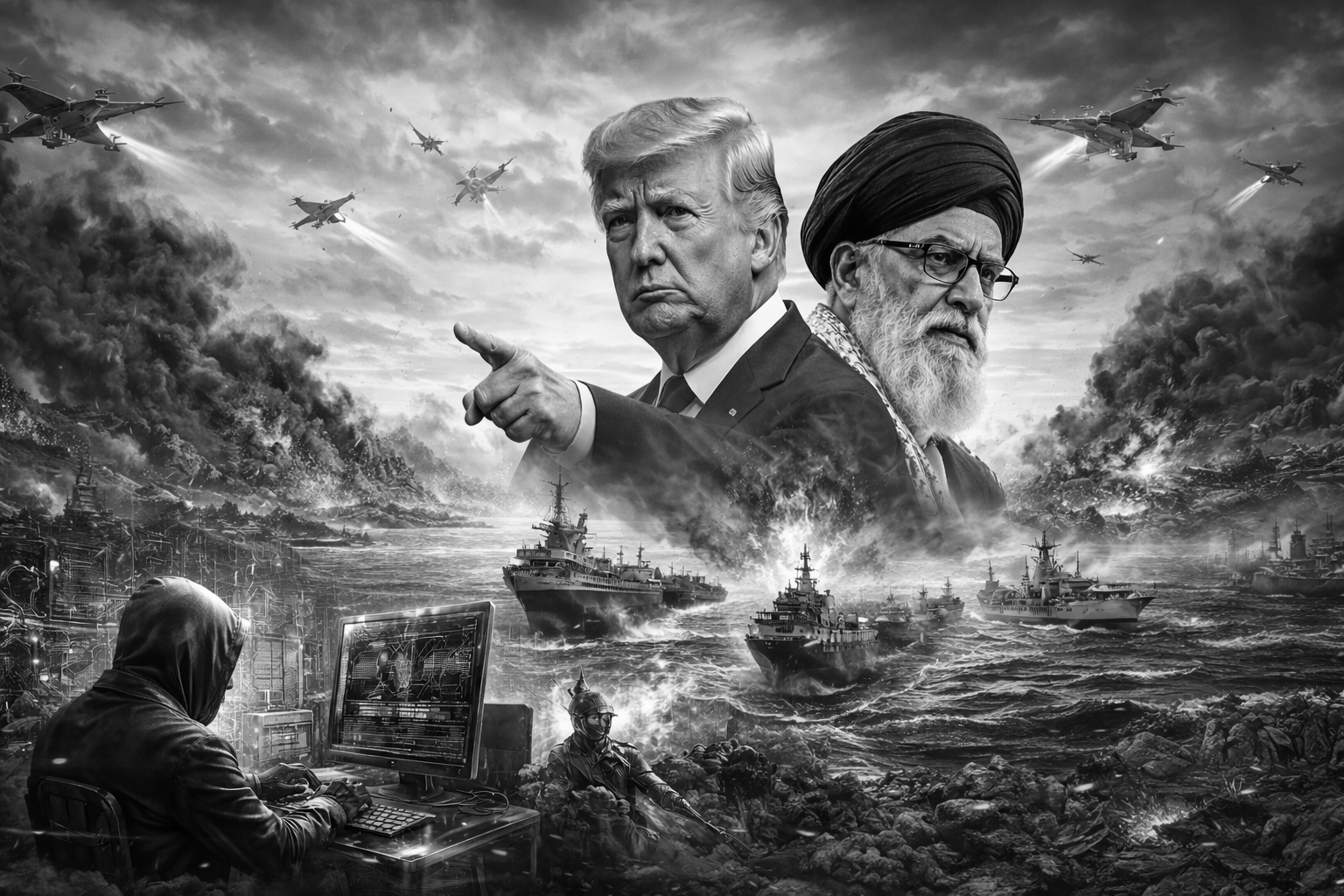
US Struggles to Manage Expanding Iran War as Conflict Spills Beyond Military Fronts
Nearly two weeks after hostilities erupted in West Asia, the United States finds itself trapped in a conflict that has proven far more complex than initially anticipated. What began as a swift joint offensive by the United States and Israel against Iran has evolved into a prolonged confrontation with global economic, military, and cyber dimensions.
The conflict escalated sharply on February 28 when US and Israeli forces launched coordinated strikes on Iranian targets. In the opening phase of the offensive, Washington and Tel Aviv declared a major strategic success after Iran’s Supreme Leader Ayatollah Ali Khamenei and several key figures in his circle were reportedly killed. The development created an early perception that Iran’s leadership structure had been severely weakened.
However, the war quickly entered a new phase. The responsibility for directing the conflict shifted to the Islamic Revolutionary Guard Corps (IRGC) , one of the most powerful pillars of Iran’s military establishment. Designed to function independently during national crises, the IRGC rapidly reorganized Iran’s response and launched a series of retaliatory attacks.
Missile and drone strikes were directed at American military bases across the Gulf region as well as Israeli targets. Although several of these projectiles were intercepted by advanced defense systems, Iran has maintained a steady stream of attacks, demonstrating its ability to sustain the conflict despite leadership losses.
Meanwhile, the United States and Israel intensified targeted strikes in Iran and Lebanon. Civilian infrastructure, including hospitals and schools, has reportedly been affected in several attacks, highlighting the growing humanitarian cost and drawing international concern.
Pressure Builds on Washington
As the conflict enters its second week without a decisive outcome, political pressure within the United States is mounting. Critics argue that President Donald Trump entered the conflict prematurely without a clear long-term strategy.
The situation worsened after Iran moved to close the Strait of Hormuz , a narrow but critical waterway through which a large portion of the world’s oil supply passes. The disruption sent shockwaves through global energy markets. Oil prices surged, stock markets plunged, and concerns about energy shortages began spreading across several regions.
Gulf countries have witnessed rising tensions, airports have reported operational disruptions, and fears of supply shortages have triggered panic in some markets. With global oil reserves tightening, many governments are urging Washington to de-escalate the conflict quickly.
Despite the pressure, Trump has continued to issue strong warnings, threatening massive retaliation if Iran keeps the Strait of Hormuz closed. Yet these statements have done little to stabilize the situation on the ground.
Another challenge facing the United States is the economic cost of the war itself. Iran’s use of relatively inexpensive Shahed drones has created a strategic imbalance. While the drones cost around $20,000 each, intercepting them often requires sophisticated missile systems costing hundreds of thousands of dollars. The growing financial burden of these defensive operations is placing additional strain on American military resources.
At the diplomatic level, Washington has begun exploring possible exit strategies. Discussions are reportedly underway with several international leaders, including Russian President Vladimir Putin , in an effort to find a pathway toward ending the conflict without undermining US global standing.
Iran’s Conditions for Peace
Despite insisting that it did not seek war, Iran now appears to hold significant leverage in shaping how the conflict may end. Tehran has outlined three key conditions for any ceasefire agreement.
The Iranian government is demanding recognition of its legal rights , payment of war reparations , and international guarantees that future attacks against the country will not occur.
However, these demands are being viewed with caution in diplomatic circles. The collapse of the earlier nuclear agreement, the Joint Comprehensive Plan of Action (JCPOA) , continues to raise doubts about the durability of any future international guarantees.
Cyber Warfare Enters the Battlefield
Even as military operations continue, the conflict is expanding into new domains. What initially appeared to be a conventional war involving airstrikes, naval routes, and energy infrastructure is now evolving into a multi-layered confrontation involving cyber warfare and global supply chains.
One of the most alarming developments has been a major cyberattack targeting the American medical technology company Stryker Corporation , which produces surgical equipment used in hospitals worldwide.
The attack was claimed by a hacker group known as Handala , which is believed by cybersecurity analysts to have possible links to Iranian intelligence networks. The cyberattack disrupted digital systems and created network disturbances affecting operations across multiple regions.
Researchers from cybersecurity organizations, including Unit 42 , note that the attackers used a destructive wiper malware a form of malicious software designed not to extort money but to permanently destroy data.
Unlike ransomware attacks that demand payment, this method suggests a strategic objective aimed at disruption and retaliation. The incident has raised serious concerns about the vulnerability of healthcare infrastructure during geopolitical conflicts.
If hospital systems, medical devices, and patient data networks become targets of cyber warfare, the consequences could extend far beyond national borders, potentially disrupting healthcare services globally.
A Conflict Expanding Across Sectors
The unfolding crisis highlights a broader transformation in the nature of modern warfare. Military confrontations today rarely remain confined to traditional battlefields. Instead, they spill over into global trade routes, financial markets, digital networks, and even civilian infrastructure.
In such a scenario, success cannot be measured solely by battlefield victories. Diplomatic engagement, cybersecurity cooperation, and protection of critical supply chains have become equally essential components of conflict management.
Although President Trump initially declared victory shortly after the strikes began, developments since then suggest a far more uncertain reality. Attacks on oil tankers, escalating tensions around the Strait of Hormuz, and continuing military operations across the Gulf region indicate that the war remains far from resolution.
The ripple effects are already being felt worldwide. Several countries are facing early signs of an energy supply crunch. In India , shortages of LPG and LNG are beginning to affect restaurants, hotels, and small businesses dependent on gas supplies. Millions of livelihoods linked to these sectors could face disruption if the crisis persists.
With tensions still high and negotiations uncertain, the world now waits anxiously for diplomatic efforts to bring the conflict to an end before it evolves into a prolonged global crisis.