
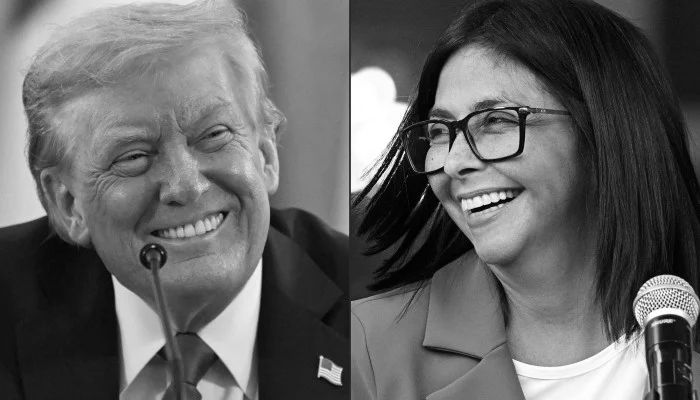
U.S. lifts sanctions on Delcy Rodríguez as 90‑day interim term ends today
In a move that marks a dramatic reversal in U.S. policy toward Caracas, the United States on Wednesday lifted sanctions on Venezuela’s acting President Delcy Rodríguez , removing her from the Treasury Department’s Specially Designated Nationals (SDN) list and signalling a major shift in Washington’s approach to Venezuela’s political and economic crisis. The change was announced through an update on the Office of Foreign Assets Control (OFAC) section of the Treasury’s website after months of renewed engagement following the U.S. capture of former President Nicolás Maduro in early January.
Rodríguez, once a key figure in Maduro’s inner circle and previously sanctioned for allegedly helping consolidate authoritarian rule in Venezuela, welcomed the decision as a step toward “normalizing and strengthening bilateral relations.” She expressed hope that the move would lead to the lifting of broader sanctions against Venezuela, enabling deeper economic cooperation and investment, and has positioned the change as part of a wider plan to rebuild ties with Washington.
The sanctions relief allows Rodríguez to access previously blocked assets, conduct transactions with U.S. entities and potentially travel to the United States, significant shifts for a leader once treated as an adversary. The Trump administration also recognized Rodríguez as Venezuela’s “sole Head of State” in legal and diplomatic settings in March and has permitted Venezuelan state oil company Petróleos de Venezuela S.A. (PDVSA) to sell oil directly to U.S. companies and on global markets. These economic changes aim to attract foreign investment into Venezuela’s oil and mineral sectors.
Washington’s strategy has drawn sharp criticism from analysts, regional observers, and democratic advocates who argue the decision raises profound questions about democratic legitimacy and geopolitical priorities. Maduro remains legally Venezuela’s president under a ruling by the country’s Supreme Court, which declared his absence “temporary ” and authorized Rodríguez’s interim role for 90 days, a period that ends this Friday , with the possibility of extension by the National Assembly, still controlled by Maduro’s party. Any future elections or extensions will likely depend heavily on U.S. policy under Trump’s administration , whose recognition and economic support of Rodríguez now play a decisive role in shaping Venezuela’s immediate political landscape.
Critics point to this as emblematic of a broader contradiction: Rodríguez and her brother Jorge were sanctioned by the U.S. in 2018 for allegedly helping Maduro maintain authoritarian power, yet the current administration is now legitimizing her leadership while sidelining the Venezuelan democratic opposition , which previously had U.S. support. This shift, they argue, suggests that commercial and geopolitical interests, particularly in oil and energy, are outweighing any principled commitment to democratic transition .
Critics say the U.S. capture of Nicolás Maduro lacked clear legal basis and sidelined Venezuela’s opposition, raising concerns that normalization efforts may entrench elite power through political deals rather than democratic elections.