
UPSC's Face Authentication Rollout Marks A Major Shift In Exam Security
The Union Public Service Commission (UPSC) has taken a significant step towards strengthening the integrity of India's most prestigious recruitment examinations by successfully implementing real-time face authentication during the Civil Services and Indian Forest Service (Preliminary) Examinations 2026.
The initiative, announced by the UPSC, is aimed at tackling one of the most persistent challenges faced by examination authorities across the country: impersonation, where an individual appears for an examination on behalf of a registered candidate. The technology was deployed across 2,072 examination venues nationwide and covered nearly 5.5 lakh candidates who appeared for the highly competitive examinations.
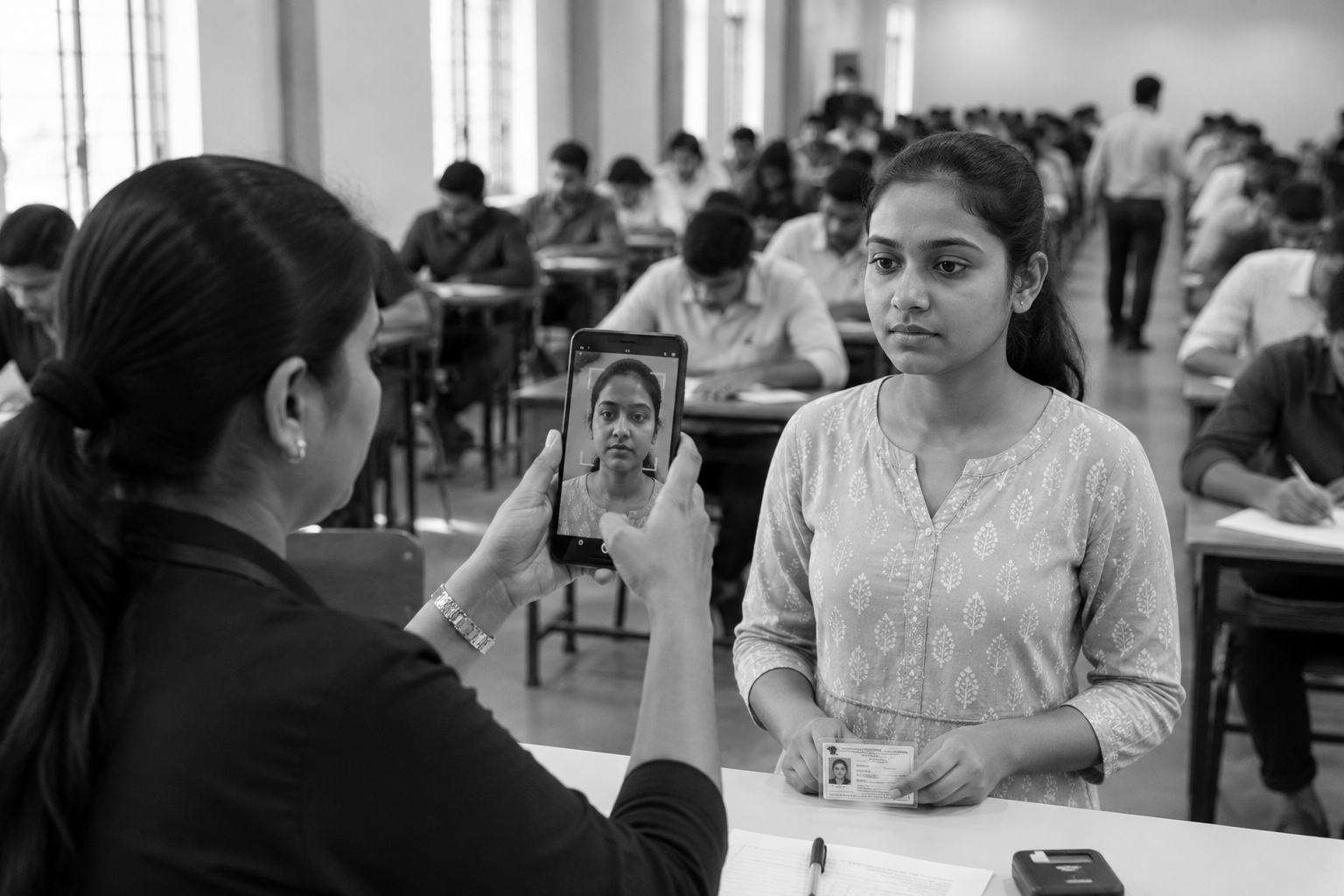
According to the Commission, the face-authentication protocol ensures that the person entering the examination hall is the same individual whose photograph was uploaded while submitting the application form. Invigilators carried out live verification using a mobile-phone-based application that authenticated candidates in real time before allowing them entry into examination centres.
The system was developed by UPSC with technical support from the National e-Governance Division (NeGD) under the Ministry of Electronics and Information Technology. A notable feature of the solution is that it does not require specialised biometric equipment. Instead, invigilators used ordinary Android smartphones, reducing costs and easing deployment across thousands of venues.
The authentication process reportedly took only six to eight seconds per candidate , allowing smooth entry without creating long queues. During peak periods, the platform processed around 12,000 authentications per minute , while more than 7,000 invigilators used the application simultaneously.
UPSC Chairman Dr. Ajay Kumar described the initiative as an important step towards ensuring impersonation-free examinations. He highlighted that while developing the technology was a challenge, deploying it at a national scale, training invigilators and integrating the process into existing examination arrangements within a short time frame were equally demanding tasks.
The move reflects growing concerns among examination authorities about organised cheating, fraudulent identities and proxy candidates. Competitive examinations in India attract millions of applicants each year and often determine access to government jobs, making them vulnerable to attempts at manipulation.
Traditionally, verification has relied on admit cards, photographs and government-issued identity documents. However, manual verification can be time-consuming and susceptible to human error, especially when large numbers of candidates arrive simultaneously at examination centres.
Face authentication provides an additional layer of security by matching a candidate's live image against the photograph submitted during registration. By automating identity checks, the Commission hopes to reduce opportunities for fraud while ensuring greater confidence in the recruitment process.
The UPSC initiative also reflects a broader shift towards the use of digital technologies in examinations and recruitment . Across India and globally, testing agencies have increasingly adopted biometric attendance systems, facial recognition tools, CCTV surveillance and artificial intelligence-based monitoring to strengthen examination security.
Experts believe that as examinations become larger and more complex, technology-driven verification systems are becoming an important component of anti-fraud strategies. Face authentication can make impersonation significantly more difficult by requiring candidates to prove their identity at the point of entry.
The successful deployment of the system by UPSC may encourage other agencies, including recruitment boards, state public service commissions and entrance examination authorities, to explore similar technologies in the future.
Security experts generally view biometric and face-authentication systems as powerful tools for preventing impersonation. Unlike traditional document checks, facial verification directly compares an individual's live image with pre-existing records, making it harder for proxy candidates to gain access to examination halls.
The technology also offers advantages in terms of speed, scalability and consistency . Large-scale examinations involving lakhs of candidates can be processed more efficiently while maintaining uniform verification standards across centres.
However, experts caution that biometric systems should not be viewed as foolproof solutions. Factors such as poor lighting, camera quality, ageing, changes in appearance, facial hair, spectacles or technical glitches can sometimes affect authentication accuracy.
The introduction of facial recognition technologies in public examinations is also likely to raise questions regarding privacy and data protection .
Facial images are considered sensitive personal information, and experts emphasise the need for robust safeguards governing how such data is collected, stored, accessed and eventually deleted. Transparency regarding data retention policies and cybersecurity measures will be important in maintaining public trust.
Authorities implementing biometric systems must ensure that candidates understand how their information is being used and that adequate protections are in place against unauthorised access or misuse.
While face authentication can significantly reduce impersonation risks, specialists argue that examination security works best through a multi-layered approach . Such a framework combines digital verification with traditional safeguards including identity document checks, trained invigilators, CCTV monitoring and post-examination audits.
Human oversight remains essential, particularly in cases where authentication systems encounter difficulties or require manual review. Experts note that technology should complement, rather than replace, established examination procedures.
For UPSC, the successful implementation of face authentication represents more than a technological upgrade. It signals a broader effort to modernise examination administration while preserving fairness, transparency and credibility in one of India's most competitive selection processes.
As recruitment agencies increasingly turn to digital solutions to combat fraud, the UPSC initiative may serve as a model for future examination reforms. Whether adopted more widely or refined further, it highlights how technology is becoming an integral part of safeguarding the integrity of public examinations in an era of growing scale and complexity.