
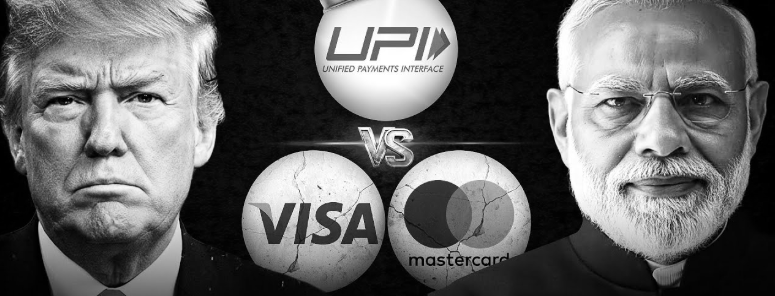
UPI Charge Row: Is India Under Pressure From Trump And US Payment Giants Visa, Mastercard?
The government says UPI will remain free for ordinary users. But the decision to create a legal route for charging some merchants has raised a wider political question: is India changing policies under pressure from the United States and President Donald Trump?
The question has gained attention because the UPI decision comes at a time when India and the US are negotiating a trade deal involving market access, digital trade, agriculture and energy.
The Lok Sabha recently passed a Bill to amend the Payment and Settlement Systems Act, 2007. The amendment creates an enabling framework under which banks and payment service providers could charge for UPI and other notified electronic payments.
The government has stressed that this does not mean users will suddenly have to pay. Person-to-person UPI payments will remain free, while the vast majority of merchant transactions will also remain free. If a Merchant Discount Rate is introduced, it would apply only to selected merchant transactions above a specified threshold and would be nominal.
But critics are asking why India needs to change a system that has become one of its biggest digital success stories.
The government's answer is that UPI needs a sustainable revenue model. Transaction volumes have exploded, increasing the need for spending on cybersecurity, fraud prevention and payment infrastructure. It also says dependence on government subsidies cannot continue forever.
UPI processed 2,366 crore transactions worth Rs 29.9 lakh crore in July 2026 alone. The system has also expanded to 11 foreign countries.
Yet there is another side to the debate.
UPI's zero-MDR model gives it a major advantage over traditional card networks such as Visa and Mastercard, where merchants generally pay transaction fees. Critics fear that introducing MDR on UPI could reduce that advantage and make the Indian payment ecosystem more favourable to established global payment companies.
This is why the issue has become linked to the larger India-US trade negotiations.
The US has repeatedly pushed for greater market access and fewer barriers for American businesses. In February, the White House said India and the US would work towards digital trade rules and address discriminatory or burdensome practices affecting digital trade. The same framework also included India's intention to purchase $500 billion of US energy products, aircraft, technology and other goods over five years.
The UPI debate therefore comes at a sensitive moment.
And then there is ethanol.
The US is the world's biggest ethanol producer, while India has rapidly expanded its own ethanol blending programme. Critics have alleged that Washington has been pushing India to open its market to American ethanol as part of trade negotiations.
Critics have raised concerns about what could happen if cheaper American ethanol enters the Indian market. There are fears that US suppliers could initially offer competitive prices to gain market share and later have greater influence over prices. These are concerns being raised in the political debate, not an established government plan.
There is also a separate question over how imported ethanol would interact with India's domestic supply. The government has said imported ethanol is not being used for E20 blending. Critics, however, have questioned whether domestic ethanol could be directed towards the blending programme while imported ethanol is used for other industrial purposes, indirectly changing the overall demand balance.
The UPI case is particularly sensitive because the payment system is not just another commercial service. It is a home-grown public digital infrastructure that transformed how Indians pay for everything from groceries to street food.
For years, the government presented UPI's zero-cost model as a national achievement.
Now it says some merchant charges may eventually be necessary to keep the system financially sustainable.
From UPI and digital trade to ethanol, data centres and other areas being discussed in India-US negotiations, critics see a pattern of decisions that could benefit American companies.
The government rejects the suggestion that external pressure is driving these policies. It says India's decisions are based on national interest, economic growth, energy security and the need to make its systems sustainable.
So the real question is not simply whether UPI will remain free.
It is whether India can negotiate with the United States without compromising the advantages it created for itself.