
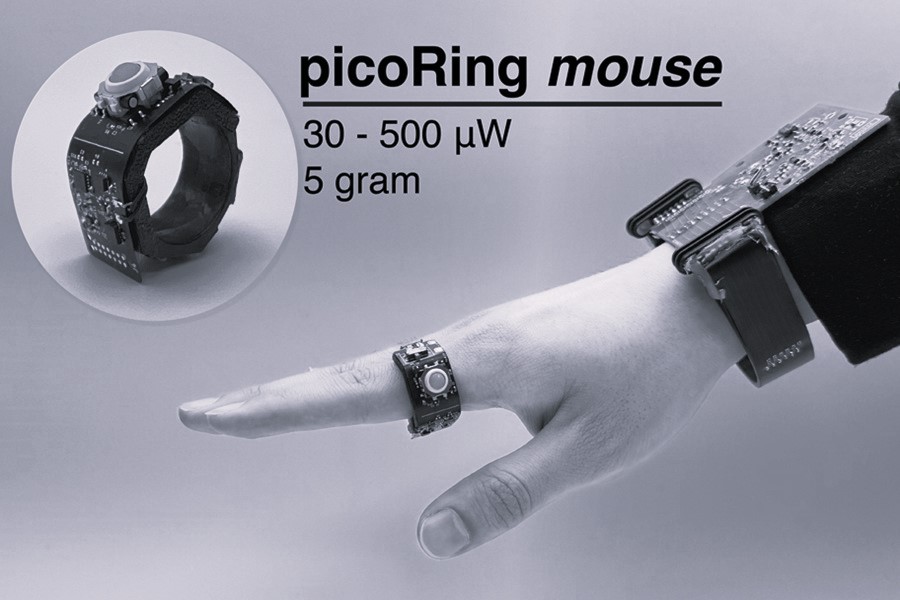
University of Tokyo’s Picoring redefines wearable controls
As wearable devices like augmented reality (AR) glasses steadily enter mainstream use, the demand for more intuitive, portable, and power-efficient input methods continues to rise. Addressing this challenge, researchers from the University of Tokyo have developed picoRing, an ultralow-power, ring-based wireless mouse that promises a new era of seamless device control.
The innovation, presented at the 38th Annual ACM Symposium on User Interface Software and Technology, represents a significant leap in wearable technology. Weighing only 5 grams, picoRing delivers an impressive one-month usage period on a single charge, a stark contrast to existing smart rings that struggle with limited battery life due to high power demands. “We created picoRing, an ultralow-power, tiny mouse that controls AR glasses for over a month on a single charge,” explained Project Assistant Professor Ryo Takahashi from the University’s Department of Electrical Engineering and Information Systems. “Previous smart rings faced short lifespans because their small batteries couldn’t support communication components for long durations.”
Innovative Communication Through Semi-Passive Inductive Telemetry traditional communication methods like Bluetooth and NFC proved inadequate. Bluetooth consumes too much energy, while NFC works only at extremely short distances. To overcome these constraints, Takahashi’s team pioneered a semi-passive inductive telemetry (semi-PIT) communication system.
Semi-PIT leverages a coil of wire embedded with distributed capacitors that amplify magnetic communication fields. This innovation enables signal transmission with only 30–500 microwatts of power consumption, hundreds of times less than conventional wireless systems. To further enhance efficiency, the researchers added a watch-like wristband relay, serving as a bridge between the ring and AR glasses, thereby offloading much of the communication power requirement.
Compact Design, Expansive Possibilities :
Although currently a prototype, picoRing demonstrates enormous potential. Its discreet and compact design allows for subtle, intuitive control ideal for AR and VR environments, where conventional mice are impractical. The system currently supports simple actions like scrolling and clicking, with future versions expected to integrate more complex gestures and health-monitoring functions. “Our technology could be adapted for health monitoring since the ring’s skin contact makes it ideal for measuring metrics like heart rate or stress,” added Takahashi. “Combining such capabilities with interaction control could lead to multifunctional wearables.”
Challenges and the Road Ahead :
Despite its promise, the picoRing still faces hurdles. The prototype remains somewhat bulky, and performance can suffer from wireless interference. The required wristband relay, while functional, may also limit user convenience until further miniaturization or electronic textile integration becomes viable.
Nevertheless, experts suggest picoRing marks a pivotal step in ultra-low-power wearable innovation. By enabling extended use without frequent charging, it could redefine user interaction with AR systems, wearables, and possibly future health-tech devices.
For now, the picoRing remains best suited for AR/VR applications environments that demand lightweight, mobile, and intuitive input. However, as Takahashi’s team continues refinement, the device could soon emerge as a new standard in wearable interface technology.