
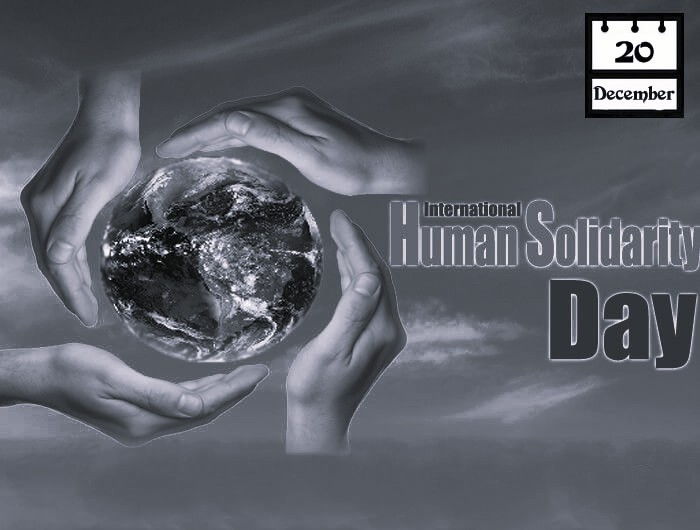
Unity in Diversity - International Human Solidarity Day
Today’s world is grappling with the fears of war, the devastation of natural disasters, and widening economic inequalities. A war fought on a distant border brings tears to the eyes of an innocent child elsewhere. When one nation is ravaged by the fury of nature, the pain resonates across the globe. In such critical times, what we need is not more weapons or power, but the human quality of responding to another’s suffering.
Solidarity means believing that "Your hardship is mine, and my future is tied to yours." This spirit alone acts as a balm for our wounded world. Rather than being fractured in isolation, we can only overcome these dark days by standing together.
While modern technology has allowed us to step onto the moon, we remain lagging in our efforts to alleviate the hunger and pain of our fellow human beings. The lines we have drawn of nations, castes, and religions distance us from one another. Yet, hunger has no language, and tears have no color. That small stir of emotion we feel when hearing the cry of the poorest of the poor is what keeps us human. The next generation does not expect wealth from us; they seek the selfless love and solidarity we show one another. No matter how deep the global crisis, if one hand holds another and says, "I am here," we can make the impossible possible.
In today's interconnected world, the United Nations observes International Human Solidarity Day every year on December 20 to tackle common challenges. It serves as a reminder that regardless of our diversity, our progress and survival depend on our mutual support.
This is not merely a celebration. It is a day that calls upon governments, civil society, and individuals to work with collective responsibility for poverty eradication and social justice.
How did this day begin?
The history of this day dates back to the turn of the millennium. As part of the Millennium Declaration (2000), world leaders identified 'Solidarity' as one of the fundamental values essential to international relations in the 21st century.
On February 3, 2003, the UN General Assembly, through resolution 57/265, established the World Solidarity Fund. Its primary goal is to eradicate poverty in developing countries. Subsequently, on December 22, 2005, via resolution 60/209, the UN officially declared December 20 as International Human Solidarity Day.
What does solidarity mean in the 21st century?
According to the United Nations, solidarity is not just about donations or pity toward poor nations; it is a structural necessity. It involves nations being aware of common interests and demonstrating unity as a global community. True solidarity is realizing that if one country is affected by climate change, disease, or economic instability, it will eventually impact the entire world.
Key Objectives of the Day
The UN focuses on four main pillars through this observance:
Celebrating Unity in Diversity:
While respecting diverse cultures and traditions, this day emphasizes that we are one through humanity. It upholds the concept of 'Vasudhaiva Kutumbakam' (The World is One Family). Diversity should not be a wall between societies but a strength for mutual learning.
Reminding Nations of International Agreements:
This day acts as a reminder for countries to honor the agreements they signed regarding human rights, climate change, and poverty. When governments fulfill their promises, trust in international relations grows.
Public Awareness:
It is vital to explain to the public how essential solidarity is for achieving Sustainable Development Goals. An aware society questions injustice, welcomes change, and fights crises with unity.
Promoting New Initiatives:
This day serves as a platform for new ideas to eradicate poverty, hunger, and unemployment. It encourages governments and young innovators to find modern solutions, such as using digital technology for education or creating new funds for impoverished nations.
Importance in the Current Global Crisis
In an era of pandemics, climate change, and wars, solidarity is more critical than ever.
Climate Crisis:
Pollution from wealthy nations causes island nations to submerge. To save the planet, countries must set aside differences. Rich nations must provide technical and financial aid to poorer ones to fight this "common enemy."
Wars and Humanity:
Modern wars damage the very foundations of humanity. Countries are working together to establish 'Humanitarian Corridors' to provide food and medicine to victims. The voice of peace must ring louder than the sound of weapons.
Growing Inequalities:
Though globalization has increased wealth, it is not distributed equally. The principle of "those who benefit more must help those in hardship" is the solution. For 'Climate Justice' to prevail, global solidarity is a prerequisite.
What can we do?
This day is not just for leaders; every citizen has a responsibility.
• Educate yourself about the problems faced by people in different countries.
• Hold your representatives accountable for social welfare and the environment.
• Support local NGOs or international relief funds.
As we move toward 2026 and beyond, the message of International Human Solidarity Day remains: "We are stronger together." In an age of increasing divisions, choosing solidarity is the only hopeful path forward. It is the foundation for eradicating poverty, protecting the Earth, and ensuring every human lives with dignity.