
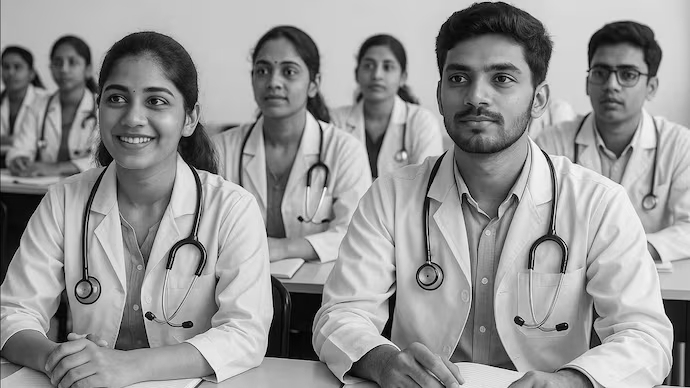
Union Cabinet Clears 10,000 New Medical Seats in push for Healthcare Reform
In a landmark decision aimed at bridging India’s healthcare gap, the Union Cabinet chaired by Prime Minister Narendra Modi has approved the creation of 10,023 new undergraduate and postgraduate medical seats across government colleges and hospitals. The scheme, sanctioned on September 24, 2025, involves an investment of Rs. 15,034 crore over the next four years.
The move forms part of the government’s vision to add 75,000 medical seats by 2030, strengthening India’s position as a global hub for affordable healthcare and expanding access to underserved rural and tribal communities.
Cabinet’s green signal
Of the new seats, 5,000 will be postgraduate and 5,023 undergraduate (MBBS). The expansion will be funded primarily by the Centre (Rs. 10,303 crore; 68.5% share) with states contributing Rs. 4,731 crore. On average, the cost per seat is pegged at Rs. 1.5 crore.
Prime Minister Modi hailed the decision, posting on X: “Approval of Phase-III of the Centrally Sponsored Scheme will add significant PG and UG medical seats. This will improve our healthcare system and ensure skilled doctors in every part of India.”
Why the expansion matters
India’s population of 1.4 billion continues to face an acute shortage of doctors, particularly in remote villages and tribal belts. Despite rapid growth in medical infrastructure, demand still outpaces supply. The government hopes this expansion will:
• Provide more opportunities for aspiring medical students.
• Improve doctor-patient ratios in rural and underserved areas.
• Strengthen healthcare resilience against emerging public health challenges.
• Generate direct and indirect jobs across teaching, paramedical, research, and administration.
Medical education in transition
India today boasts 808 medical colleges, the highest in the world with 1.23 lakh MBBS seats. Over the last decade, 69,352 MBBS seats were added (127% growth), while postgraduate seats rose by 43,041 (143%).
The government has also approved 22 new AIIMS under the Pradhan Mantri Swasthya Suraksha Yojana, cementing its focus on affordable tertiary healthcare. To overcome the faculty bottleneck, the National Medical Commission (NMC) recently issued new regulations (July 2025), broadening eligibility norms for teaching staff.
Key changes include:
• Non-teaching hospitals with 220+ beds can now be designated as teaching institutions.
• Senior government specialists with 10 years’ experience can be appointed as Associate Professors without mandatory residency.
• New colleges can begin UG and PG courses simultaneously.
• Faculty with MSc-PhD qualifications in Microbiology and Pharmacology are now eligible.
These reforms are expected to fast-track the production of doctors and address long-standing shortages in medical faculty.
Broader impact
The new expansion plan carries both national and global implications :
• Healthcare equity : By leveraging existing infrastructure, the scheme ensures cost-effective expansion and balanced regional distribution of doctors.
• Medical tourism : With more doctors and global-standard training, India could strengthen its reputation as a destination for affordable, quality treatment, boosting foreign exchange earnings.
• Socio-economic gains : Improved healthcare access is expected to reduce disease burden, enhance productivity, and generate significant employment opportunities.
Outlook
India’s universal health coverage journey remains a work in progress. Experts point out that while infrastructure is growing, accessibility in tribal and hilly regions remains a challenge. The newly approved seats are a step forward but must be matched with timely infrastructure upgrades, faculty recruitment, and regulatory oversight. With this decision, the Modi government reaffirms its ambition of turning India into not just a healthcare powerhouse for its citizens, but also a global supplier of medical talent and services.