
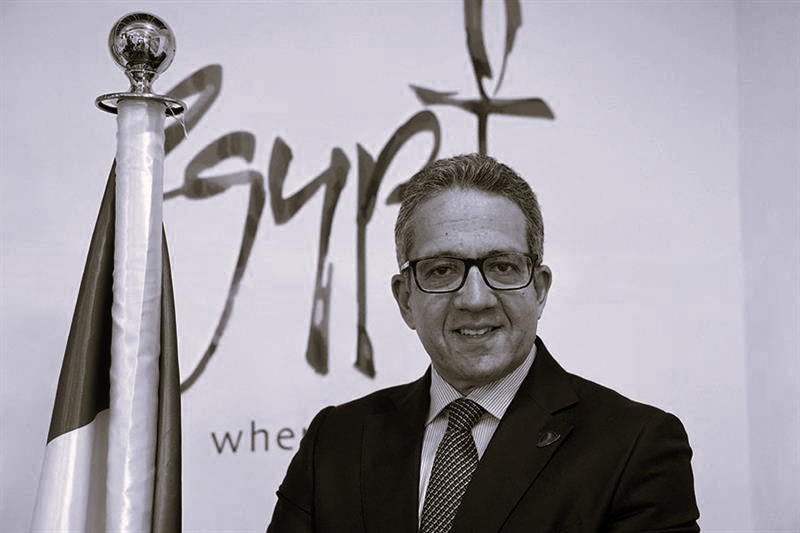
UNESCO’s new direction - Egyptologist to steer agency after US exit
UNESCO is set to have its first director from the Arab world after Egyptian former tourism and antiquities minister Khaled el-Anani was nominated by the agency’s executive board on Monday. If confirmed by UNESCO’s General Assembly next month, el-Anani will inherit an organization reeling from the Trump administration’s recent decision to pull the United States out, resulting in a potential budget shortfall for the agency best known for designating World Heritage sites across the globe.
El-Anani, widely seen as the front-runner for the post of director-general, won Monday’s vote against his only challenger, Firmin Edouard Matoko, an economist from the Republic of Congo who has promoted education in refugee camps. The board’s decision, representing 58 of UNESCO’s 194 member states, is expected to be ratified at the General Assembly meeting in Uzbekistan next month.
Noble ambitions and persistent problems
In addition to identifying and preserving World Heritage sites and cultural traditions, the Paris-based United Nations Educational, Scientific and Cultural Organization (UNESCO) works to promote girls’ education, raise Holocaust awareness, and fund scientific research in developing countries, among other missions. Outgoing UNESCO chief Audrey Azoulay notably led a high-profile initiative to rebuild the ancient Iraqi city of Mosul after its destruction by the Islamic State group. However, UNESCO has long faced criticism over alleged mismanagement and inefficiency.
US President Donald Trump argued that the agency, having voted in 2011 to admit Palestine as a member, was overly politicized and biased against Israel. Supporters of UNESCO in the US, however, contend that Washington’s withdrawal has given China an outsized influence in the organization. The leadership vote also comes at a time when the broader UN system, now 80 years old, is confronting financial strain and deepening divisions over the wars in Gaza and Ukraine.
Nominee will be UNESCO’s first Arab leader
El-Anani, 54, began his career as a tour guide at ancient Egyptian sites before earning a doctorate in France and rising to prominence as an Egyptologist. He served as Egypt’s Minister of Antiquities from 2016 to 2019, and later as Minister of Tourism and Antiquities after the two portfolios were merged. He currently teaches Egyptology at a public university in Cairo. Arab nations have long sought to lead UNESCO. Both the African Union and Arab League expressed support for his candidacy. Egyptian President Abdel Fattah el-Sissi hailed the nomination as a “historic achievement that adds to Egypt’s diplomatic and cultural legacy, and to the accomplishments of the Arab and African peoples.”
During his tenure in government, el-Anani oversaw major tourism projects, including the National Museum of Egyptian Civilization in Cairo, the restoration of the Jewish Temple, and several archaeological discoveries that helped revive Egypt’s struggling tourism sector. El-Anani is expected to prioritize UNESCO’s cultural programs and has pledged to continue efforts to combat antisemitism and religious intolerance. Although he lacks prior UN experience, his supporters argue that this could enable him to implement bold reforms. He has also expressed interest in encouraging the United States to rejoin UNESCO, after its withdrawal in 2018.
Challenger is a UNESCO insider
Matoko, 69, has spent most of his career within UNESCO, serving in Rwanda after the genocide and participating in peace negotiations in El Salvador and other regions. He has emphasized the importance of practical, technical solutions for education and development.
He recalled helping to train teachers at a refugee camp in Somalia in the 1990s and later meeting one of them who had become her country’s education minister. Both candidates have pledged to attract greater private-sector funding to offset the loss of contributions from the US and other nations, continuing efforts initiated under Azoulay.