
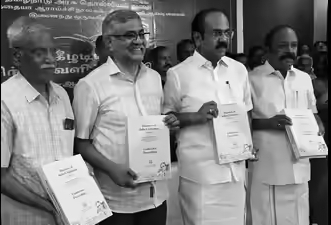
Underwater excavations begin at Poompuhar
In a move hailed as a significant stride in uncovering Tamil Nadu’s maritime past, underwater archaeological excavations have begun off the coast of Poompuhar (ancient Kaveripoompattinam). The project is being conducted by the Tamil Nadu State Department of Archaeology (TNSDA) in collaboration with the Indian Maritime University. The announcement came from State Minister for Archaeology, Thangam Thennarasu, during Indus Day celebrations in Keeladi. The site to be explored lies at the mouth of the Cauvery River, near present-day Mayiladuthurai district, historically a major port city during the Sangam era.
Background and earlier studies
Poompuhar (also known historically as Kaveripoompattinam) is steeped in Tamil literature and inscriptions as one of the major ancient port cities of the Cholas and other early Tamil dynasties. It has long been believed to have subsided due to “kadalkol” (rising sea, inundation) and other natural phenomena.
1981 Preliminary Surveys: Early exploratory work included geophysical surveys by the Tamil Nadu Archaeology Department in collaboration with the National Institute of Oceanography. These used equipment like side-scan sonar, echo sounders, and magnetometers to detect submerged features off the shore. Some masonry structures, brick works, and shoreline features were identified. 1990s Underwater Dives: Diving expeditions revealed remains such as wharves, pier walls, brick structures, and laterite stone constructions. Pottery fragments (blackware, red-and-black ware, buff ware) and other material artifacts were recovered and dated to roughly 2nd century BCE to 4th/5th CE in many cases.
2023 Remote Sensing Studies: A more recent study led by Bharathidasan University, supported by the Department of Science & Technology and involving institutions like the National Institute of Ocean Technology (NIOT), used multi-beam echo-sounder data and satellite/bathymetric surveys. That study asserted the existence of submerged harbour infrastructure: harbour channels, dockyards, settlements, and possibly a lighthouse, at depths of 50-100 meters about 30-40 km off the modern shore.
However, some of the more expansive claims (e.g. that the city is ~15,000 years old) have been met with skepticism in the academic community, particularly among archaeologists who argue that remote sensing alone cannot provide definitive evidence of human construction nor precise dating without physical artifacts.
What do the new excavations aim to do?
With these recent underwater excavations, the goals include:
1. Material Evidence: To move beyond remote sensing and surveying to actual physical, material evidence structural remains, artifacts that can be directly dated, studied, catalogued.
2. Mapping Port Infrastructure: Confirming the layout and extent of ancient harbour facilities, dockyards, turning basins, piers, etc. These can help reconstruct harbor operations and trade patterns.
3. Trade Links and Cultural Context: To understand Poompuhar’s role in trade networks (regional and international), material exchanges, urban development in the context of Sangam and post-Sangam periods.
4. Dating and Chronology: To pin down more accurately when various features were built, used, submerged. This includes understanding events like sea level changes, tsunamis, erosion, subsidence.
5. Public Heritage and Awareness: Bringing findings into museums (e.g. Marine Archaeological Site Museum in Poompuhar), public access, and integrating them in cultural narratives, tourism etc.
Methodology & Key persons
The digging/exploratory work involves both diver-based and remote techniques (e.g. use of remotely operated vehicles (ROVs), sonar mapping, maritime technology). Key archaeologists involved include K. Rajan and R. Sivanantham of the Tamil Nadu State Archaeology Department. Institutional partners include the Indian Maritime University among others.
Recent announcement & Start of excavations
The excavations officially commenced on September 19, 2025. Thangam Thennarasu has stated that this represents an effort to reclaim and project Tamil heritage, to place the ancient civilization more visibly on both national and global stages. Chief Minister M.K. Stalin has expressed that Poompuhar’s excavations will reveal the “pride of the flourishing Poompuhar,” once submerged.
Challenges / Skepticism
Dating Difficulties: Some claims, especially about very ancient ages (e.g. 15,000 years) have been questioned. Critics point out that remote sensing alone does not establish whether submerged features are natural or human-made, nor can it reliably date structures without recovered artifacts.
Preservation Under Water: Saltwater, biofouling, current action, sedimentation—all threaten preservation of submerged remains, and can complicate excavation and documentation.
Logistical & Technical Constraints: Working underwater is expensive, requires specialized equipment, safety protocols, skilled divers/technicians. Also, sediments may cover features deeply.
Interpretation: Even when structures are located, interpreting their function (harbour, warehouse, settlement) requires corroboration from multiple data sources: ceramics, inscriptions, relative dating etc.
Significance of the Site
Poompuhar is legendary in Tamil literature (e.g. Silappathikaram, Manimekalai) as a bustling port, with rich cultural and trade connections. Verifying its physical remains aids in connecting literature and history. Understanding the interactions of ancient Tamil society with other civilizations e.g. trade with Southeast Asia, possibly with the Roman world via imports, ports, maritime routes. Helps fill in gaps about how sea-levels changed, how ancient coastal geography evolved, and how natural disasters (tsunami, storm surges) shaped human settlement. Adds to heritage, tourism potential, identity building among local communities.
What’s Expected / What to Watch
• Uncovering of physical structures such as quay walls, piers, docks, possibly protected or buried by sediment or shifted over time.
• Recovery of artifacts (pottery, tools, metal objects, marine trade goods) that can be securely dated.
• Detailed mapping of the seabed features and geographic changes over time.
• Collaboration reports/publication of findings; possible museum display of artifacts.
• Scientific papers or conferences detailing the findings.
The beginning of systematic underwater excavations at Poompuhar marks a landmark moment for Tamil Nadu’s archaeological work. It builds upon decades of remote sensing, preliminary dives, and literary tradition, moving toward concrete evidence to illuminate an ancient maritime civilization. As work progresses, the discoveries are likely to deepen our understanding not just of Poompuhar’s own history, but of ancient coastal life, trade, and urbanism in South India.