
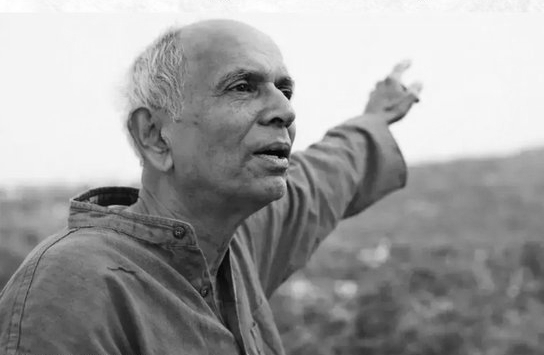
UN champion of the earth and defender of the Western Ghats, Madhav Gadgil, dies at 83
What makes someone walk away from the world’s best universities to protect India’s forests instead is the belief that knowledge has little meaning unless it serves the land and the people who live on it. That conviction shaped the life and work of renowned ecologist Madhav Gadgil, who passed away in Pune late Wednesday night after a brief illness. He was 83.
Born in Pune on May 24, 1942, Gadgil came from a distinguished academic family. His father, Dhananjay Ramchandra Gadgil, was a noted economist and former director of the Gokhale Institute. Gadgil studied biology at Fergusson College, earned his master’s degree in zoology from the University of Mumbai, and completed his PhD at Harvard University in 1969, working on mathematical ecology and animal behaviour. At a time when a career abroad promised comfort and global recognition, he chose to return to India, convinced that ecological science had to be rooted in the country’s own landscapes and communities.
After returning in 1971, Gadgil joined the Indian Institute of Science in Bengaluru, where he played a transformative role. He founded the Centre for Ecological Sciences, which became one of India’s foremost institutions for ecological research, and later helped establish the Centre for Theoretical Studies. Through decades of teaching and mentorship, he shaped generations of ecologists and conservation thinkers, laying the foundations of modern ecological science in the country.
Gadgil’s influence extended far beyond academia. He consistently argued that ecology was not merely about forests and wildlife, but about people and their relationship with nature. He served on several high-level bodies, including the Scientific Advisory Council to the Prime Minister, the National Advisory Council and the National Tiger Conservation Authority .He was also a key intellectual force behind the Biological Diversity Act and championed the idea of People’s Biodiversity Registers, repeatedly emphasising that “ ecology is not just about forests and wildlife, but about people and their relationship with nature ”. For him, conservation was inseparable from democracy and social equity.
He is best known to the wider public for chairing the Western Ghats Ecology Expert Panel in 2010. The panel recommended that nearly 75 percent of the Western Ghats, one of the world’s richest biodiversity hotspots, be declared an ecologically sensitive area. Gadgil warned that unchecked mining, deforestation, large dams and infrastructure projects would destabilise the fragile mountain ecosystem. These recommendations triggered intense political backlash, particularly in Kerala and Karnataka , and were eventually diluted, but the report fundamentally altered India’s environmental discourse and forced a national reckoning on the costs of unrestrained development.
Gadgil often cautioned that short-term economic gains could never justify long-term ecological ruin , warning that ignoring ecological limits would invite disaster. His words proved prophetic. Repeated floods and landslides across the Western Ghats, including the devastating Wayanad landslide in 2024, brought renewed attention to the dangers he had highlighted years earlier, reinforcing his reputation as a scientist who spoke inconvenient truths long before their consequences became visible.
A prolific scholar and public intellectual, Gadgil authored or co-authored more than 250 scientific papers and several influential books, including This Fissured Land and Ecology and Equity . He also wrote extensively in English and Marathi , committed to what he described as the need to democratise environmental knowledge so that citizens could meaningfully participate in decisions affecting their surroundings.
His work earned him numerous honours, including the Padma Shri in 1981, the Padma Bhushan in 2006, the Shanti Swarup Bhatnagar Prize , the Volvo Environment Prize and the Tyler Prize for Environmental Achievement. In 2024, the United Nations conferred on him the Champions of the Earth award , its highest environmental honour, recognising his lifetime of contributions to conservation and ecological thought.
Following his death, condolences poured in from across the political and scientific spectrum. The Prime Minister described him as a towering intellectual who strengthened India’s environmental consciousness, while chief ministers and leaders from Maharashtra, Karnataka and Kerala acknowledged his lasting impact on conservation policy and public debate. Scientists, environmentalists and former students remembered him as a fearless voice who spoke truth to power and remained committed to ecological justice throughout his life.
Madhav Gadgil was more than a scientist. He was a teacher, a public intellectual and a moral compass who believed that development divorced from ecological wisdom was ultimately self-destructive. As India confronts climate change and accelerating environmental degradation, his life’s work stands as both a guide and a warning. He chose the harder path of standing with the land, even when it meant standing alone , and in doing so left behind a legacy that will endure far beyond his lifetime.