
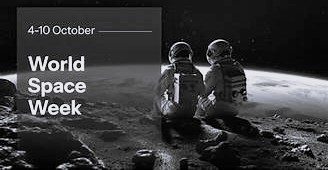
UN celebrates World Space Week 2025, Focuses on “Living in Space”
This week marks World Space Week, celebrated globally from October 4–10, highlighting humanity’s growing engagement with space. The 2025 theme, “Living in Space,” emphasizes how scientific innovation, international cooperation, and space law are shaping a future where humans could live beyond Earth, while also improving life on our planet.
Established by the UN in 1999, World Space Week honors two historic milestones: the 1957 launch of Sputnik 1 , the first artificial satellite, and the 1967 Outer Space Treaty , which laid the foundation for international space law. Today, over 90 countries operate satellites, and the global space economy is projected to exceed $730 billion by 2030.
“Space is not a distant dream. It's already a shared reality,” said the Director of the UN Office for Outer Space Affairs (OOSA). She stressed that international collaboration could help solve pressing Earthly challenges.
The week encourages public imagination about lunar bases, long-term orbital missions, and other ventures beyond Earth. Technologies developed for space, from solar panels to water purification systems, already benefit daily life on Earth, alongside satellite-based GPS, telecommunications, and weather monitoring.
The week encourages public imagination about lunar bases, long-term orbital missions, and other ventures beyond Earth, highlighting how human ingenuity is extending our reach into space. Many of the technologies developed to support these missions—ranging from solar panels to water purification systems—already enrich daily life on Earth, alongside satellite-based GPS, telecommunications, and weather monitoring, demonstrating the tangible benefits of space research.
However, as more nations and private companies launch satellites, space congestion is rising: over 45,000 human-made objects now orbit Earth, including active satellites and debris. To address these challenges, the UN Office for Outer Space Affairs (OOSA) sets sustainability standards, maintains a registry of orbiting objects, and supports national laws aligned with international treaties, ensuring safe and equitable access for all.
At the same time, lunar exploration is expanding rapidly. More than 100 missions are planned by 2030, coordinated through OOSA’s “One Moon for All” initiative, which promotes peaceful, inclusive, and safe operations. These efforts illustrate that space is not only a frontier for scientific discovery but also a platform for fostering global cooperation and shared responsibility.
Space is increasingly becoming a vital tool for global development. The UN has assisted countries such as Kenya, Nepal, and Guatemala in launching their first satellites and leveraging space-based data for disaster response, climate monitoring, food security, and environmental protection. By connecting the benefits of space exploration to pressing Earthly challenges, these initiatives highlight its potential to improve lives worldwide.
As private companies and geopolitical competition continue to expand humanity’s presence in space, multilateral cooperation remains critical . Ensuring that space remains conflict-free, accessible, and inclusively governed gives every UN Member State a voice in shaping humanity’s future among the stars, linking scientific ambition with equitable global stewardship.