
Two daughters of India, two very different tributes: Modi’s tweets stir conversation
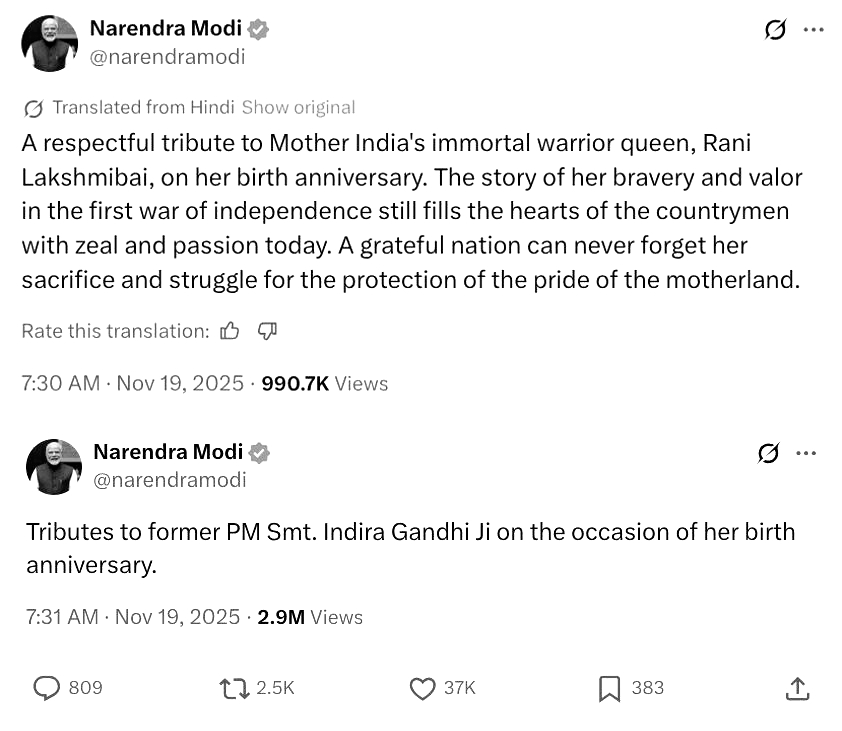
Prime Minister Narendra Modi’s posts on the birth anniversaries of former Prime Minister Indira Gandhi and freedom fighter Rani Lakshmibai on Tuesday triggered discussion after he offered only a dry single-line tribute to Gandhi while dedicating a comparatively longer message praising the valour of the Jhansi queen. Critics argued that the contrast reflected a pattern of selective recognition of historical figures associated with political rivals.
In his post on Indira Gandhi’s birth anniversary, the Prime Minister wrote a brief line acknowledging her birthday, without further elaboration. A minute earlier, his tribute to Rani Lakshmibai described her as a “symbol of courage, resilience and unwavering commitment to India’s freedom,” highlighting her role in the 1857 uprising.
Across the country, Congress leaders, regional politicians, and supporters marked Indira Gandhi’s birth anniversary with large-scale tributes. At Gandhi Bhavan in Telangana, floral offerings were made by party workers and local leaders. Senior Congress figures paid homage in the Central Hall of Parliament in New Delhi, while gatherings in Jammu and South Goa featured speeches and commemorations highlighting her national and international impact.
Tributes to Rani Lakshmibai were equally extensive, with cultural performances, processions, and exhibitions held in Uttar Pradesh, Maharashtra, and Madhya Pradesh. Students, historians, local representatives, and community groups participated in events celebrating her bravery. Lakshmibai, born in 1828, became queen of Jhansi after her marriage to Maharaja Gangadhar Rao and later resisted the British attempt to annex her kingdom under the Doctrine of Lapse. Her leadership during the 1857 uprising and her martyrdom in 1858 have long made her a symbol of resistance and patriotism.
Political observers noted that while both women are celebrated as “daughters of India,” their treatment in contemporary political discourse varies. Indira Gandhi, India’s first and only woman Prime Minister, led the country through the 1971 Bangladesh Liberation War, ushered in major agricultural and economic reforms, strengthened foreign policy, and introduced the Green Revolution, though her tenure remains polarising due to the Emergency.
Rani Lakshmibai, on the other hand, is widely regarded as a unifying national figure whose battlefield leadership against British rule continues to be invoked in narratives of women’s empowerment and national pride.
The contrasting tone of the Prime Minister’s messages prompted responses from opposition leaders and commentators who argued that national legacies should be honoured without political filters. Supporters of the government maintained that the Prime Minister has the prerogative to frame tributes as he sees fit.
Indira Gandhi and Rani Lakshmibai, though separated by centuries, share a significant place in the national imagination as women who shaped India one through political leadership, the other through armed resistance. As the country reflects on their anniversaries, the debate over how national icons are remembered continues to shape India’s political landscape and its vision for the future, particularly with regard to acknowledging women who defined the nation’s history.