
TVK Chief Vijay Faces Legal Heat as Campaign Row Triggers Political Debate
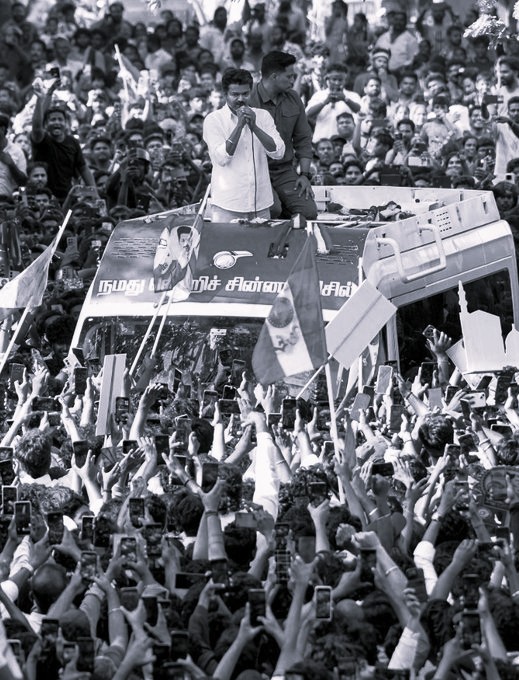
The booking of actor-turned-politician Vijay and members of his party, Tamilaga Vettri Kazhagam (TVK) , under provisions of the Bharatiya Nyaya Sanhita (BNS), 2023 , for alleged violations of the Model Code of Conduct (MCC) has evolved into a politically significant development ahead of the Tamil Nadu Assembly elections scheduled for April 23. The case, registered by the Peravallur police , stems from a campaign roadshow in Chennai where authorities alleged that party cadres assembled before the permitted time, deployed nearly 30 sound systems, and caused traffic congestion and public inconvenience. While such violations are typically addressed through routine legal action during elections, the scale of mobilisation and Vijay’s high-profile political debut have amplified the issue beyond its procedural dimensions.
The controversy unfolds at a critical juncture for TVK, which is making its electoral debut with an aggressive campaign strategy aimed at challenging Tamil Nadu’s entrenched political order. Vijay’s decision to contest from Perambur and Tiruchirappalli East reflects a calculated attempt to build a broad-based appeal across urban and semi-urban constituencies. His campaign, marked by large crowds and high-energy roadshows, has attracted significant attention, particularly among youth and first-time voters, positioning him as a potential disruptor in the state’s traditionally bipolar political landscape.
At the same time, the legal action has fed into a growing political narrative around alleged selective enforcement. Prior to this incident, TVK had approached the Election Commission of India seeking the transfer of senior administrative and police officials, alleging bias in granting permissions for campaign activities. Supporters of the party have interpreted the case against Vijay as part of a broader pattern of heightened scrutiny, although no formal evidence has substantiated claims of political targeting. The episode has also drawn reactions from other political voices, further intensifying the debate over fairness in enforcement during the election period.
From the administration’s perspective, however, the action reflects a stricter approach to enforcing electoral norms, particularly in densely populated urban areas where large gatherings can disrupt daily life and pose safety concerns. Election authorities have consistently emphasized uniform implementation of MCC guidelines to ensure a level playing field. Yet, in a politically charged environment, actions involving high-profile leaders often acquire symbolic significance, blurring the line between regulatory enforcement and political perception.
Ultimately, the case underscores a broader tension between mass political mobilisation and regulatory compliance in contemporary elections. For Vijay and TVK, it represents an early test of political maturity balancing popular outreach with adherence to institutional norms. For authorities, it highlights the challenge of maintaining neutrality while enforcing rules in a high-stakes contest. As campaigning intensifies, the incident is likely to remain part of the larger political discourse, reflecting how legal processes and electoral politics increasingly intersect in shaping public narratives.