
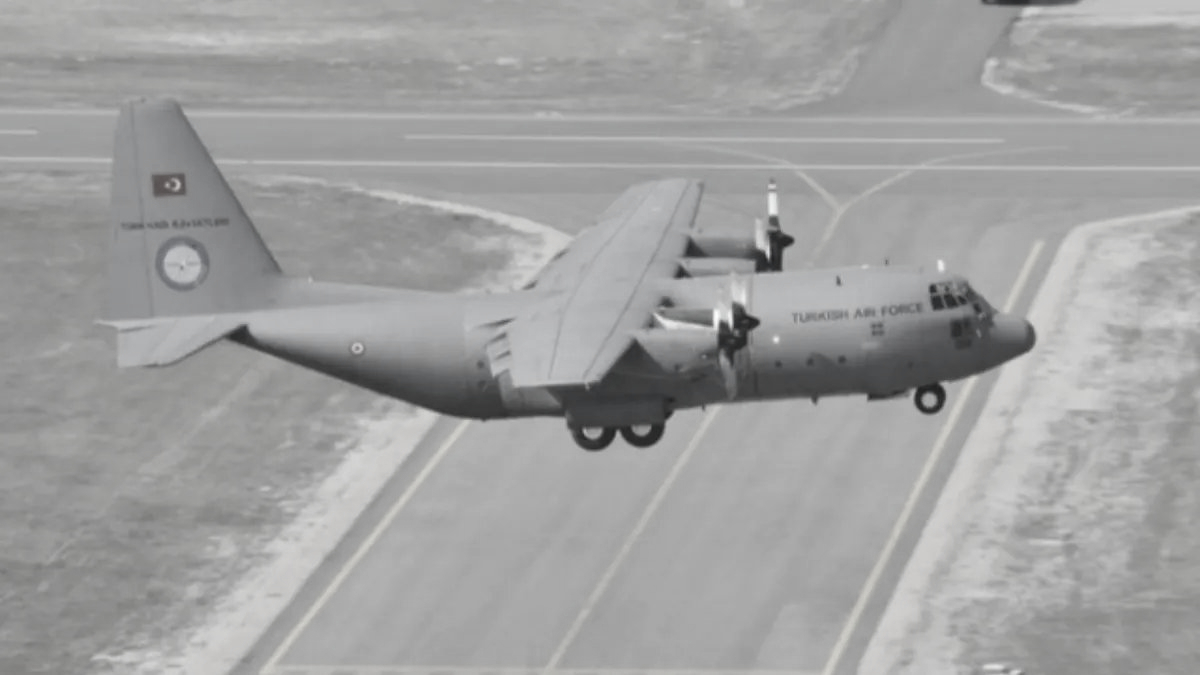
Turkish military C‑130 plane crashes in Georgia while returning from Azerbaijan
A Turkish Air Force C‑130 Hercules military transport aircraft crashed on 11 November 2025 in Georgia’s Sighnaghi municipality, just five kilometres from the Azerbaijan border, while returning from a mission in Azerbaijan. The Georgian Interior Ministry reported that the aircraft disappeared from radar shortly after entering Georgian airspace without sending a distress signal, and local footage showed it trailing smoke and spiraling before impact. Turkey confirmed that 20 military personnel, including crew members, were on board. Joint search and rescue operations have been launched by Turkish, Georgian, and Azerbaijani authorities, with emergency teams and UAVs deployed to the crash site.
The aircraft was operating as part of ongoing Turkish‑Azerbaijani military cooperation. Turkey and Azerbaijan maintain close defense ties, routinely conducting joint exercises, transporting personnel, and delivering equipment. The C‑130 was likely engaged in routine operations such as rotating troops, supplying military bases, or supporting joint training exercises. Given Azerbaijan’s strategic position in the Caucasus and Turkey’s regional defense commitments, such logistical missions are frequent and critical.
The C‑130 Hercules, introduced in 1956, is a rugged, four-engine turboprop transport aircraft renowned for its versatility. It can carry troops, vehicles, and cargo, perform medical evacuations, airdrops, and operate from short or unprepared airstrips. While the design dates back decades, the C‑130 remains viable today because airframes are routinely upgraded with modern avionics, engines, and structural improvements. Turkey operates both older C‑130E/H models purchased in the 1970s–1990s and newer C‑130J variants delivered in recent years, all maintained under technical assistance agreements with the U.S. Lockheed Martin.
The C‑130 fleet has been involved in several tragic accidents over the years, resulting in thousands of deaths worldwide. Notable incidents include a 1992 Nigerian Air Force crash that killed 159, a 2005 Iranian Air Force crash that killed 94 onboard plus 12 on the ground, a 2015 Indonesian Air Force crash that killed 122 onboard plus 17 on the ground, and a 2021 Philippine Air Force crash that killed 50 onboard plus 3 on the ground. These four major incidents alone account for 457 fatalities, illustrating the inherent risks of operating heavy-lift military aircraft in challenging environments.
Turkey acquired its C‑130 fleet through U.S. Foreign Military Sales (FMS) programs. The sales include the aircraft, spare parts, technical documentation, and ongoing support for critical components. While routine maintenance and operational control are handled by the Turkish Air Force, major overhauls, specialized repairs, and technical upgrades remain supported by the U.S., ensuring safety and interoperability. The U.S. continues to sell these aircraft because the C‑130 platform remains highly capable even decades after its original design, and modernization programs make older airframes effective and safe. Additionally, such sales strengthen military partnerships and ensure interoperability with U.S. forces.
In response to the Georgia crash, Turkish, Georgian, and Azerbaijani authorities launched search and rescue operations and an investigation into the cause. Factors likely to be examined include aircraft age and maintenance, operational load, flight path and terrain, weather conditions, and coordination across borders. Turkish President Recep Tayyip Erdoğan described those aboard as “martyrs” and expressed condolences, while Azerbaijani and Georgian officials pledged full cooperation. The incident, occurring in a geopolitically sensitive region, highlights both the strategic importance and operational challenges of military air logistics in the Caucasus.