
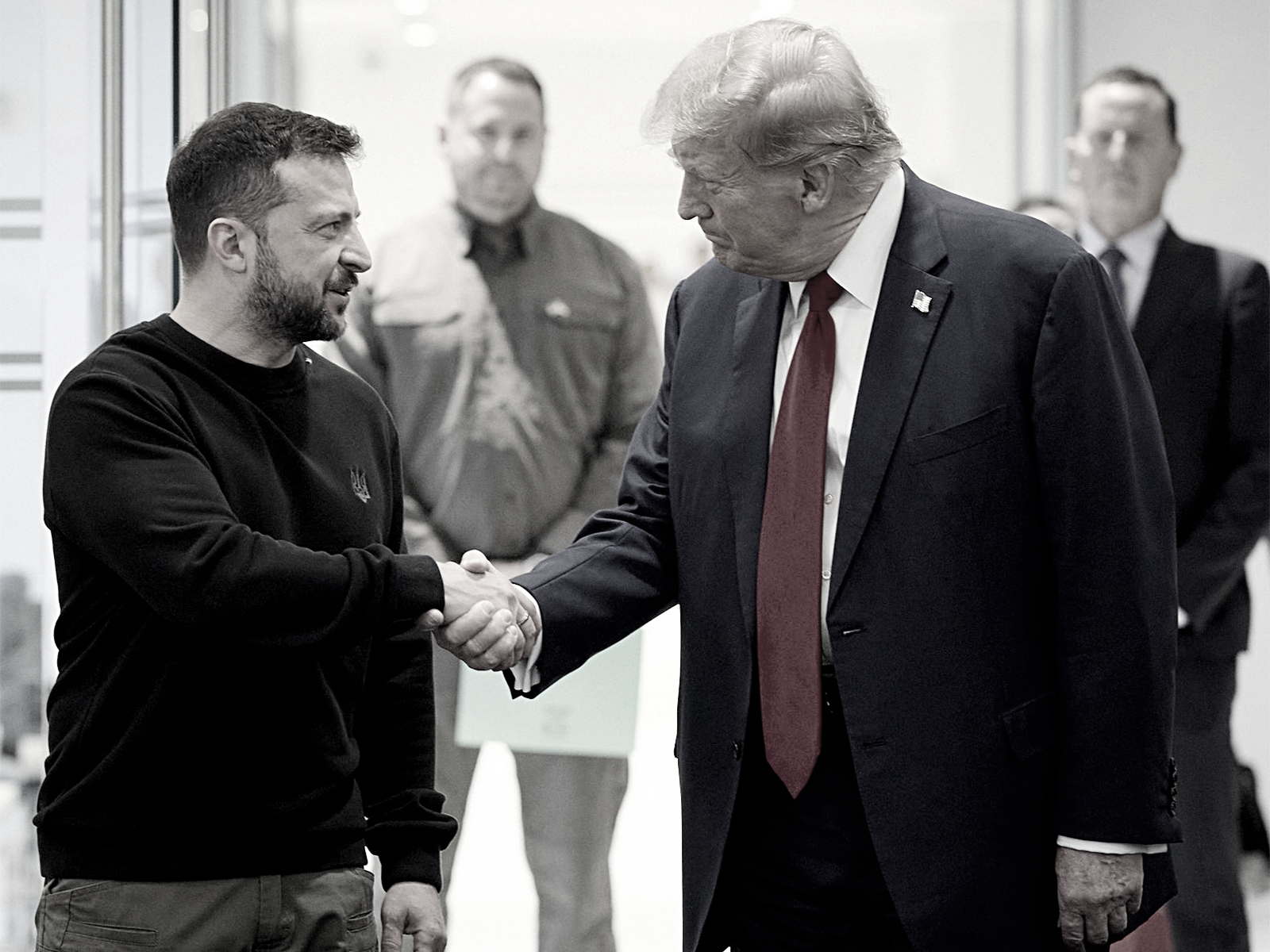
Trump-Zelenskyy meet: US president hesitant on selling Tomahawk missile
US President Donald Trump hosted Ukrainian President Volodymyr Zelenskyy for a bilateral lunch at the White House on Friday , describing the meeting as “very interesting and cordial” while urging both sides to “stop the killing” and negotiate a peace deal. Trump also declined Zelenskyy’s request for US Tomahawk cruise missiles, citing the need to maintain American stockpiles, saying, “We’d much rather have them (Ukraine) not need Tomahawks. Ukraine is seeking Tomahawk missiles to strengthen its long-range strike capabilities against Russian targets deep behind the front lines. The Tomahawk, a US-made precision cruise missile with a range of over 1,600 km, is prized for its accuracy and ability to evade air defenses.
We’d much rather have the war be over.” He expressed optimism about brokering a “long-lasting” peace between Russia and Ukraine, despite acknowledging the personal animosity between Zelenskyy and Russian President Vladimir Putin as a major obstacle. “They don’t like each other. I say that in front of President Zelenskyy, but I say it in front of President Putin, too. They have tremendous bad blood. It really is holding up, I think, a settlement. I think we’re going to get it done,” he said, highlighting the importance of a lasting solution and referencing his administration’s previous success in the Middle East, including the recent ceasefire between Israel and Hamas.
The lunch followed a two and half hour phone call between Trump and Putin on October 17, which officials described as “constructive” and marked by “great progress.” Kremlin aide Yuri Ushakov confirmed that Trump proposed a summit in Budapest, Hungary, which Putin “immediately supported.” Both sides agreed that their foreign policy teams, US Secretary of State Marco Rubio and Russian Foreign Minister Sergey Lavrov, would meet next week to lay groundwork for the summit, which is expected in early November 2025. One of the central topics discussed during the Trump and Putin call was the possible supply of Tomahawk missiles to Ukraine. According to Russian state media, Putin warned Trump that sending the missiles would not alter battlefield outcomes but would harm US, Russia relations and the chance for peace. Zelenskyy had traveled to Washington in a formal suit, signaling the seriousness of his request, but left without securing a commitment on the Tomahawks, highlighting the limits of Ukraine’s leverage even in a high-profile meeting. Analysts note that Trump’s tone shifted sharply after his call with Putin, from being assertive and demanding in previous engagements with Zelenskyy to a calmer, more diplomatic posture emphasizing negotiation and mediation.
During the lunch, Trump also reiterated his assertion that India has reduced and is now pulling back from Russian oil purchases, claiming, “India is not going to be buying Russian oil anymore… They already de-escalated and more or less stopped. That’s a big stop.” He referenced that India previously imported around 38% of its oil from Russia. India, however, officially responded that its energy policy is guided by national interest and consumer protection, not external pressure. Ministry of External Affairs spokesperson Randhir Jaiswal said, “India is a significant importer of oil and gas. It has been our consistent priority to safeguard the interests of the Indian consumer in a volatile energy scenario. Our import policies are guided entirely by this objective. Ensuring stable energy prices and secured supplies have been the twin goals of our energy policy. This includes broad-basing our energy sourcing and diversifying as appropriate to meet market conditions.” He added that discussions with the US to expand energy cooperation were ongoing, emphasizing that any reductions in Russian oil imports are strategic and economically driven, not a result of US pressure. Analysts note that Trump’s framing of India “completely stopping” Russian oil purchases is an exaggeration, aimed at projecting his image as a global dealmaker and signaling progress in isolating Russia.
Despite Trump’s optimism, neither Russia nor Ukraine has a clear path to decisive victory. Ukraine depends heavily on Western weapons and ammunition, without which deep strikes or sustained offensives are limited. Russia faces economic and logistical pressure, including Ukrainian strikes on refineries that reduce fuel exports and disrupt domestic logistics. Territorial gains by Russia have been incremental and costly, while Ukraine’s regained territories remain contested. The war has become one of attrition, where sustaining losses, resupply, and external support are decisive factors rather than battlefield heroics. Given these dynamics, a protracted stalemate or frozen conflict is considered the most likely outcome. Russia could consolidate some territorial gains if Western support to Ukraine falters, while Ukraine could regain momentum if foreign aid and munitions increase.
Trump also reiterated his previous claims of defusing eight global conflicts, including the May escalation between India and Pakistan, calling the Ukraine war his “number nine” to solve. He emphasized stopping the ongoing bloodshed: “Thousands of people being slaughtered each and every week-NO MORE. GO HOME TO YOUR FAMILIES IN PEACE! Enough blood has been shed.” He urged both leaders to “make a DEAL” and suggested that history should decide the outcome, framing himself as a mediator capable of brokering peace. With the upcoming Budapest summit between Trump and Putin, expectations remain cautious. While Trump continues to project optimism, Zelenskyy’s objectives, particularly securing advanced weaponry - remain unmet, and the war itself shows no signs of immediate resolution.