
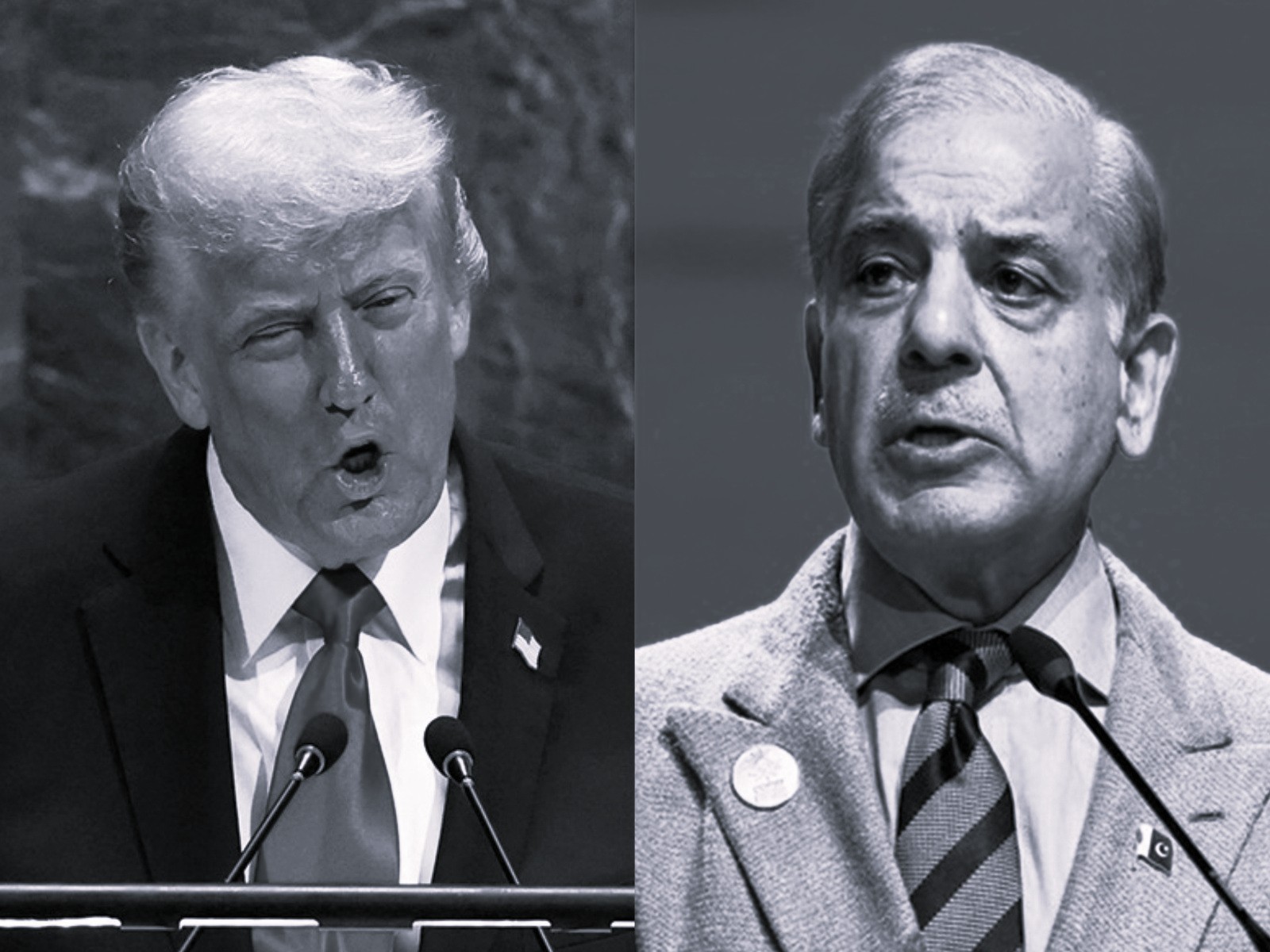
Trump–Sharif Meeting in Shadows as India Prepares UNGA Speech
The closed-door meeting between US President Donald Trump and Pakistan Prime Minister Shehbaz Sharif at the Oval Office — also attended by Pakistan’s Army Chief General Asim Munir — has raised eyebrows in diplomatic circles. Coming on the sidelines of the ongoing 80th UN General Assembly (UNGA) in New York, the encounter has triggered speculation both for its timing and its secrecy.
Unlike Trump’s earlier engagement with Turkish President Recep Tayyip Erdogan, which included a joint briefing and official photographs, no images or press notes have been released by the White House after the Trump–Sharif talks. The only confirmation has come from Pakistan’s Prime Minister’s Office, which described the atmosphere as “pleasant” but also admitted that the meeting was delayed by nearly half an hour. Media outlets in Washington have openly questioned why such an important bilateral exchange took place without even a customary photo-op.
The presence of General Munir alongside Sharif is being viewed as particularly telling. Observers note that Trump has in the past spoken frequently and directly with Pakistan’s military leadership — often treating the Army Chief as the real power centre in Islamabad. This meeting only reinforced that perception, with critics pointing out that Washington is now dispensing with the usual diplomatic “back channel” courtesies and engaging the Pakistani military head-on.
Sharif, who is in the US to address the UNGA, has already delivered Pakistan’s national statement. His speech underscored Islamabad’s usual themes on Kashmir and development, but the Oval Office meeting may prove more consequential in shaping the trajectory of US–Pakistan ties. Analysts warn that a rapid revival of this partnership, particularly in its military dimension, could once again emerge as a point of friction in US–India relations.
India, meanwhile, will have its moment at the UNGA on Saturday. External Affairs Minister S. Jaishankar is scheduled to deliver India’s address, with officials indicating that his speech will emphasise counter-terrorism, reform of multilateral institutions, and the vision of a multipolar global order. Against the backdrop of Pakistan’s renewed visibility in Washington, Jaishankar’s words are expected to carry additional weight — both to reaffirm India’s global stance and to remind the world of the destabilising role of terrorism.
As the UNGA debate continues, the silence from the White House on the Trump–Sharif encounter only deepens the intrigue. For now, the spotlight shifts to Jaishankar’s speech, which will signal how India intends to position itself amid shifting equations in Washington and Islamabad.