
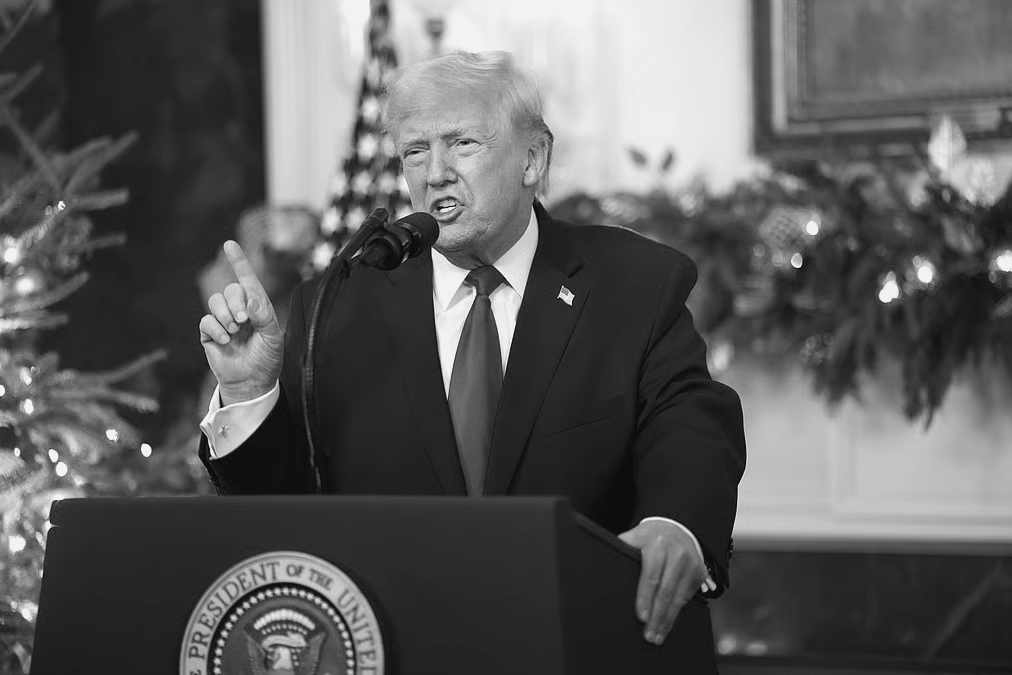
Trump’s year-end address focuses on Immigration, claims credit for ending eight wars
US President Donald Trump on Wednesday addressed the nation as part of his year-end address, outlining what he described as the key achievements of his second term in office, with a strong emphasis on immigration enforcement, economic measures and foreign policy successes, including a contested claim that his administration ended eight wars.
Delivering a 19-minute prime-time speech from the White House nearly 11 months after returning to office in January, Trump said a “mess” had been inherited from the previous administration and that corrective action was now under way. A range of accomplishments was listed, including securing the border, triggering what was described as “ reverse migration ”, bringing prices down, using tariffs to generate billions of dollars in revenue, creating jobs and cracking down on illegal immigration.
Significant focus was placed on foreign policy, with Trump claiming that American strength had been restored and multiple conflicts had been resolved within months of his return to power. He stated that eight wars had been settled in 10 months , that the Iran nuclear threat had been destroyed and that the war in Gaza had been brought to an end, resulting in what was described as historic peace in the Middle East and the release of hostages, both living and dead.
While the conflicts were not named during the address, Trump has repeatedly claimed throughout the year that his administration played a decisive role in stopping hostilities or preventing wars between several countries, including India and Pakistan, Thailand and Cambodia, Armenia and Azerbaijan, Kosovo and Serbia, Israel and Iran, Egypt and Ethiopia, and Rwanda and the Democratic Republic of the Congo .
However, there is no independent or official confirmation that eight active wars were conclusively ended by the US during this period. Several of the disputes cited by Trump remain unresolved, are governed by fragile ceasefires, or involve long-standing tensions rather than formally declared wars. In many cases, diplomatic engagement predates the current administration and includes the involvement of multiple international actors. Analysts and foreign governments have also questioned US mediation claims in some instances, casting doubt on the assertion that eight wars were definitively stopped.
Immigration formed a central pillar of the address, with Trump asserting that his administration had successfully curbed the flow of migrants into the country. Rising housing costs were attributed to what was described as a “ colossal border invasion ”, with blame placed on the previous administration for allowing “millions and millions” of migrants into the US and providing them with taxpayer-funded housing.
It was claimed that this influx contributed to soaring rents for American citizens and that more than 60 per cent of growth in the rental market had come from foreign migrants. Migrants were also accused of taking American jobs and placing pressure on public services, including emergency rooms and schools, while receiving free health care and education funded by taxpayers.
Trump further claimed that the country was now witnessing “reverse migration” for the first time in 50 years , with migrants returning to their home countries and easing pressure on housing and employment. On jobs, it was stated that in the year before the election, all net job creation had gone to foreign migrants, while since January, all net job growth had been taken up by American-born citizens .
The year-end address reiterated the administration’s core political themes of border control, economic nationalism and assertive diplomacy. While supporters view the speech as a reaffirmation of strong leadership and policy direction, critics and policy experts continue to question the accuracy of several claims, particularly those related to global conflicts and migration-related economic data.