
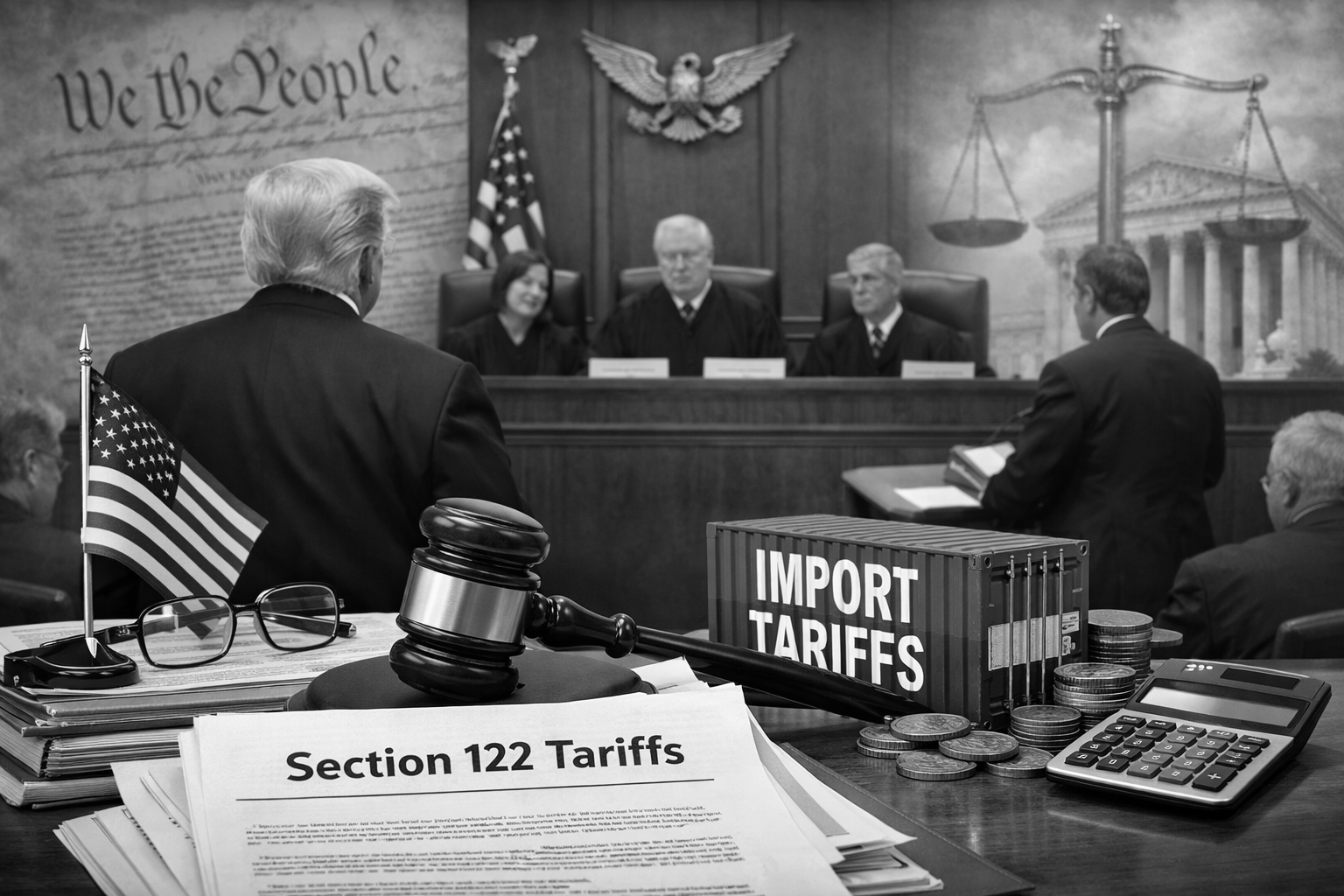
Trump’s Tariffs Back in Court as US Trade Court Reopens Battle Over Global Import Duties
The legal battle over Donald Trump’s ambitious tariff policy has entered a crucial phase, as the US Court of International Trade examines the legality of newly imposed temporary global tariffs under Section 122 of the Trade Act of 1974 . The case, brought by over two dozen US states and multiple businesses , challenges the administration’s attempt to impose 10% import duties , arguing that the provision is being stretched beyond its original intent.
The dispute comes in the wake of a major setback earlier this year, when the US Supreme Court struck down Trump’s earlier tariff regime in the landmark Learning Resources, Inc. v. Trump case. In that ruling, the court held that the International Emergency Economic Powers Act (IEEPA) does not grant the president authority to impose tariffs, reinforcing that such powers lie primarily with Congress . The decision forced the administration to abandon its broader tariff framework and seek alternative legal mechanisms.
In response, Trump quickly pivoted to Section 122 , a rarely used provision that allows the president to impose tariffs of up to 15% for 150 days to address balance-of-payments deficits . However, this move has sparked fresh controversy, as critics argue that trade deficits which Trump seeks to reduce are fundamentally different from the financial imbalances the law was designed to address. The tariffs, currently set at 10% , are scheduled to expire on July 24 unless extended with congressional approval.
During a lengthy court hearing , judges closely scrutinized the interpretation of key terms in the 1974 law, particularly whether “balance-of-payments deficits” can be equated with modern trade imbalances. The provision itself dates back to a period when the US dollar was tied to gold , and global financial stability was a primary concern. Critics contend that the law has become outdated , while the government maintains that it still provides sufficient authority for temporary economic measures.
The case has also exposed legal inconsistencies . Notably, the administration had previously argued in court that Section 122 was not suitable for addressing trade deficits, even as it now relies on the same provision. At the same time, the trade court itself had earlier suggested that Section 122 could serve as an alternative to IEEPA - highlighting the ambiguity surrounding the statute.
Plaintiffs, including states led by Oregon Attorney General Dan Rayfield , argue that the tariffs amount to executive overreach , placing an unfair financial burden on American consumers and businesses. They are pushing for a swift judicial ruling , warning that continued enforcement of the tariffs effectively acts as an unauthorized tax on imports.
Legal experts, however, suggest that the court may ultimately defer to presidential discretion , particularly given the temporary nature of the tariffs and the traditionally broad authority granted to the executive in trade matters. Yet, if the court rules against the administration, it could lead to fresh appeals , potential refund claims , and a clearer definition of the limits of presidential power in economic policymaking.
As the July deadline approaches, the case is shaping into a pivotal moment for US trade law. Its outcome could redefine the balance between executive authority , legislative oversight , and the legal tools available to address global economic challenges setting a precedent that may influence American trade policy for years to come.