
Trump's Hormuz Gamble Fails Its First Test
Donald Trump wanted a decisive blow. He wanted a naval blockade in the Strait of Hormuz that would strangle Iran's oil empire, one that took more than 40 years to build and bring Tehran to its knees. The blockade came into effect just yesterday. And within hours, it was already being defied.
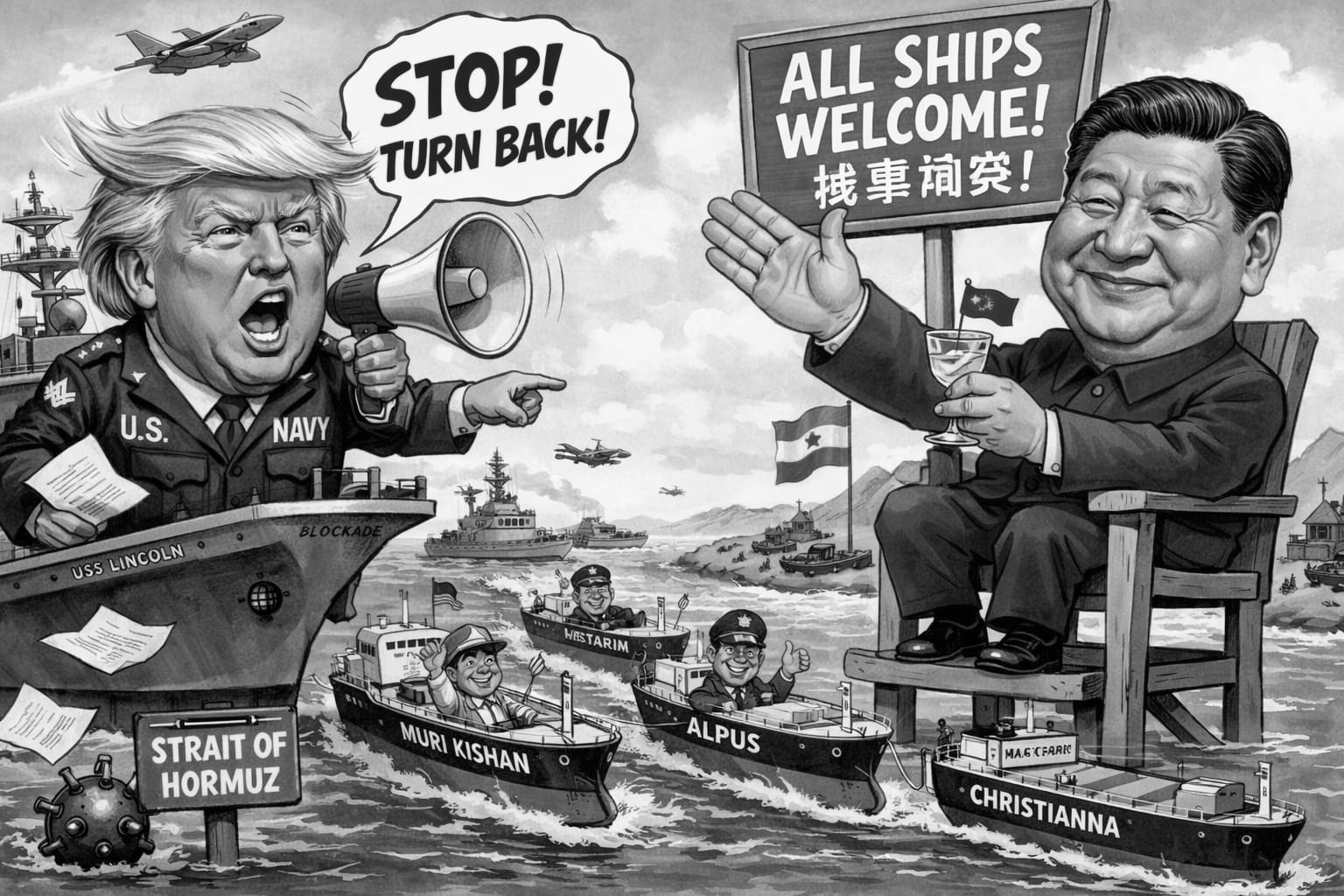
This is the story of day one. Four vessels passed through the strait openly, without hesitation, as if the most powerful navy on earth had simply not shown up. The first was the Ritari , a US-sanctioned tanker linked to China, which sailed east from Sharjah in the UAE through the strait overnight. Its movement wasn't covert, maritime tracking data logged every mile. Then came the Muri Kishan , also under US sanctions for Iran-related trade, sailing west from Lanchan in China, last spotted east of Iran's Qeshm Island. A third tanker, the Alpus , passed through heading east after departing Iran's port of Bushehr. And a fourth vessel, a bulk carrier called the Christianna , crossed from Iran's Bandar Imam Khomeini. Three of these four ships are under direct US sanctions. All four passed freely.
Iran didn't miss the moment. Its embassy mocked Washington with theatrical flair, saying, "The United States Navy, with its big, beautiful ships, issued repeated warnings. Reportedly, the tanker's captain upgraded to premium to skip the ads." This is the humiliation that Trump's blockade delivered on its very first day.
But to understand why this is happening, you have to understand what a blockade actually demands. It is not simply a declaration. It is not a post on social media. Enforcing a blockade means constant surveillance, the physical ability to intercept vessels, board them, inspect them, and if necessary, seize them. It means total control of contested water. And the Strait of Hormuz is anything but uncontested.
Iran has spent decades preparing for exactly this scenario. Sea mines that can cripple ships without warning. Swarms of fast attack boats armed with missiles. Drones, both aerial and surface-level. Land-based missile systems that can reach anything moving through those narrow waters. Tehran has made its position crystal clear, any action threatening Iran's security will receive a proportional response, any harm to its national interests will, in its words, " inevitably create security vulnerabilities that could endanger the safety of the American people. " This is not empty rhetoric from a cornered regime. This is a calculated warning from a country that has turned the threat of asymmetric warfare into an art form.
Which is why experts believe the United States is unlikely to pursue outright confrontation. Firing on oil tankers in one of the world's most critical waterways risks catastrophic environmental damage and dangerous escalation. Instead, what may actually unfold is something quieter and more methodical, selective interceptions, boarding operations, legal maneuvers under prize law , where ships can be stopped, searched, and seized without firing a shot. What is being called a blockade may, in practice, look nothing like one.
The US currently has 15 warships positioned in West Asia , including the USS Abraham Lincoln and 11 naval destroyers . The firepower is undeniable. But raw military power and effective enforcement are two very different things. History is instructive here. Blockades rarely produce instant results. Britain's blockade of Germany during World War I eventually weakened the German war effort , but it took years and caused enormous civilian suffering in the process. The World War II experience confirmed the same truth: blockades work slowly, grinding economies down over time, and only when paired with broader, sustained pressure.
Iran, for its part, has already shown a remarkable ability to withstand economic siege. Despite years of punishing US sanctions, Iran exported nearly 58 million barrels of oil last month alone , one of its highest monthly totals in the past year and a half. A significant share of that oil went to China , which is now watching this blockade with visible fury. Beijing has publicly condemned the move as "dangerous and irresponsible," warning that military escalation will only heighten tensions, undermine the fragile ceasefire already in place, and threaten the freedom of navigation that global commerce depends on.
And global commerce has every reason to be worried. The Strait of Hormuz is not just an oil pipeline. Roughly 30% of the world's oil passes through it, along with around 30% of global fertilizer shipments. Disrupt that flow and the consequences ripple far beyond energy markets, into agriculture, into food security, into the everyday cost of living for billions of people. Oil prices have already risen by approximately 60% since the conflict began. Any further tightening of this chokepoint could send shockwaves through an already strained global economy.
Even America's closest allies are reluctant to follow. The UK and France are reportedly staying out , pushing for diplomacy rather than confrontation. Saudi Arabia , a nation with its own deep anxieties about regional stability, has reportedly urged Washington to abandon the blockade and return to the negotiating table, warning that Trump's move could provoke Iran into blocking other vital shipping routes as well.
And that ambiguity may be the biggest story of all. Trump wanted a blockade that would deliver a swift, decisive victory. What he has on day one is sanctioned ships sailing through unchallenged, allies refusing to participate, and Iran mocking him on the internet.