
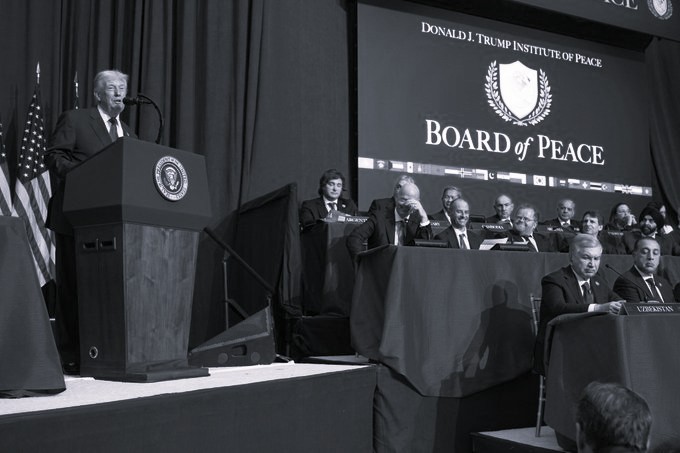
Trump’s Gaza Initiative Raises Stakes for Peace and Global Diplomacy
At the inaugural meeting of his newly created Board of Peace in Washington, US President Donald Trump announced that nine countries had pledged USD 7 billion for Gaza’s reconstruction , while five nations committed troops to an international stabilisation force. The United States separately pledged USD 10 billion , though the allocation and legislative approval remain unspecified. The initiative comes as Gaza faces one of its most severe humanitarian crises in decades.
After more than two years of conflict, Gaza’s infrastructure lies in ruins. Entire neighbourhoods have been destroyed, hospitals and schools damaged, and essential services such as electricity, water, and sewage systems disrupted. Hundreds of thousands of Palestinians remain displaced, many in overcrowded shelters with limited access to food, water, and medical care. Experts estimate that nearly USD 70 billion will be required to fully rebuild the territory, making the current pledges only an initial step.
Countries pledging troops include Indonesia, Morocco, Kazakhstan, Kosovo, and Albania , while Egypt and Jordan will train police forces. The proposed International Stabilisation Force , led by Maj. Gen. Jasper Jeffers , plans for roughly 20,000 soldiers and 12,000 police officers, initially deployed in Rafah . A key mission is the disarmament of Hamas , a core condition of the fragile ceasefire agreement with Israel , though Hamas has offered limited commitment.
Long-term governance of Gaza remains uncertain. Palestinian authorities and factions differ on administrative control, and reconstruction is seen as dependent on a credible political process addressing sovereignty and self-determination. Israel welcomed the focus on security but stressed it retains the right to act if threats emerge. Several global powers expressed caution, attending only as observers due to concerns the Board could overshadow the United Nations .
Analysts warn that Gaza’s dense urban terrain, armed factions, and local mistrust pose risks to peacekeepers. The ceasefire remains fragile, and durable peace will require not just reconstruction, but credible governance, security, and sustained diplomatic engagement.