
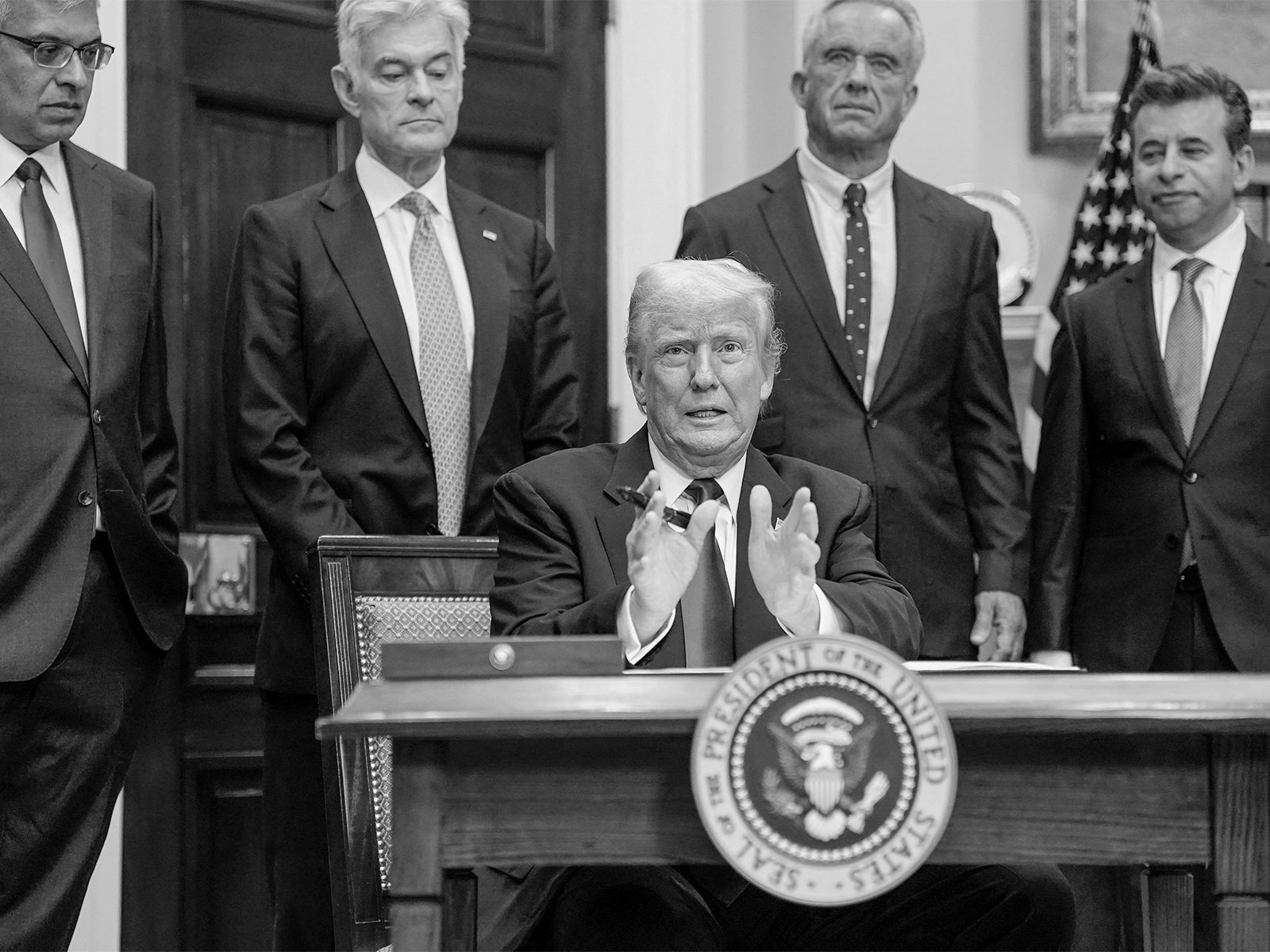
Trump's biggest tariff shocker for the world! announces 100% tariff on Pharma
U.S. President Donald Trump has announced a 100% tariff on all imported branded and patented pharmaceutical products, effective October 1, 2025. The move, revealed in a Truth Social post, exempts only companies that are “building” manufacturing plants in the U.S. defined as those that have broken ground or are under construction. The decision marks a bold step in Trump’s push to bring drug manufacturing back to America, but economists warn it could trigger inflation, shortages, and new trade conflicts.
In a move that has sent shockwaves through global markets, U.S. President Donald Trump announced a sweeping 100% tariff on imported pharmaceuticals, declaring, “We will no longer allow foreign countries to profit from American sickness. Drugs must be made in America.” The announcement followed his post on Truth Social, where Trump wrote, “Starting October 1st, 2025, we will be imposing a 100% Tariff on any branded or patented Pharmaceutical Product, unless a Company IS BUILDING their Pharmaceutical Manufacturing Plant in America. ‘IS BUILDING’ will be defined as ‘breaking ground’ and/or ‘under construction’. There will, therefore, be no Tariff on these Pharmaceutical Products if construction has started. Thank you for your attention to this matter!”
Trump’s plan, framed as a national security measure under Section 232 of the Trade Expansion Act of 1962, follows his earlier tariffs on foreign-made trucks and comes amid multiple new investigations into imported goods. While he insists the move targets “patented drugs”, Trump made no mention of generics, creating a gray area that leaves much of the $700 billion global pharmaceutical trade in limbo. Analysts say the ambiguity could cause confusion at customs and disrupt supply chains, with companies unsure whether certain formulations fall under the tariff’s scope.
Markets reacted swiftly. In India, shares of major exporters such as Sun Pharma, Cipla, Dr. Reddy’s Laboratories, and Lupin all fell between 2% and 5%, reflecting fears of lost U.S. revenue. API makers like Divi’s Laboratories and Aurobindo Pharma also slid, as the U.S. remains their largest buyer. Meanwhile, on Wall Street, pharmaceutical giants with U.S. production bases such as Merck, Johnson & Johnson, and Pfizer saw modest gains, buoyed by hopes that local manufacturing will benefit from the policy. Investors speculated that companies with U.S. plants or plans to build them could see a windfall.
Globally, the countries most exposed include Ireland ($73.3B, 29.7%), Switzerland ($21.7B, 8.8%), Singapore ($19.3B, 7.8%), Germany ($17.3B, 7.0%), and India ($13.1B, 5.3%), according to U.S. Census Bureau data. While Ireland’s pharmaceutical exports to the U.S. operate under a special 15% EU framework, nations like Switzerland and Singapore are far more vulnerable. India, the fifth-largest supplier, faces a mixed outlook: though generics may escape direct tariffs for now, the overall uncertainty, potential supply-chain disruptions, and reduced competitiveness against U.S.-based firms could hurt growth.
For India, the near-term effect is negative. Export-oriented drug makers could lose billions in annual revenue, forcing them to raise domestic prices to compensate. Analysts warn that Indian consumers may face higher prices for branded formulations, as companies rebalance their portfolios. Moreover, jobs and R&D investments linked to U.S. demand could slow. While India might explore a WTO challenge, such disputes can drag on for years, offering little immediate relief.
Economically, the policy risks backfiring. Pharmaceutical demand is highly inelastic meaning consumers buy nearly the same amount regardless of price especially for patented or life-saving drugs. With price elasticity estimated at -0.1 to -0.3, a 100% tariff will double prices but reduce demand only marginally, leading to higher costs for U.S. patients and insurers. For generics, which are somewhat more elastic (-0.4 to -0.7), demand could shift toward local producers, but shortages and inflation remain likely. The U.S. may thus see rising healthcare inflation, supply bottlenecks, and public backlash, while foreign producers face a demand shock.
Critics argue the U.S. needs a better industrial strategy such as incentives for domestic manufacturing or public–private partnerships rather than blunt tariffs that tax consumers and strain allies. Tariffs on drugs risk mirroring the 2020 trade wars, which raised prices but failed to bring large-scale reshoring. Experts warn of a “protectionist spiral”, as affected nations consider retaliatory measures or shift exports elsewhere, potentially igniting a fresh global trade war.
In the longer term, some multinationals may accelerate plans to build U.S. facilities to avoid tariffs, while others could reroute production through third countries. India could attempt to capture part of this shift by expanding generic output or signing bilateral deals, but success depends on how strictly Washington enforces the rules.
For now, Trump’s 100% pharmaceutical tariff stands as one of the most controversial economic weapons in recent memory a populist pitch to “bring jobs home” that may instead leave American patients paying more, foreign suppliers losing business, and the world’s medicine supply entangled in new geopolitical battles.