
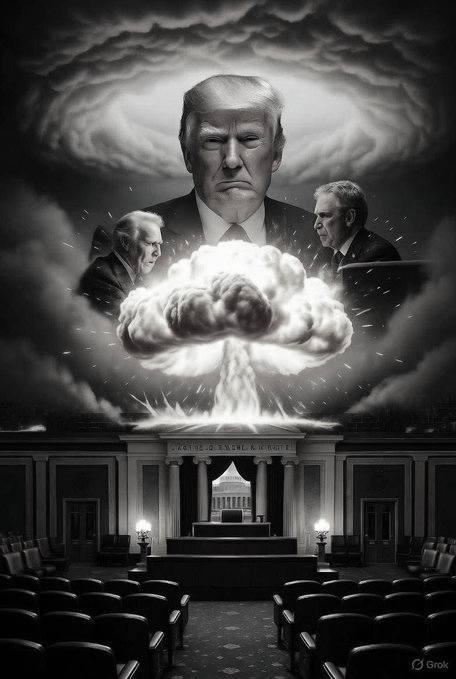
Trump urges Republicans to invoke the "nuclear option," scrap Senate filibuster
US President Donald Trump on Thursday called on Senate Republicans to invoke the so-called “nuclear option”, abolishing the filibuster rule, to end the ongoing government shutdown and allow legislation to pass with a simple majority.
“It is now time for the Republicans to play their ‘TRUMP CARD,’ and go for what is called the Nuclear Option, Get rid of the Filibuster, and get rid of it, NOW!” Trump posted on Truth Social.
His comments came shortly after returning from an Asia tour, during which he said he faced repeated questions from foreign journalists about “how Democrats shut down the government, and why the powerful Republicans allowed them to do it.”
What Is the ‘Nuclear Option’?
The filibuster is a Senate procedure that typically requires 60 votes to advance most legislation. It allows the minority party to block bills even if the majority supports them. Invoking the “nuclear option” would mean changing Senate rules to allow bills to pass with a simple majority (51 votes), effectively curbing the minority’s power.
While the rule has already been relaxed for confirming judges and certain appointments, legislative measures still require 60 votes. With Senate Republicans currently holding 53 seats, they would need every member of their caucus to agree to abolish it, an outcome that remains uncertain.
Trump’s Argument
Trump contended that Democrats would not hesitate to scrap the filibuster if it helped them advance their legislative agenda, citing potential moves such as granting statehood to Washington, D.C., and Puerto Rico.
He also recalled how several Democratic senators, including those under then-President Joe Biden, had previously pushed to modify or remove the filibuster to secure voting rights protections and abortion access, but failed to win full party support at the time.
“If the Democrats ever came back into power... it will be done on the first day they take office,” Trump warned, urging Republicans to “use the Great Strength and Policies made available to us by ending the Filibuster.”
His remarks come as the government shutdown surpasses 30 days, disrupting federal services and triggering concerns over expiring food assistance programs and flight delays caused by staffing shortages in air traffic control, according to The Hill .
Possible link between Trump’s Asia trip and his renewed aggression
Political observers suggest that Trump’s escalating tone may have been influenced by his recent Asia trip, where he faced probing questions about the U.S. government’s dysfunction. The scrutiny reportedly frustrated the president, who has long been sensitive to how America’s internal issues are perceived abroad.
Upon returning to Washington, Trump immediately intensified his rhetoric, calling for an end to the filibuster and announcing a new nuclear weapons testing initiative, moves widely interpreted as efforts to project decisive leadership and global strength.
Analysts believe the timing reflects Trump’s pattern of responding to perceived criticism with bold, high-impact actions that reinforce his image as a strong leader capable of breaking political gridlock.
Divisions Within the GOP
Despite Trump’s pressure, many Senate Republicans remain opposed to dismantling the filibuster.
Majority Leader John Thune (R-S.D.) has publicly rejected the idea, warning that it could destroy Senate traditions. Senators Lisa Murkowski (R-Alaska) and Mitt Romney (R-Utah) have also voiced concerns that ending the rule could backfire if Democrats regain control.
Even some who favor limited reform have only proposed temporary exemptions, not a permanent rule change, to address the shutdown.
Chances of Success - Slim for Now
Analysts say the odds of the filibuster being scrapped remain low, estimated at below 20 percent. With several key Republicans firmly opposed, Trump lacks the unified support needed to change Senate rules.
His call appears to be more political than procedural, a way to rally his base, redirect public frustration, and pressure his own party to act decisively amid growing criticism over the shutdown.
In short, Trump’s demand may sound bold, but without unanimous Republican backing, the nuclear option is unlikely to become reality anytime soon.