
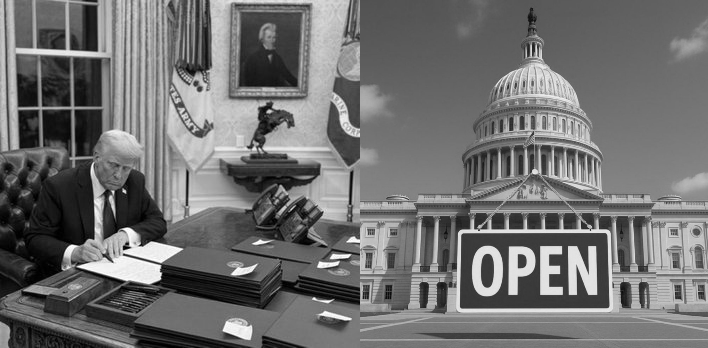
Trump signs bill to reopen U.S. government, ending longest shutdown in history
U.S. President Donald Trump on Wednesday signed into law a funding package to reopen the federal government, officially ending the 43-day shutdown, the longest in the nation’s history.
The United States has experienced 22 government shutdowns since the modern budget process was established in 1976. While most were short-lived, the latest one marks the longest federal shutdown ever, surpassing the 35-day closure that occurred in late 2018 and early 2019.
The shutdown began after Congress failed to agree on a budget deal, triggering a funding lapse for several federal agencies. The stalemate arose from sharp differences between Democrats and Republicans over an Obamacare-related healthcare programme that the ruling party wanted to eliminate, while Democrats insisted on retaining it.
Speaking from the Oval Office during the signing ceremony, Trump blamed Democrats for the impasse, calling their position an attempt to “extort American taxpayers.” He said the prolonged shutdown had “inflicted massive harm” on public services and disrupted the lives of millions of citizens.
“For the past 43 days, Democrats in Congress shut down the government of the United States in an attempt to extort American taxpayers for hundreds of billions of dollars for illegal aliens. Today, we’re sending a clear message that we will never give in to extortion,” he said.
The funding bill, H.R. 5371, was passed by the U.S. Senate earlier this week and later approved by the House of Representatives by a vote of 222 to 209, with nearly all Republicans and a few Democrats voting in favour. In the Senate, the measure had cleared an earlier hurdle with a 63–37 vote, reflecting bipartisan but limited support. The legislation provides funding for most government operations through January 30, 2026, and full-year appropriations for key sectors such as agriculture, rural development, veterans’ affairs, military construction, and other essential services.
According to the White House, the measure will ensure the immediate resumption of government services and the prompt payment of salaries to about one million federal employees who had gone without pay. The shutdown led to over 20,000 flight cancellations or delays, suspension of food-stamp benefits for millions, and partial closure of national parks and public facilities.
Trump described the legislation as a “fiscally responsible product” that supports veterans, farmers, and rural communities without including “partisan, poison-pill provisions” sought by Democrats. He also reiterated his call to end the filibuster, a Senate rule that allows unlimited debate and often delays key legislation.
The reopening of the government is expected to bring relief to Indian students, professionals, and businesses in the U.S., who had faced delays in visa processing, work-permit renewals, and federally funded research projects. The return of normal operations will also restore regulatory approvals and trade processes affecting Indian companies in technology, pharmaceuticals, and manufacturing sectors.
Political analysts say the episode underscores the deep partisan divide in U.S. politics and may shape the country’s upcoming elections. Internationally, the shutdown dented America’s image as a stable democracy and raised doubts among global investors about its political reliability.
Experts note that the U.S. could avoid similar crises by adopting automatic continuing resolutions to maintain basic funding when budget talks stall. In India’s parliamentary system, if the Lok Sabha fails to pass the Union Budget, it is treated as a de facto vote of no confidence in the government, requiring the ruling party to either resign or seek a fresh mandate.