
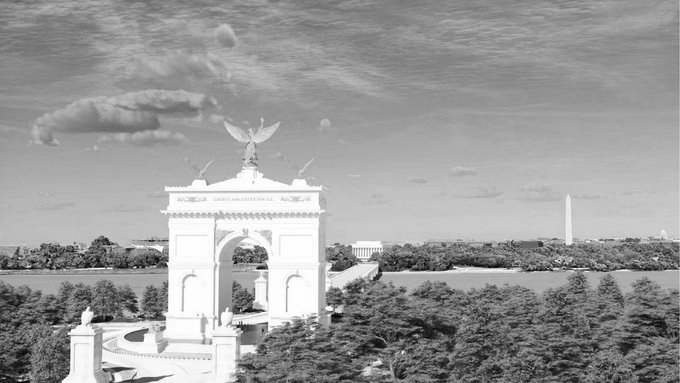
Trump Says Planned Washington Arch Would Become 'Military Complex' With Drones, Snipers
US President Donald Trump has said his planned 250-foot (76-metre) memorial arch between the Lincoln Memorial and Arlington National Cemetery will also become a “top-grade military complex” capable of housing drones, snipers and large quantities of ammunition.
Trump said Sunday that he had agreed, at the military’s “strong request” and for national security purposes, to convert the proposed triumphal arch into a facility that could rapidly deploy large numbers of drones and accommodate snipers on its roof and plaza areas. He also said the structure would store large quantities of sniper ammunition.
The announcement adds a new national security argument to a project Trump has promoted as a monument marking the 250th anniversary of US independence. It also follows his efforts to describe other Washington projects, including the planned White House ballroom, as serving defensive or national security purposes. The Pentagon, however, said it had no information beyond Trump's statement about the proposed military functions of the arch.
The arch is planned for Memorial Circle, beside the Arlington Memorial Bridge, a busy route linking Washington, DC, with northern Virginia. The location is also near Arlington National Cemetery, the Pentagon and Joint Base Myer-Henderson Hall.
The project is already facing a legal challenge. Three veterans and an architectural historian have sued, arguing that Congress must authorise the arch before construction can proceed. Nicolas Sansone, an attorney representing the challengers, said Trump's national security argument did not resolve what the plaintiffs describe as the project's legal problems.
The administration has argued that Congress does not need to approve the project because lawmakers authorised a similar structure more than a century ago. Interior Secretary Doug Burgum has said excavation work for the arch was being prepared, although the project continues to face legal and regulatory hurdles.
The arch has received preliminary approval from the US Commission of Fine Arts, whose members were appointed by Trump. The National Capital Planning Commission also approved the site and preliminary plans in July, but final planning approval remains pending and is expected to be considered this autumn.
The project has also raised concerns over its impact on Washington's historic landscape. The National Park Service has identified 37 historic properties that could be adversely affected, while officials have acknowledged that the structure would alter views around the Lincoln Memorial and Arlington National Cemetery.
The Federal Aviation Administration has separately determined that the proposed arch would not pose a hazard to aircraft, subject to safety requirements. The FAA review is separate from the project's remaining planning and legal approvals.
Trump's arch is part of a broader effort to reshape Washington. Other projects include the White House ballroom, renovations to the Kennedy Center, refurbishment of the Lincoln Memorial Reflecting Pool and redevelopment of a golf course in East Potomac Park that could affect public access to running and cycling paths.
The administration continues to pursue the arch despite the lawsuit and pending approvals.